“The politicians, special interests and the media are in a spate of high excitement over next week’s elections,” writes Bob Herbert (New York Times, “The System’s Broken,” 30 October 2006, A27). On the other side, there is “an increasing sense of disenchantment and unease … Big money and gerrymandering have placed government out of the reach of most Americans. … It’s time to bring the intelligence, creativity and energy of the broader population into the quest for constructive change.”
Amen.
Sunday, October 15, 2006
Sometime this Tuesday, Oct. 17 (7:45 in the morning or thereabout is my guess), the U.S. population will hit 300 million. According to figures reported in the Wall Street Journal, it will reach 400 million in about 35 years. I think everything is gonna be fine. No worries, demographers. Honest. (From the ranting fellow who has no idea what he is talking about.)
Wednesday, October 11, 2006
Grim Numbers
Bulletin: (Maybe) 600,000 Iraqi dead from the war we launched three years ago, out of their population of roughly 27 million, according to a Johns Hopkins Bloomberg School of Public Health study as reported in today’s New York Times.
600,000 is the mean estimate, and said to be by no means exact. Our “coalition forces,” it is sad to say, are to blame for much of the carnage though not all.
Taking the very mininum count — which is reported to be 426,369 — as a percentage of the Iraqi population, the equivalent American count would be 4,651,299. Would you put that on page 16?
600,000 is the mean estimate, and said to be by no means exact. Our “coalition forces,” it is sad to say, are to blame for much of the carnage though not all.
Taking the very mininum count — which is reported to be 426,369 — as a percentage of the Iraqi population, the equivalent American count would be 4,651,299. Would you put that on page 16?
Sunday, October 01, 2006
A Note on a Great Betrayal
From a letter to the editor; the New York Times, printed 29 September 2006 (A22):
The Rev. Connell Maguire, Navy cpt (ret.), puts the recent shameful repudiation of the bedrock legal principle on which the U.S. stands (English Common Law, of which a major part is the right to habeas corpus) in a solemnly eloquent way:
“The day the detainee bill is signed will be a day that will live in dishonor in our history. The practices that appalled us in the past when used by sleazy regimes will be incorporated into our legal heritage.
“If we do not reject the responsible party in power, we will indict ourselves as accomplices before decent world opinion.”
Americans are a good, decent people. We must demonstrate this in a few weeks and throw out the outlaws dominating — and destroying — the principles for which our patriot ancestors bled and died.
The Rev. Connell Maguire, Navy cpt (ret.), puts the recent shameful repudiation of the bedrock legal principle on which the U.S. stands (English Common Law, of which a major part is the right to habeas corpus) in a solemnly eloquent way:
“The day the detainee bill is signed will be a day that will live in dishonor in our history. The practices that appalled us in the past when used by sleazy regimes will be incorporated into our legal heritage.
“If we do not reject the responsible party in power, we will indict ourselves as accomplices before decent world opinion.”
Americans are a good, decent people. We must demonstrate this in a few weeks and throw out the outlaws dominating — and destroying — the principles for which our patriot ancestors bled and died.
Tuesday, September 19, 2006
When it comes to politics, there seems to be a fine line between urgency and hysteria. The WORLD CAN’T WAIT! campaign promises October 5 to be a “day of mass resistance” against the reviled “Bush regime.” I do not know whether to say right on or slow down. Honestly, it seems like a tough pick.
Sure, these fuckers need to be driven out of office as soon as possible, for the good of the nation — if not for the good of the Nation. Even if the November elections don’t prove a watershed for the (nominal) opposition party, the hope still remains with the American people who, I think, have put up with much more than anyone ought to deserve, faced with a government that seems to care little about their interests or, at least, campaigns on solid contempt for them.
All said, if this ‘mass resistance’ turns out to be some misguided, ineffectual protests at whatever designated ‘centers of power’, to hell with it! Too lame. What kind of mass resistance would that be? Not that I at all recommend this, but they’re not talking about storming the White House for God’s sake, which would never work anyway. These people intend to keep it nonviolent, and that’s good; but with a logo of the Earth on fire, that … um, fiery urgency could well turn into hysteria, which is no good for anybody.
P.S.: I wrote the above about one month ago, though I think the planned uprising is still planned to go underway. Whether it will be reported in the mainstream press is of course another issue, but I am going to try to keep hope about it. You know, we really shouldn’t keep waiting any longer. Five years is far too long; much of America has probably been destroyed. But not by al Qaeda, which did take thousands of our people from us five years ago last week.
Sure, these fuckers need to be driven out of office as soon as possible, for the good of the nation — if not for the good of the Nation. Even if the November elections don’t prove a watershed for the (nominal) opposition party, the hope still remains with the American people who, I think, have put up with much more than anyone ought to deserve, faced with a government that seems to care little about their interests or, at least, campaigns on solid contempt for them.
All said, if this ‘mass resistance’ turns out to be some misguided, ineffectual protests at whatever designated ‘centers of power’, to hell with it! Too lame. What kind of mass resistance would that be? Not that I at all recommend this, but they’re not talking about storming the White House for God’s sake, which would never work anyway. These people intend to keep it nonviolent, and that’s good; but with a logo of the Earth on fire, that … um, fiery urgency could well turn into hysteria, which is no good for anybody.
P.S.: I wrote the above about one month ago, though I think the planned uprising is still planned to go underway. Whether it will be reported in the mainstream press is of course another issue, but I am going to try to keep hope about it. You know, we really shouldn’t keep waiting any longer. Five years is far too long; much of America has probably been destroyed. But not by al Qaeda, which did take thousands of our people from us five years ago last week.
Monday, September 11, 2006
We are five years, unbelievably half a decade, past the morning in our history when a horrific trauma impacted our collective psyche; the public discourse has yet to fully heal, though we’ve moved on. Also we’ve moved forward to a state of affairs (it pains me to say, so deeply I regret this) that has left our country in a nearly unrecognizable shape.
Albeit for a brief, clear moment, the skeletal carcass of the monuments to our financial prowess, the grevious damage upon the nerve center of our military might and a smouldering hole in a Pennsylvania field were immediately packaged like a commercial brand and spoken with a cynical tongue to the end of dividing a united citizenry.
Truthfully, I fear we have begun to forget how September 11 has long since been stripped of any physical meaning, its shocking and terrible immediacy supplanted by a slogan for perpetuating the atrocious violence of that autumn day, indeed a GOP trademark stamped onto the embers of nearly 3,000 of our countrymen. It demonstrated a remarkable contempt for the American people, bearing witness to such eager politicization of the tragedy.
This has been pointed out elsewhere, but it is important to mention that Bin Laden’s scythe killed 2,973 Americans (CNN’s statistic), and our President’s led to the deaths (by the Washington Post’s count as of August 29) of 2,944 Americans in Iraq, 330 in Afghanistan and 1,836 in the Gulf states (cit. Wikipedia).* This toll exceeds bin Laden’s 1.7 times, nearly by a factor of two.
So much has changed, and there are positive developments. It is never all gloom and doom; that way lies pessimism, one of the worst of humanity’s inclinations. Look at Lebanon: its people just recently suffered the equivalent of an Sept. 11 attack every day for one month. That is inconceivable. Of course, the Lebanese have their own problems to deal with, namely their (rough) equivalent to our Klan.**
I keep hope that we Americans will stay fast to hope, that not only will we someday heal ourselves but also that we start fighting the jihadis and cease strengthening them. For the sake of the victims we remember today, in fact for the sake of my beloved country and the world, may justice yet be done for them.
*I do not of course blame Katrina on President Bush, as that would be ludicrous; I do point out that his administrative response, that is the lack thereof, of his subordinate executive agencies magnified and amplified what was the natural consequence of the hurricane’s impact, as is amply documented.
**Naturally that is speculation; I think it is legitimate to draw an analogy between their Hizb’ullah and our Ku Klux Klan, which until it was largely marginalized by the victories of the civil rights movement had an impressive pull on our southern territories, viz. Lebanon’s south, championing similarly racist terrorism.
NOTE: The maximum toll posted as of today from Iraq Body Count is roughly 46,000 Iraqi civilian deaths. As a percentage of the U.S. population, this is about 552,000 Americans; the toll from the Civil War, by comparison, was 558,052 (the Louisiana State University Civil War Center).
That figure is roughly 235 greater than what befell us five years ago today. It is, to make a crude estimate, the equivalent of a September 11 attack every week for the entire span of time that has passed between then and now.
Albeit for a brief, clear moment, the skeletal carcass of the monuments to our financial prowess, the grevious damage upon the nerve center of our military might and a smouldering hole in a Pennsylvania field were immediately packaged like a commercial brand and spoken with a cynical tongue to the end of dividing a united citizenry.
Truthfully, I fear we have begun to forget how September 11 has long since been stripped of any physical meaning, its shocking and terrible immediacy supplanted by a slogan for perpetuating the atrocious violence of that autumn day, indeed a GOP trademark stamped onto the embers of nearly 3,000 of our countrymen. It demonstrated a remarkable contempt for the American people, bearing witness to such eager politicization of the tragedy.
This has been pointed out elsewhere, but it is important to mention that Bin Laden’s scythe killed 2,973 Americans (CNN’s statistic), and our President’s led to the deaths (by the Washington Post’s count as of August 29) of 2,944 Americans in Iraq, 330 in Afghanistan and 1,836 in the Gulf states (cit. Wikipedia).* This toll exceeds bin Laden’s 1.7 times, nearly by a factor of two.
So much has changed, and there are positive developments. It is never all gloom and doom; that way lies pessimism, one of the worst of humanity’s inclinations. Look at Lebanon: its people just recently suffered the equivalent of an Sept. 11 attack every day for one month. That is inconceivable. Of course, the Lebanese have their own problems to deal with, namely their (rough) equivalent to our Klan.**
I keep hope that we Americans will stay fast to hope, that not only will we someday heal ourselves but also that we start fighting the jihadis and cease strengthening them. For the sake of the victims we remember today, in fact for the sake of my beloved country and the world, may justice yet be done for them.
*I do not of course blame Katrina on President Bush, as that would be ludicrous; I do point out that his administrative response, that is the lack thereof, of his subordinate executive agencies magnified and amplified what was the natural consequence of the hurricane’s impact, as is amply documented.
**Naturally that is speculation; I think it is legitimate to draw an analogy between their Hizb’ullah and our Ku Klux Klan, which until it was largely marginalized by the victories of the civil rights movement had an impressive pull on our southern territories, viz. Lebanon’s south, championing similarly racist terrorism.
NOTE: The maximum toll posted as of today from Iraq Body Count is roughly 46,000 Iraqi civilian deaths. As a percentage of the U.S. population, this is about 552,000 Americans; the toll from the Civil War, by comparison, was 558,052 (the Louisiana State University Civil War Center).
That figure is roughly 235 greater than what befell us five years ago today. It is, to make a crude estimate, the equivalent of a September 11 attack every week for the entire span of time that has passed between then and now.
Saturday, September 02, 2006
Enterprising blogger Beep Beep tagged (remarks), who in turn tagged the Center. So here it all is, keeping to the format. [Even the part about the crying, as in books that make you do so. Not shyin away. Not here.]
A Book That Changed My Life
Handily, this goes to Nineteen Eighty-Four by the venerable George Orwell (Eric Blair). My God, what an unthinkable dystopian picture of the future. None of it ever came true.
A Book I’ve Read More Than Once
Probably Fahrenheit 451 by Ray Bradbury, but I’m sure there are others. Have to dig it.
The One Book That Would be Goin’ to a Desert Island
’Tuff question. How about Paul Johnson’s A History of the Jews. Not to pass the time per se, but rather to reflect on familial heritage going back to ancient times. And, yes, incidentally it would pass the time. Big ’ol book.
A Book that Made Me Laugh
Nothing recently, but if The Onion’s “Complete News Archives Volume 16” (or Embedded In America) counts as a book, most definitely.
A Book that Made Me Cry
Well, I’m no sentimental windbag, but several years ago there was a book that at the end of it left me with, say, a raindrop a-fallen on my head. It goes to A Tree Grows in Brooklyn, an integral part of literary Americana. Or, on the other hand, I was so tired of the book that, as I closed its last page, was just so happy it was over. But that was a long time ago.
A Book that I Wish had been Written
Richard B. Cheney’s classic, comprehensive tome Iraq: Its People, History, and Customs. Not a best-seller.
A Book I Wish had Never Been Written
Mein Kampf does rank high in this category, but I’d pick Jayson Blair’s scheme to get-rich-off-my-shame-of-plagiarism that his publisher titled Burning Down My Master’s House. To add insult to the injury of staining the reputation of one of the world’s finest newspapers (the New York Times, that’s right), it seems he played the race card. Sure, no one died, and I do not intend to compare him with the former in any way, as it is obvious that Mr. Blair’s book did not lead to the unconscionable horrors of human history. And to be fair to the disgraced journalist, I did not read his book. Nor do I intend to.
A Book I Have Been Meaning to Read
The Knights Templar by Stephen Howarth. My father recommended it highly.
Currently Reading...
A few books right now, first of which is Karen Armstrong’s Holy War: The Crusades and Their Impact on Today’s World. Then, shifting gears, America Beyond Capitalism: Reclaiming Our Wealth, Our Liberty, and Our Democracy (Gar Alperovitz).
TAGALONG
Ali Eteraz
David Masciotra
Jane Holland
Andy Dunn
Jill Stevenson
A Book That Changed My Life
Handily, this goes to Nineteen Eighty-Four by the venerable George Orwell (Eric Blair). My God, what an unthinkable dystopian picture of the future. None of it ever came true.
A Book I’ve Read More Than Once
Probably Fahrenheit 451 by Ray Bradbury, but I’m sure there are others. Have to dig it.
The One Book That Would be Goin’ to a Desert Island
’Tuff question. How about Paul Johnson’s A History of the Jews. Not to pass the time per se, but rather to reflect on familial heritage going back to ancient times. And, yes, incidentally it would pass the time. Big ’ol book.
A Book that Made Me Laugh
Nothing recently, but if The Onion’s “Complete News Archives Volume 16” (or Embedded In America) counts as a book, most definitely.
A Book that Made Me Cry
Well, I’m no sentimental windbag, but several years ago there was a book that at the end of it left me with, say, a raindrop a-fallen on my head. It goes to A Tree Grows in Brooklyn, an integral part of literary Americana. Or, on the other hand, I was so tired of the book that, as I closed its last page, was just so happy it was over. But that was a long time ago.
A Book that I Wish had been Written
Richard B. Cheney’s classic, comprehensive tome Iraq: Its People, History, and Customs. Not a best-seller.
A Book I Wish had Never Been Written
Mein Kampf does rank high in this category, but I’d pick Jayson Blair’s scheme to get-rich-off-my-shame-of-plagiarism that his publisher titled Burning Down My Master’s House. To add insult to the injury of staining the reputation of one of the world’s finest newspapers (the New York Times, that’s right), it seems he played the race card. Sure, no one died, and I do not intend to compare him with the former in any way, as it is obvious that Mr. Blair’s book did not lead to the unconscionable horrors of human history. And to be fair to the disgraced journalist, I did not read his book. Nor do I intend to.
A Book I Have Been Meaning to Read
The Knights Templar by Stephen Howarth. My father recommended it highly.
Currently Reading...
A few books right now, first of which is Karen Armstrong’s Holy War: The Crusades and Their Impact on Today’s World. Then, shifting gears, America Beyond Capitalism: Reclaiming Our Wealth, Our Liberty, and Our Democracy (Gar Alperovitz).
TAGALONG
Ali Eteraz
David Masciotra
Jane Holland
Andy Dunn
Jill Stevenson
Friday, September 01, 2006
End of the Generation
Confidently not a dystopian forecast after all, but simply an evolution of social fabric into technotribalism, along with increasing isolation between people and pixelated stratification and fragmentation of human thought. Less things to talk about, but more to destroy. Nothing to buy; everything to sell.
In fact I see a generation aching for purpose in a seemingly nihilistic world where nothing appears to matter. But this assumes that generations still exist, and they do not. It is clear enough, in the midst of such opacity and madness, that they no longer do; no one understands the past while events of the present cripple the future.
This whole world is just hanging in limbo. Everyone is afraid to judge, and when they do it is often hysterical. We have left Utopia, and we will always fear Hell. The mission may prove to be whether we have the will to do what is best for the common good, or even ourselves. Until that proving ground is struck, may there be no decision. Only indifference, perhaps a conclusive shrug, then silence.
Confidently not a dystopian forecast after all, but simply an evolution of social fabric into technotribalism, along with increasing isolation between people and pixelated stratification and fragmentation of human thought. Less things to talk about, but more to destroy. Nothing to buy; everything to sell.
In fact I see a generation aching for purpose in a seemingly nihilistic world where nothing appears to matter. But this assumes that generations still exist, and they do not. It is clear enough, in the midst of such opacity and madness, that they no longer do; no one understands the past while events of the present cripple the future.
This whole world is just hanging in limbo. Everyone is afraid to judge, and when they do it is often hysterical. We have left Utopia, and we will always fear Hell. The mission may prove to be whether we have the will to do what is best for the common good, or even ourselves. Until that proving ground is struck, may there be no decision. Only indifference, perhaps a conclusive shrug, then silence.
Friday, August 25, 2006
The Slow Death of an American City
New Orleans, one year out, remains largely unrebuilt. The lower-income areas, for example, seem to have stayed devastated. The negligence, corruption and indeed the criminality that have been associated with this tragedy have gone unanswered.
Judging by relevant reports I have come across, the massive levee failure that wrecked a home to millions, and a monument to our culture, was not only systemic but preventable. Eminently preventable.
No one person deserves sole blame for the entire chronicle of horror; rather, it is distributed among several actors, whose actions — and, crucially, inactions — magnified the scale of what Mother Nature wrought twelve months ago.
“Katrina,” not Hurricane Katrina, has become a political slogan, a rallying cry of the militant anti-Bush organizers, even “REMEMBER KATRINA!” — as if it were the Maine. But the event cannot be dissociated from the causal chain of events, and the context out of which they happened.
Yet the basic fact remains that our government failed the people of New Orleans, therefore all Americans; last year millions solemnly watched the city’s poor without means of escape packed into shelters, among the dead and scavenging for food. Last year we bore witness to the televised accounts of refugees in our own country.
The American people did a hell of a lot to help, immensely more than the government, which proved sickeningly dysfunctional.* The whole episode did indeed go a long way to show just how good and decent Americans are. In spite of it all, one year removed, an American city had been left to die.
Rebuild; Restore; Renew. That is the way, and that is the hope. No idea when it will happen, but until it does this will be a shame on our national conscience, for which someday we will eventually forgive. But not forget. May a dead city be reborn.
(Note: Do not know why I am feeling so personally affected here, as the above words suggest. But then I think about, as I have before, my father’s ancestors who came to Louisiana from Sicily and the Old Country back in the 1820s; and of my distant relatives living in Baton Rouge, thankfully far from the brunt of the damage. Never got to meet ‘em, though.)
An ugly myth has apparently circulated for awhile, in which the dastardly Army Corps of Engineers purposefully flooded the black Lower Ninth Ward, among other tall tales; I think that mirrors the story about the Maine’s sinking at the dastardly hands of wicked Spainards.
*Indeed the New York Times described the inaptly named Federal Emergency Management Agency (FEMA) as “an international symbol of dysfunction and incompetence,” and since the Katrina disaster “little has fundamentally changed” within its bureaucratic structure.
UPDATE: CNN reports, “Nationally, 67 percent of Americans disapprove of Bush’s handling of the Katrina disaster, according to an AP-Ipsos poll earlier this month.” This seems to match past poll results ever since the very beginning of the crisis. It adds, “The death toll in Louisiana from Katrina is close to 1,600, including nearly 300 who died in other states after fleeing from the hurricane” (Aug. 29, 2006). If I may, on top of the 2,600 brave souls who have perished in Iraq, the criminality and negligence of our government has topped bin Laden’s murder of 3,000 of our people by over one-third, whose fifth-year anniversary arrives soon.
Judging by relevant reports I have come across, the massive levee failure that wrecked a home to millions, and a monument to our culture, was not only systemic but preventable. Eminently preventable.
No one person deserves sole blame for the entire chronicle of horror; rather, it is distributed among several actors, whose actions — and, crucially, inactions — magnified the scale of what Mother Nature wrought twelve months ago.
“Katrina,” not Hurricane Katrina, has become a political slogan, a rallying cry of the militant anti-Bush organizers, even “REMEMBER KATRINA!” — as if it were the Maine. But the event cannot be dissociated from the causal chain of events, and the context out of which they happened.
Yet the basic fact remains that our government failed the people of New Orleans, therefore all Americans; last year millions solemnly watched the city’s poor without means of escape packed into shelters, among the dead and scavenging for food. Last year we bore witness to the televised accounts of refugees in our own country.
The American people did a hell of a lot to help, immensely more than the government, which proved sickeningly dysfunctional.* The whole episode did indeed go a long way to show just how good and decent Americans are. In spite of it all, one year removed, an American city had been left to die.
Rebuild; Restore; Renew. That is the way, and that is the hope. No idea when it will happen, but until it does this will be a shame on our national conscience, for which someday we will eventually forgive. But not forget. May a dead city be reborn.
(Note: Do not know why I am feeling so personally affected here, as the above words suggest. But then I think about, as I have before, my father’s ancestors who came to Louisiana from Sicily and the Old Country back in the 1820s; and of my distant relatives living in Baton Rouge, thankfully far from the brunt of the damage. Never got to meet ‘em, though.)
An ugly myth has apparently circulated for awhile, in which the dastardly Army Corps of Engineers purposefully flooded the black Lower Ninth Ward, among other tall tales; I think that mirrors the story about the Maine’s sinking at the dastardly hands of wicked Spainards.
*Indeed the New York Times described the inaptly named Federal Emergency Management Agency (FEMA) as “an international symbol of dysfunction and incompetence,” and since the Katrina disaster “little has fundamentally changed” within its bureaucratic structure.
UPDATE: CNN reports, “Nationally, 67 percent of Americans disapprove of Bush’s handling of the Katrina disaster, according to an AP-Ipsos poll earlier this month.” This seems to match past poll results ever since the very beginning of the crisis. It adds, “The death toll in Louisiana from Katrina is close to 1,600, including nearly 300 who died in other states after fleeing from the hurricane” (Aug. 29, 2006). If I may, on top of the 2,600 brave souls who have perished in Iraq, the criminality and negligence of our government has topped bin Laden’s murder of 3,000 of our people by over one-third, whose fifth-year anniversary arrives soon.
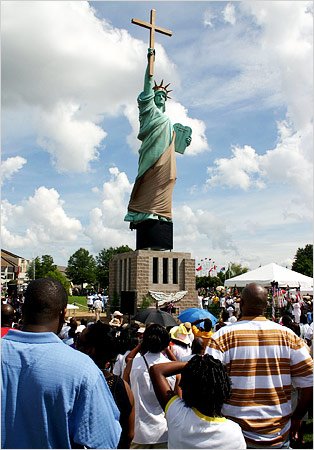
Wednesday, August 23, 2006
In light of ever-present ‘media overload’ (or M.O.), Wikipedia has long been an interest of mine, ever since it launched into my consciousness a couple of years ago. Science has rated it exceptionally accurate, regarding its scientific articles at least.* The attacks this self-described public encyclopedia has undergone are conclusively baseless.
To a large extent, as a previous post echoes, Wikipedia is a fundamentally democratic medium and is pointedly populist in its form. The content, to which my contributions have been few and far-in-between — given that, minor changes/fixes, does not deserve the overly critical reception it gets, for instance, from CNN — which once sarcastically described the Wiki as a source that “anyone can edit,” ignoring the stringent filtering process.
[Anyone can edit, true, but edits are peer-reviewed — P2P — by hundreds, indeed thousands, of people: fellow contributors, observers, etc.]
Marshall Poe, in the September issue of the Atlantic Monthly, notes that Wikipedia “has the potential to be the greatest effort in collaborative knowledge gathering the world has ever known,” while in its origins the collaborative ethic was jump-started with so-dubbed “‘wiki magic,’” which Poe writes is “the mysterious process by which communities with common interests work to improve wiki pages by incremental contributions” (p. 91), so the serial additions became parallel.
The number of Wikipedia articles increased from 100- to 500-thousand, from January 2003 to March 2005; by March 2006, it had doubled, as the Monthly explains (pp. 90, 91). Founders Larry Sanger and Jimmy Wales set up a framework in which “authors were enjoined to present the conventionally acknowledged ‘facts’ in an unbiased way, and, where arguments occurred, to accord spaces to both sides,” Poe writes, lest the entire project “slide into a morass of unproductive invective” (p. 91).
He opines that “Wikipedia suggests a different theory of truth” from the standard, objective… encyclopedic one. Continues: “The community [of dedicated Wikipedians and fellow path-takers] decides that two plus two equals four … by consensus. Yes,” Poe exclaims, “that means that if the community changes its mind and decides that two plus two equals five, then two plus two does equal five.
“The community isn’t likely to do such an absurd or useless thing,” he adds, “but it has the ability” (p. 93). Sure, true enough, as Merriam-Webster has the same “ability” to define democracy as an empty slogan, or a commodity for export (preferably at gun-point).
Mr. Poe concludes that the network “is well ordered and … very useful” and “is laying claim to … a territory we might call ‘common knowledge,’ … the place where all nominal information about objects of widely shared experience will be negotiated, stored, and renegotiated” (p. 94). Oh, almost forgot; it’s all for free, as any decent store of information ought to be.
*As is typical, I am mistaken; the journal Nature, we read, “compared [Encyclopedia] Britannica and Wikipedia science articles and suggested that the former are usually only marginally more accurate than the latter” (ibid, my emphasis), not Science.
Also, Poe refers to an IBM “study [which] suggests that although vandalism does occur … watchful members of the huge Wikipedia community usually swoop down to stop the malfeasance shortly after it begins” (ibid). Very true. In fact, the day after satirical troublemaker Stephen Colbert — while riffing on “Wikiality” — called on people to edit the ‘Elephants’ page to read that the number of elephants has “tripled in the last three months,” sure enough someone (out of who know’s how many) added in caps at the top, THE NUMBER OF ELEPHANTS HAS TRIPLED IN THE LAST SIX MONTHS! It was gone a few minutes later. (I was kind of disappointed that I hadn’t had the chance to write it myself.)
To be sure, I am not a committed ‘Wikipedian’ by any possible measure, but I am thoroughly committed to the idea of such an open-source, democratic body of knowledge. As I’ve said before, keep it alive. And I fuckin’ meant it.
To a large extent, as a previous post echoes, Wikipedia is a fundamentally democratic medium and is pointedly populist in its form. The content, to which my contributions have been few and far-in-between — given that, minor changes/fixes, does not deserve the overly critical reception it gets, for instance, from CNN — which once sarcastically described the Wiki as a source that “anyone can edit,” ignoring the stringent filtering process.
[Anyone can edit, true, but edits are peer-reviewed — P2P — by hundreds, indeed thousands, of people: fellow contributors, observers, etc.]
Marshall Poe, in the September issue of the Atlantic Monthly, notes that Wikipedia “has the potential to be the greatest effort in collaborative knowledge gathering the world has ever known,” while in its origins the collaborative ethic was jump-started with so-dubbed “‘wiki magic,’” which Poe writes is “the mysterious process by which communities with common interests work to improve wiki pages by incremental contributions” (p. 91), so the serial additions became parallel.
The number of Wikipedia articles increased from 100- to 500-thousand, from January 2003 to March 2005; by March 2006, it had doubled, as the Monthly explains (pp. 90, 91). Founders Larry Sanger and Jimmy Wales set up a framework in which “authors were enjoined to present the conventionally acknowledged ‘facts’ in an unbiased way, and, where arguments occurred, to accord spaces to both sides,” Poe writes, lest the entire project “slide into a morass of unproductive invective” (p. 91).
He opines that “Wikipedia suggests a different theory of truth” from the standard, objective… encyclopedic one. Continues: “The community [of dedicated Wikipedians and fellow path-takers] decides that two plus two equals four … by consensus. Yes,” Poe exclaims, “that means that if the community changes its mind and decides that two plus two equals five, then two plus two does equal five.
“The community isn’t likely to do such an absurd or useless thing,” he adds, “but it has the ability” (p. 93). Sure, true enough, as Merriam-Webster has the same “ability” to define democracy as an empty slogan, or a commodity for export (preferably at gun-point).
Mr. Poe concludes that the network “is well ordered and … very useful” and “is laying claim to … a territory we might call ‘common knowledge,’ … the place where all nominal information about objects of widely shared experience will be negotiated, stored, and renegotiated” (p. 94). Oh, almost forgot; it’s all for free, as any decent store of information ought to be.
*As is typical, I am mistaken; the journal Nature, we read, “compared [Encyclopedia] Britannica and Wikipedia science articles and suggested that the former are usually only marginally more accurate than the latter” (ibid, my emphasis), not Science.
Also, Poe refers to an IBM “study [which] suggests that although vandalism does occur … watchful members of the huge Wikipedia community usually swoop down to stop the malfeasance shortly after it begins” (ibid). Very true. In fact, the day after satirical troublemaker Stephen Colbert — while riffing on “Wikiality” — called on people to edit the ‘Elephants’ page to read that the number of elephants has “tripled in the last three months,” sure enough someone (out of who know’s how many) added in caps at the top, THE NUMBER OF ELEPHANTS HAS TRIPLED IN THE LAST SIX MONTHS! It was gone a few minutes later. (I was kind of disappointed that I hadn’t had the chance to write it myself.)
To be sure, I am not a committed ‘Wikipedian’ by any possible measure, but I am thoroughly committed to the idea of such an open-source, democratic body of knowledge. As I’ve said before, keep it alive. And I fuckin’ meant it.
Tuesday, August 22, 2006
MEDIA OVERLOAD?
Cannot think of a better way to describe it, but it definitely seems like we are not only looking at information overload but media overload. Whole blocs of overwhelming, instantly-analytical-perpetually-updated chunks of posts, bulletins, comments, diggs (patent pending, right?), et cetera. Not only can one not keep up, but a clear picture of the world, or of anything, is denied. How can any decisions be made in an environment like this?
Further, we have a really self-conscious media culture. People talk about ‘self-parody,’ and that is part of it but there’s more to the mix than the reflections at the surface. Granted that this culture has become increasingly complex and accelerated, and in the interests of simplicity and clarity (but not oversimplification and hypercoherence), we need to either break away from it or break it down. I am not talking about destruction; there is too much of that already.
Some dissonance is good. But I think too much is out there, anyways. For instance, How can the world’s most feared nation (and its most necessary) understand the world it has come to dominate? It may be an insane question, but it is posed here nonetheless. By this I do not mean the media cultures, and subcultures, that both connect and divide Americans have a purely political outlet. But how we perceive the world, much less each other, is undoubtedly important in any sphere; what we do to act on it moreso.
Cannot think of a better way to describe it, but it definitely seems like we are not only looking at information overload but media overload. Whole blocs of overwhelming, instantly-analytical-perpetually-updated chunks of posts, bulletins, comments, diggs (patent pending, right?), et cetera. Not only can one not keep up, but a clear picture of the world, or of anything, is denied. How can any decisions be made in an environment like this?
Further, we have a really self-conscious media culture. People talk about ‘self-parody,’ and that is part of it but there’s more to the mix than the reflections at the surface. Granted that this culture has become increasingly complex and accelerated, and in the interests of simplicity and clarity (but not oversimplification and hypercoherence), we need to either break away from it or break it down. I am not talking about destruction; there is too much of that already.
Some dissonance is good. But I think too much is out there, anyways. For instance, How can the world’s most feared nation (and its most necessary) understand the world it has come to dominate? It may be an insane question, but it is posed here nonetheless. By this I do not mean the media cultures, and subcultures, that both connect and divide Americans have a purely political outlet. But how we perceive the world, much less each other, is undoubtedly important in any sphere; what we do to act on it moreso.
Thursday, August 17, 2006
Zapped!
“Well I’m about to get upset from watchin’ my TV, been checkin’ out the news until my eyeballs fail to see/
“I mean to say that every day is just another rotten mess, and when it’s gonna change my friend is anybody’s guess/
“So I’m watching and I’m waiting, hopin’ for the best/
“Even think I’ll go prayin’, every time I hear ‘em sayin’ that there’s no way to delay that trouble comin’ every day ...”
(THE MOTHERS OF INVENTION, 1966)
“I mean to say that every day is just another rotten mess, and when it’s gonna change my friend is anybody’s guess/
“So I’m watching and I’m waiting, hopin’ for the best/
“Even think I’ll go prayin’, every time I hear ‘em sayin’ that there’s no way to delay that trouble comin’ every day ...”
(THE MOTHERS OF INVENTION, 1966)
Wednesday, August 16, 2006
Snakes-a-Comin' (Real Soon)
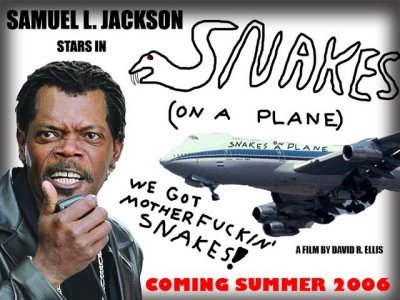
Re-postage (from January 13), with different words and different picture ... but same spirit:
Snnnaaaakes! 3-Day Weekend $100 mil blockbuster? Can Jackson get those motherfuckin snakes off his motherfuckin plane??
Rumble-Jumble, Parte Trois...
The Post’s Metro section printed up a piece on “freegans”, or “free vegans”, who dumpster-dive but don’t actually need to. These kids have a point, if they’re not also sort of insane. Indeed there’s a lot of overconsumption and waste in our society when it comes to food.
But they’re running a risk, at least health-wise. And it is naïve to attack a system from the waste end — you’re working backwards.
Besides, to make a last (but not least) point, what about the people who actually have to bum food out of the dump to survive? It is selfish on principle, and we read that such freegans seem to be principally-motivated at some level, to act in such a self-illusory (and likely pointless) way — especially if it deprives ... panhandlers. You know, homeless.
(The people most often ignored, or best simply invisible; more often than not, they don’t get the front-page of a major newspaper’s Metro pages.)
Crunchy Cons: Sounds like something I’d want to be a part of at first look, at least to be a kind of honorary observer. They’re a motley sort of freewheeling, unconventional right-wingers. To be clear, not an orthodoxical Right, but probably conservative in disposition instead of an ideological sense, a tricky stand to which I have much sympathy — and some attachment.
I’ve often been styled, cast or even pigeonholed into a number of ideo-set designations, be they “ultra-liberal” by those who really don’t know who I am, even “reactionary” — by people who really have no idea. (Although I’m not comfortable with such place-markers and ideological thinking in general, and for the most part ideology as a practice is bullshit, ‘left-wing conservative’ seems comfortable.*)
*Then again, social libertarian seems fitting, too; essentially, anything that isn’t extreme, intolerant or irrational — if it blossoms within those bounds, chances are I might go along with it.
ISRAEL/LEBANON update: The fire has largely ceased for now, as far as I can tell from the far-outside, so at month’s end it looks like this...
If the guns were reversed, with the proportions kept, the Israeli and Lebanese civilian deaths (respectively) are 1,840 and 24. To deny the obvious tragedy that has befallen Lebanon, from within and without and with the help of several actors, is to deny the equal moral weight between Israelis and Lebanese.
The Post published an op-ed by the Secretary of State, who writes (“A Path To Lasting Peace”, A13) that “we have increased our immediate humanitarian assistance to $50 million” (my italics). Increased to 50 million dollars? The paper, on page 10, reads that “Losses to infrastructure” in Lebanon have thus far totaled $2,400,000,000. The 50 mil is 1/48th of that; in proportion to the Israeli infrastructure damage, that comes out to 27 mil.
“For our part, the United States is helping to lead relief efforts for the people of Israel, ... we have increased our immediate humanitarian assistance to $27 million.” You would not see that sentence, especially by our State Secretary, and for good reason. The idea is simply insulting to Israel; such little funds for so much damage.
For the U.S., again keeping the proportions, if we take the place of Israel, is 1,860; if the place of Lebanon is taken, 87,630 ... which is about 29 9/11s (over the course of a month, roughly one every day), whose fifth anniversary looms quite soon. [Suppose a far greater power promised financial aid for our reconstruction? It would be (by my count) a transparently paltry $3,947,305 for our $1,894,736,832 in damages. Maybe my math is wrong. But it would be a start.]
The Post’s Metro section printed up a piece on “freegans”, or “free vegans”, who dumpster-dive but don’t actually need to. These kids have a point, if they’re not also sort of insane. Indeed there’s a lot of overconsumption and waste in our society when it comes to food.
But they’re running a risk, at least health-wise. And it is naïve to attack a system from the waste end — you’re working backwards.
Besides, to make a last (but not least) point, what about the people who actually have to bum food out of the dump to survive? It is selfish on principle, and we read that such freegans seem to be principally-motivated at some level, to act in such a self-illusory (and likely pointless) way — especially if it deprives ... panhandlers. You know, homeless.
(The people most often ignored, or best simply invisible; more often than not, they don’t get the front-page of a major newspaper’s Metro pages.)
Crunchy Cons: Sounds like something I’d want to be a part of at first look, at least to be a kind of honorary observer. They’re a motley sort of freewheeling, unconventional right-wingers. To be clear, not an orthodoxical Right, but probably conservative in disposition instead of an ideological sense, a tricky stand to which I have much sympathy — and some attachment.
I’ve often been styled, cast or even pigeonholed into a number of ideo-set designations, be they “ultra-liberal” by those who really don’t know who I am, even “reactionary” — by people who really have no idea. (Although I’m not comfortable with such place-markers and ideological thinking in general, and for the most part ideology as a practice is bullshit, ‘left-wing conservative’ seems comfortable.*)
*Then again, social libertarian seems fitting, too; essentially, anything that isn’t extreme, intolerant or irrational — if it blossoms within those bounds, chances are I might go along with it.
ISRAEL/LEBANON update: The fire has largely ceased for now, as far as I can tell from the far-outside, so at month’s end it looks like this...
If the guns were reversed, with the proportions kept, the Israeli and Lebanese civilian deaths (respectively) are 1,840 and 24. To deny the obvious tragedy that has befallen Lebanon, from within and without and with the help of several actors, is to deny the equal moral weight between Israelis and Lebanese.
The Post published an op-ed by the Secretary of State, who writes (“A Path To Lasting Peace”, A13) that “we have increased our immediate humanitarian assistance to $50 million” (my italics). Increased to 50 million dollars? The paper, on page 10, reads that “Losses to infrastructure” in Lebanon have thus far totaled $2,400,000,000. The 50 mil is 1/48th of that; in proportion to the Israeli infrastructure damage, that comes out to 27 mil.
“For our part, the United States is helping to lead relief efforts for the people of Israel, ... we have increased our immediate humanitarian assistance to $27 million.” You would not see that sentence, especially by our State Secretary, and for good reason. The idea is simply insulting to Israel; such little funds for so much damage.
For the U.S., again keeping the proportions, if we take the place of Israel, is 1,860; if the place of Lebanon is taken, 87,630 ... which is about 29 9/11s (over the course of a month, roughly one every day), whose fifth anniversary looms quite soon. [Suppose a far greater power promised financial aid for our reconstruction? It would be (by my count) a transparently paltry $3,947,305 for our $1,894,736,832 in damages. Maybe my math is wrong. But it would be a start.]
Tuesday, August 15, 2006
Realist Decries 'Unrealism', Delusional Idiocy

I’ve had, and continue to have, plenty of respect (and occasional disagreement) with conservative commentator George Will, who in today’s Washington Post (“The Triumph of Unrealism”, A13) is right on the money about the recent MI-5 disrupt of the liquid-bomb plot.
He writes:
“Cooperation between Pakistani and British law enforcement ... has validated John Kerry’s belief ... that ‘many of the interdiction tactics that cripple drug lords, including governments working jointly to share intelligence, patrol borders and force banks to identify suspicious customers, can also be some of the most useful tools in the war on terror.’”
Will adds that “a ‘senior administration official’ ... denied the obvious, that Kerry had a point,” informing the radical Weekly Standard that, with a straight face,
The idea that the jihadists would all be peaceful, warm, loveable, God-fearing people if it weren't for U.S. policies strikes me as not a valid idea. [Democrats] do not have the understanding or the commitment to take on these forces. It’s like John Kerry. The law enforcement approach doesn’t work.”
As the staid, reasonable columnist concludes, “This farrago [wtf?] of caricature and non sequitur makes the administration seem eager to repel all but the delusional. But perhaps such rhetoric reflects the intellectual contortions required to sustain the illusion that the war in Iraq is central to the war on terrorism, and that the war, unlike ‘the law enforcement approach,’ does ‘work.’
“The official is correct that it is wrong ‘to think that somehow we are responsible - that the actions of the jihadists are justified by U.S. policies.’ But few outside the fog of paranoia that is the blogosphere [hey!] think like that. It is more dismaying that someone at the center of government considers it clever to talk like that. It is the language of foreign policy — and domestic politics — unrealism.”
(I don’t appreciate the cheap swipe at bloggers, but then again some among us can reach heights of paranoid fantasy at times, on any range of topics. We’re not robots, Bow-tie.)
Sunday, August 13, 2006
Crazy Thought (Again)
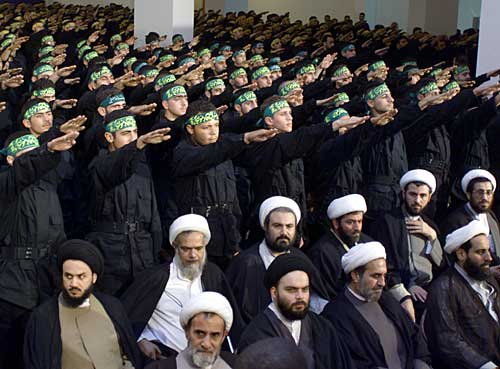
Ummm... should we actually negotiate with these people? Lookat the salute for God's sakes! Why are we even thinking about doing that? Look at them! Just fucking dangerous.
God forbid I demonize the official enemy, in this case Hizb'ullah (the Party of God). God forbid I choose to demonize demons. God forbid I react negatively to what appears to be a Nazi salute.
But, go ahead, hammer out a negotiated settlement with these folks. (I am talking to you, Kofi!) Of course I want this war to stop, do not get me wrong. (I often get myself wrong.) But do not lose your heads. I am trying not to lose mine. A wise man said, Do not cut what you cannot untie. That implies the Lebanese government, at a last option, must cut it off with these so-called Holy Partisans or whatever the else these murderous thugs want to name themselves. If it cannot, sorry Mr. Siniora, but the bullshit has got to end.
Both states must respect the territorial sovereignty of the other; as I have consistently advocated, a cease-fire must be enforced by the relevant multinationals or what-have-you, and by the by such a call to lay down arms has begun as of a few hours ago; reparations by Israel and Lebanon must be paid immediately for their respective collateral damage; and the political structure of Lebanon must be re-made from within, toward the effect of leaving a disarmed Hizbollah and, instead, a political party without recourse to violence, a choice that is entirely up to the Lebanese (at that an acceptable one for Israel, as top Israeli officials have in fact indicated).
No more for now. On a personal note, may this ceasefire have lasting value, indeed a semblance of permanence; may Israel and Lebanon find the peace their people both seek; and may rogues like Hezbollah and their thuggish minions be stamped out once and, hopefully, for all.
Thursday, August 03, 2006
What?!
The enemies of free people are the temptations to be naïve, embrace cynicism to suffice for a lack of spirit or common energy and turn ourselves into fatalists only trusting an invisible predetermined Higher Plan.
These are not abstract words, nor are they slogans in the hope of rallying some deeper cause, a target hidden from the piercing light of day that drives out the fog of contradiction and confused, interpretive talking-head shout-match referees who radiate from lofty perches of assumed expertise.
What am I talking about, hell, if I only knew. Power is out of the hands of people like me, we’re just left to comment and rant and ceaselessly opine, presuming there’s anything useful to say that hasn’t already been said. Lacking qualities in our collective experience, maybe to simplify and generalize beyond the scope of which is surely legit, are Honesty, Trust and Respect. These are taken for granted to not exist practically anywere outside the realm of the imagined or aspired.
There’s your summer reading. (Goodnight.)
These are not abstract words, nor are they slogans in the hope of rallying some deeper cause, a target hidden from the piercing light of day that drives out the fog of contradiction and confused, interpretive talking-head shout-match referees who radiate from lofty perches of assumed expertise.
What am I talking about, hell, if I only knew. Power is out of the hands of people like me, we’re just left to comment and rant and ceaselessly opine, presuming there’s anything useful to say that hasn’t already been said. Lacking qualities in our collective experience, maybe to simplify and generalize beyond the scope of which is surely legit, are Honesty, Trust and Respect. These are taken for granted to not exist practically anywere outside the realm of the imagined or aspired.
There’s your summer reading. (Goodnight.)
Tuesday, August 01, 2006
Re-posting (from May 26), with some updates...
A team of UCLA researchers under the direction of one Donald Taskin is reported to have found, contrary to malicious Drug War agitprop, that inhaling the haze of Mary-Jane, “even regularly and heavily, does not lead to lung cancer.”
Intaking the toke, according to Tashkin’s work, may — perhaps — even have “‘some protective effect’” on the lungs.
The Post adds that past studies Tashkin conducted had pointed to toxic agents in marijuana akin to those which are understood to be cancerous in tobacco. However, “the chemical THC [TetraHydroCannabinol] … may kill aging cells and keep them from becoming cancerous,” Tashkin asserts.
Unlike the wacky tobacke, the other leaf is highly addictive thanks to nicotine; likely, there’s the greater health threat — with the accepted, massively subsidized cash crop and not the demon-plant sown into the black market.
NOTES: (Researchers of the Kaiser Permanente Medical Care Program, in 1997, tentatively “concluded that … marijuana use and cancer were not associated in overall analyses” in their study.
(Ahmedin Jemal and Kenneth Chu of the Journal of the National Cancer Institute write that “a contribution” to overall trends of “lung cancer mortality” post-1950 among people under the age of 45 “from marijuana smoking cannot be ruled out.”
(L.E. Hollister of Pharmacological Reviews, however, pointed out in 1986 that cases of “emphysema or lung cancer have not yet been documented.”
(Yet according to a 1998 Lancet study, “chronic” smokers — and this is portrayed as by no means certain — may suffer “bronchitis and histopathological changes that may be precursors to the development of malignant disease” [p. 3].)
Who knows? I don’t, certainly.
A team of UCLA researchers under the direction of one Donald Taskin is reported to have found, contrary to malicious Drug War agitprop, that inhaling the haze of Mary-Jane, “even regularly and heavily, does not lead to lung cancer.”
Intaking the toke, according to Tashkin’s work, may — perhaps — even have “‘some protective effect’” on the lungs.
The Post adds that past studies Tashkin conducted had pointed to toxic agents in marijuana akin to those which are understood to be cancerous in tobacco. However, “the chemical THC [TetraHydroCannabinol] … may kill aging cells and keep them from becoming cancerous,” Tashkin asserts.
Unlike the wacky tobacke, the other leaf is highly addictive thanks to nicotine; likely, there’s the greater health threat — with the accepted, massively subsidized cash crop and not the demon-plant sown into the black market.
NOTES: (Researchers of the Kaiser Permanente Medical Care Program, in 1997, tentatively “concluded that … marijuana use and cancer were not associated in overall analyses” in their study.
(Ahmedin Jemal and Kenneth Chu of the Journal of the National Cancer Institute write that “a contribution” to overall trends of “lung cancer mortality” post-1950 among people under the age of 45 “from marijuana smoking cannot be ruled out.”
(L.E. Hollister of Pharmacological Reviews, however, pointed out in 1986 that cases of “emphysema or lung cancer have not yet been documented.”
(Yet according to a 1998 Lancet study, “chronic” smokers — and this is portrayed as by no means certain — may suffer “bronchitis and histopathological changes that may be precursors to the development of malignant disease” [p. 3].)
Who knows? I don’t, certainly.