Rumble-Jumble (part 2):
Kofi warns of “humanitarian disaster” in Gaza, forgets he laid a wreath for a guy who was a really big “humanitarian disaster” for Palestinians and Israelis alike.
Harper’s reports that President Bush has added so-called “‘signing statements’” claiming Executive “exemption … from provisions of new laws” to Congressional legislation — such as the one instantly nullifying Sen. McCain’s absurd DON’T TORTURE PEOPLE ACT — 750 times.
(Continues: “… since Washington”, “all other presidents” up until Bush have done this 568 times.)
Why is the website for the Korean Central News Agency (KCNA), the Pyongyang propaganda organ, hosted by the Japanese? Don’t they hate each other? The site even has an English mirror, so you can catch up with all the wacky bulletins yourself.
Dave Chappelle has returned. Well, no, he hasn’t, but we all would like to think so.
[Banana muffins are really not that bad, seriously.]
So psyched for A Scanner Darkly.
According to a couple forums (those of the New York Times and Foreign Policy magazine, respectively), my “ignorant and superficial” observations consumed with “delusional” “prejudice” are not worthy of civilized company… so, my apologies for brainwashing all of you.
— LONG CHAIN OF RAMBLES TO FOLLOW —
Interesting things about the Koran (Qur’an?), maybe this is a matter of translation, interpretation or whatever, but it sheds some light. Now, the enemy of Western civilization is Islamic fundamentalism, right? Or, in more modern parlance, radical Islamism; nonetheless, not Islam itself, as a religion, as a body of holy laws, precepts, etc. That’s the moderate consensus. Yes?
Yet according to The Bible of the World (eds. Robert Ballou, Friedrich Spiegelberg & Horace Friess, 1939), an impressive anthology of all major holy texts, the central “Mohammedan” verses (suras) are riddled with calls toward respecting Jews and Christians as “readers of the Book” (p. 1313), therefore only God (Allah) can “judge between them as to that in which they have differed” (ibid.), as all three are originally rooted in Abraham’s covenant — that is at least my read of it.
But then there’s this passage, under the title ‘The Holy War’:
“And fight for the cause of God against those who fight against you … kill them wherever ye shall find them … for seduction from the truth is worse than slaughter … War is prescribed to you” (p. 1317). [Then again, preemptive attacks are strictly forbidden; they strike you, strike back but never strike first.]
More worrisome, there’s this:
“O believers! take not the Jews or Christians as friends. They are but friends to one another [what?!]; and if any one of you taketh them for his friends, then surely he is one of them! Verily God will not guide the evil-doers” (p. 1322). What happened to the benign “people of the book” stuff? I’m confused. Then again, mirroring the contradictions of the Judeo-Christian testaments, “God loveth not the abettors of violence” (p. 1324).
[Mohammad(ed?), historically, was a great warrior, who lead the charge of wiping out the Arabian pagans and conquering the surrounding lands by the sword; this contradicts the ‘peaceful prophet’ theme we often hear. Then again, God delivered the Israelites from the Canaanites, Jebusites and others, all the idolaters, which is often interpreted as a literal succession of genocidal battles against polytheistic tribes by the early Hebrews. So, if Islam was in fact established through violence, that’s hardly unique.]
Clearly, if not less obscurely, there is the bloody window of fanatical interpretations and demagoguery one could take away. To do so is to sully and corrupt the inner truths, the spirit of this and any religious text — not simply the letters that stride its thin surface. The letters are important, sure, but literalism is dangerous.
Like any religious text, I think, the Koran reflects the mental schism within all humanity, that is good and evil, right and wrong, the light and the darkness, viz. the wrath in the Old Testament and the compassion in the New — with the obvious exceptions of the Roman crucifixion and the Apocalypse.
Enough of my sermonizing. Afraid of EURABIA? In al Hayat, an Arabic daily printed in London, Elias Harfouch writes, “Unlike the theories expounded and exported to European cities by extremist ideologists in the Muslim world who consider the ‘other’ as an enemy, the facts confirm that the majority of Europe’s Muslims has the option of opening up and integrating the community, as well as embracing its cultural values.
“The poll which covered a wide segment of Muslims and that was published by ‘The [London] Times’ showed that 13% of those surveyed considered the London bombers martyrs. However, it is noteworthy that 87% deemed the bombings offensive to Muslims, and highly condemned the perpetrators” (6 July 2006, “The Responsibility to Fight Extremism”).
— RAMBLES A SHAMBLES, HAS CONCLUDED —
Gotta kick the cynicism and paranoia, though it’s mostly the former. And the naïve fatalism. (Am I this crazy?) “Trust your instincts,” I hear. “If something appears suspicious, or out of the ordinary, please report it immediately ...” Until next time.
Wednesday, July 05, 2006
Monday, June 26, 2006
UPDATES: Jonathan Cohen, blogger of the excellent Business Watch and specialist in ‘socially-responsible business’, explains that net-neutral “is a complicated” matter “evolving as we speak,” but essentially “relates to whether the Internet highway stays the same or charges tolls.”
He adds: “The Internet highway is to democracy as the paved highway is to commerce.”
The Post’s position is to let things run their course; if things go wrong, Congress can step in — but not “pre-empt” the process.
The Examiner, a local Washington-metro daily, editorializes that protecting net neutrality is important, but should not be legislated; otherwise, such state control would be as destructive as any corporate takeover. So, if we “suppress an open and democratic flow of information”, either through state or corporate control, we lose out (“Congress should keep its hands off the Internet,” 22 June 2006, p. 18).
Jeffrey Birnbaum, author of the “K Street Confidential” column at the Post, writes that the advocacy propaganda from both pro- and anti-neutrality is muddying the public conception of what it all really means.
But what does it mean? I asked him, on a Post chatroom:
My understanding of this net neutrality issue is not exactly clear, but does it break down to whether telecom corporations can effectively monopolize broadband service through higher so-called access barriers? If so, would enacting a preservation of net-neutral law signal a move to state control of the Internet?
Birnbaum:
Mr. Cohen had referred me to an Associated Press wire, in which we read that advocates at the Center for Democracy and Technology (CDT) oppose the “‘wait and see’” approach called for by the editors at the Post.
From the CDT report:
It continues: “… the focus of the debate today should be squarely on preserving the openness of the Internet — as opposed to other, non-Internet services that also may be carried over broadband networks. … ‘Internet’ neutrality better reflects the proper scope of the issue than does ‘network’ neutrality” (p. 1).
Whether this is simply semantics, I can’t say, but the CDT does clarify. “… the Internet has always been a ‘neutral’ network,” it reads, adding that it “was developed within the academic world, relying on funding from the U.S. government, as a means of supporting research and education in the sciences and engineering. Commercial interests were not initially involved” (p. 4).
In conclusion, the CDT does not support “binding rules” but, rather, seeks to “require careful monitoring and reporting” to prevent any “favorable treatment” in the public, “neutral Internet” (p. 11). That appears to be something of a consensus; that is, do not let the grid runners get tied up, but also do not let those people (within their rational self-interests) choke off and close avenues of opportunity and growth in the system.
(S. 2686 remains under hearing and committee revision. On June 22, Sen. Stevens [the bill’s principal author] explained, in plain English, “Various provisions in the bill have been endorsed by nearly every segment of the communications industry”, such as “the US Telephone Association, the National Cable Telecommunications Association, the Cellular Association, the Satellite Association, the Motion Picture Association of America, the Recording Industry Association of America, all of the rural telephone associations, and the National Association of Broadcasters. …” And others.)
He adds: “The Internet highway is to democracy as the paved highway is to commerce.”
The Post’s position is to let things run their course; if things go wrong, Congress can step in — but not “pre-empt” the process.
The Examiner, a local Washington-metro daily, editorializes that protecting net neutrality is important, but should not be legislated; otherwise, such state control would be as destructive as any corporate takeover. So, if we “suppress an open and democratic flow of information”, either through state or corporate control, we lose out (“Congress should keep its hands off the Internet,” 22 June 2006, p. 18).
Jeffrey Birnbaum, author of the “K Street Confidential” column at the Post, writes that the advocacy propaganda from both pro- and anti-neutrality is muddying the public conception of what it all really means.
But what does it mean? I asked him, on a Post chatroom:
My understanding of this net neutrality issue is not exactly clear, but does it break down to whether telecom corporations can effectively monopolize broadband service through higher so-called access barriers? If so, would enacting a preservation of net-neutral law signal a move to state control of the Internet?
Birnbaum:
I personally don’t see anything as drastic at stake here as ‘state control.’ The state doesn’t want control and no one wants to give it to the state. What is at stake is a little loosening of rules that would allow broader pricing authority. I did get a call this morning from an Internet veteran who did assert that companies could be allowed to meddle in content, but I doubt that the government would permit much of that.”
Mr. Cohen had referred me to an Associated Press wire, in which we read that advocates at the Center for Democracy and Technology (CDT) oppose the “‘wait and see’” approach called for by the editors at the Post.
From the CDT report:
As a preliminary matter,” we read, “CDT believes the term ‘network neutrality’ is imprecise and has come to mean different things to different stakeholders in the debate. For some, network neutrality means creating a full common carriage regime for broadband networks; for others, the focus is on interconnection. …”
It continues: “… the focus of the debate today should be squarely on preserving the openness of the Internet — as opposed to other, non-Internet services that also may be carried over broadband networks. … ‘Internet’ neutrality better reflects the proper scope of the issue than does ‘network’ neutrality” (p. 1).
Whether this is simply semantics, I can’t say, but the CDT does clarify. “… the Internet has always been a ‘neutral’ network,” it reads, adding that it “was developed within the academic world, relying on funding from the U.S. government, as a means of supporting research and education in the sciences and engineering. Commercial interests were not initially involved” (p. 4).
In conclusion, the CDT does not support “binding rules” but, rather, seeks to “require careful monitoring and reporting” to prevent any “favorable treatment” in the public, “neutral Internet” (p. 11). That appears to be something of a consensus; that is, do not let the grid runners get tied up, but also do not let those people (within their rational self-interests) choke off and close avenues of opportunity and growth in the system.
(S. 2686 remains under hearing and committee revision. On June 22, Sen. Stevens [the bill’s principal author] explained, in plain English, “Various provisions in the bill have been endorsed by nearly every segment of the communications industry”, such as “the US Telephone Association, the National Cable Telecommunications Association, the Cellular Association, the Satellite Association, the Motion Picture Association of America, the Recording Industry Association of America, all of the rural telephone associations, and the National Association of Broadcasters. …” And others.)
Wednesday, June 21, 2006
A lot of talk on ‘net neutrality’ (NN). Before I take a position either which way, it may be useful to first take some time and figure out what it is, how attractive the alternatives are. And also, on balance, whether what it all amounts to in the end run is a good thing.
Owing much of the discussion to the Center for Internet and Society (CIS) and Free Press (respectively Lawrence Lessig and Robert McChesney), ought the “network owners … become content gatekeepers”? Clearly, no, if by that we mean that the enablers for the Web intend to control it. Conversely, yes, if we mean that these enablers intend to improve and broaden access, etc. (To borrow a phrase out of a certain college paper’s office, my “indecision is final”.)
But am I being sucked into alarmism? I hope not, if I keep a cool, level head about things; or, I hope so, if that gets me to the truth. But the connection to the business of blogging seems somewhat clear enough, specifically this ‘netroots’ movement as inspired by DailyKos and the like, which are attempting — quite successfully, by fits and starts — to be on par with ‘mainstream’ media in terms of influencing public policy, the party system, etc.
My concern regards one of access and resource, which not even the largest blogging entities possess. As the so-called blogosphere has grown, perhaps matured, into a patently self-styled forum for ideologues and partisans, I have only become more concerned. I’ve been blogging for over three years, but I have yet to take full scope of what it amounts to, that is what I’ve stumbled into.
The intention was never partisan hackery; the aim is, and was, to keep a running tally, initially out of boredom and, later, out of misdirected rage or amusement, of whatever felt noteworthy at the time. I cannot claim that my vision here was lost, for there was none to begin with.
[Some final comments for now on the Netroots concept and how it looks to be panning out, this Digital New Left (DNL) — whose target is not simply the Republican establishment but, more significantly, the Democratic. But the DNL is not radically democratic enough: Either end the two-party system entirely, or try to work around it. As long as politics (in effect) means money, to generalize, people — most people, not the psychotically pressure-cooked politicos à la the Washington set — won’t be drawn to it.]
As the Philadelphia Inquirer reports, “All the sides [in the NN debate] say they are fighting on behalf of consumers, innovation and free speech” (19 June 2006). I asked the author of the story, Miriam Hill, about why — in the words of the much under-rated Sen. Arlen Specter (R-PA) — this issue has involved such “‘sharply contrasting’ views”.
Ms. Hill wrote back to me, reflecting that she, as well, felt the “need to understand it better. … The ‘sharply contrasting’ views stem from broadband providers' desire to be able to charge business customers whatever they want.” Adding: “Those customers (Google, eBay, etc.) want everyone to have to pay the same freight.”
Steve Forbes (“Ominous Neutrality”, Wall Street Journal, 12 June) writes that malevolent “well-financed lobbyists … want Congress to pass innovation-stifling restrictions” on the telecoms’ embryonic broadbands, such as “premature, unnecessary regulations” such as, well, whatever they are, he won’t specify. Having them charge higher fees for effectively monopolized “super-high-speed services that gobble extra bandwidth on the network,” somehow, “sounds like the free market at work”. [My hypocrisy cannot be overstated; I am a beneficiary of the cable monopoly Comcast and its broadband service.]
A Washington Post editorial (“The Internet’s Future”, 11 June 2006, sec. A, p. 20) elaborated on the issue, spelling out some of the misconceptions surrounding it. NN-supporters’ arguments are “absurd” because “the market for Internet connections … is competitive” versus that for cable television; and, “Thanks to technology, the Internet will always be a relatively democratic medium with low barriers to entry.” So, Congress ought not “burden the Internet with pre-emptive regulation” that may only prove “speculative.” This is essentially Mr. Forbes’ argument, with the calls against thwarting “innovators” and the like. Whether it is all speculation, and that we really have no idea what will happen here, is beyond discussion.
Editors at the Washington Times (“Free-market telecom”, 12 June) spouted that NN legislation would be “a solution to a non-existent problem” and completely abhorrent to the free-market-information-super-highway, originally developed by the Defense Advanced Research Projects Agency (DARPA) — and is currently under no one’s control, though its ‘gatekeepers’ represent the major telecom interests, i.e. Verizon, Comcast, etc.
This picture may change relatively soon, either for good or bad. The Times, in light of this, sees — dare I say it — a powerfully anti-capitalist subsidy for what may amount to Internet control as “free-market common sense”.
Owing much of the discussion to the Center for Internet and Society (CIS) and Free Press (respectively Lawrence Lessig and Robert McChesney), ought the “network owners … become content gatekeepers”? Clearly, no, if by that we mean that the enablers for the Web intend to control it. Conversely, yes, if we mean that these enablers intend to improve and broaden access, etc. (To borrow a phrase out of a certain college paper’s office, my “indecision is final”.)
But am I being sucked into alarmism? I hope not, if I keep a cool, level head about things; or, I hope so, if that gets me to the truth. But the connection to the business of blogging seems somewhat clear enough, specifically this ‘netroots’ movement as inspired by DailyKos and the like, which are attempting — quite successfully, by fits and starts — to be on par with ‘mainstream’ media in terms of influencing public policy, the party system, etc.
My concern regards one of access and resource, which not even the largest blogging entities possess. As the so-called blogosphere has grown, perhaps matured, into a patently self-styled forum for ideologues and partisans, I have only become more concerned. I’ve been blogging for over three years, but I have yet to take full scope of what it amounts to, that is what I’ve stumbled into.
The intention was never partisan hackery; the aim is, and was, to keep a running tally, initially out of boredom and, later, out of misdirected rage or amusement, of whatever felt noteworthy at the time. I cannot claim that my vision here was lost, for there was none to begin with.
[Some final comments for now on the Netroots concept and how it looks to be panning out, this Digital New Left (DNL) — whose target is not simply the Republican establishment but, more significantly, the Democratic. But the DNL is not radically democratic enough: Either end the two-party system entirely, or try to work around it. As long as politics (in effect) means money, to generalize, people — most people, not the psychotically pressure-cooked politicos à la the Washington set — won’t be drawn to it.]
As the Philadelphia Inquirer reports, “All the sides [in the NN debate] say they are fighting on behalf of consumers, innovation and free speech” (19 June 2006). I asked the author of the story, Miriam Hill, about why — in the words of the much under-rated Sen. Arlen Specter (R-PA) — this issue has involved such “‘sharply contrasting’ views”.
Ms. Hill wrote back to me, reflecting that she, as well, felt the “need to understand it better. … The ‘sharply contrasting’ views stem from broadband providers' desire to be able to charge business customers whatever they want.” Adding: “Those customers (Google, eBay, etc.) want everyone to have to pay the same freight.”
Steve Forbes (“Ominous Neutrality”, Wall Street Journal, 12 June) writes that malevolent “well-financed lobbyists … want Congress to pass innovation-stifling restrictions” on the telecoms’ embryonic broadbands, such as “premature, unnecessary regulations” such as, well, whatever they are, he won’t specify. Having them charge higher fees for effectively monopolized “super-high-speed services that gobble extra bandwidth on the network,” somehow, “sounds like the free market at work”. [My hypocrisy cannot be overstated; I am a beneficiary of the cable monopoly Comcast and its broadband service.]
A Washington Post editorial (“The Internet’s Future”, 11 June 2006, sec. A, p. 20) elaborated on the issue, spelling out some of the misconceptions surrounding it. NN-supporters’ arguments are “absurd” because “the market for Internet connections … is competitive” versus that for cable television; and, “Thanks to technology, the Internet will always be a relatively democratic medium with low barriers to entry.” So, Congress ought not “burden the Internet with pre-emptive regulation” that may only prove “speculative.” This is essentially Mr. Forbes’ argument, with the calls against thwarting “innovators” and the like. Whether it is all speculation, and that we really have no idea what will happen here, is beyond discussion.
Editors at the Washington Times (“Free-market telecom”, 12 June) spouted that NN legislation would be “a solution to a non-existent problem” and completely abhorrent to the free-market-information-super-highway, originally developed by the Defense Advanced Research Projects Agency (DARPA) — and is currently under no one’s control, though its ‘gatekeepers’ represent the major telecom interests, i.e. Verizon, Comcast, etc.
This picture may change relatively soon, either for good or bad. The Times, in light of this, sees — dare I say it — a powerfully anti-capitalist subsidy for what may amount to Internet control as “free-market common sense”.
Not much has been so far conclusively been done in the Senate of late, where efforts “to impose ‘net neutrality’ provisions” are yet to be compromised with the G.O.P. drive to block any perceived “interfer[ence] with commercial deals among phone and cable companies and the content providers” (Arshad Mohammed, Washington Post, 13 June, sec. D, p. 4).
I usually do not write up something like this. But it is important, for (as has been thus far hinted) the very future of the Internet as we now know it might be at stake. Or may not. Judging by the mess of bills up for committee debate and revision, it seems that there is quite a lot of confusion over the issue. But to get to the heart of the matter, it is necessary to strip away the rhetorical gimmicks and “findings”.
On May 1, Senators Ted Stevens (R-AR) and Daniel Inouye (D-HI) put forward a bill, entitled the ‘Communications, Consumer’s Choice, and Broadband Deployment Act’ (S. 2686), now in committee. The next day, Rep. Edward Markey (D-MA-7) et al introduced their ‘Network Neutrality Act’ (H.R. 5273) and, to top it off, on May 19 Sen. Olympia Snowe (R-NH) and others proposed an ‘Internet Freedom Preservation Act’ (S. 2917).
All of the bills under the microscope address bringing the 1934 Communications Act into the new century. The relevant questions, I think, are how we are intending to do this and what are we looking at.
Stevens’ bill is the longest and most regulatory/confusing of the three. The relevant part of it — and there are many detours, including provisions regarding the War on Terror, etc. — is §901: if, one year from now, “the developments in Internet traffic processing, routing, peering, transport, and interconnection” are found by both the Senate Commerce, Science, and Transportation Cmte. and the House Cmte. on Energy and Commerce to have any “significant problems” in that and some other respects, then those committees will in their power “ensure that consumers can access lawful content and run Internet applications and services over the public Internet subject to the bandwidth purchased and the needs of law enforcement agencies” (pp. 131, 132).
Markey and Snowe, respectively, would charge the telecoms to have enforced certain “safeguards” so as to “not block, impair, degrade, discriminate against, or interfere with the ability of any person to utilize their broadband service” (pp. 5, 6) and, so, make sure the Internet remains free; and makes sure that it would not interfere with “certain management and business-related practices” that, for instance, protect consumers and data (pp. 3, 4). Sure, both of these assume that the motives of the telecoms are indeed to discriminate on the basis of bandwidth, accessibility, etc.; even so, it may be a good step in what is hopefully the right direction.
Mssrs. Lessig and McChesney, respectively of CIS and Free Press, point at “a real grass-roots coalition of more than 700 groups, 5,000 bloggers and 750,000 individual Americans” opposing the select group of telecommunications interests who disingenuously wave banners that shout COMPETITION and CHOICE.
May the righteous win.
Wednesday, June 14, 2006
Tuesday, June 13, 2006
Thursday, June 08, 2006
Friday, May 26, 2006
A team of UCLA researchers under the direction of one Donald Taskin reports, contrary to drug-war agitprop, that inhaling the haze of Mary-Jane, “even regularly and heavily, does not lead to lung cancer” (Marc Kaufman, “Study Finds No Cancer-Marijuana Connection,” Washington Post, 26 May 2006, p. A3, my emphasis).
Intaking the toke, according to Tashkin’s work, may — perhaps — even have “‘some protective effect’” on the lungs.
The Post adds that past studies Tashkin conducted had pointed to toxic agents in marijuana akin to those which are understood to be cancerous in tobacco. However, “the chemical THC [TetraHydroCannabinol] … may kill aging cells and keep them from becoming cancerous,” Tashkin asserts.
Unlike the wacky tobacke, the other leaf is highly addictive thanks to nicotine; likely, there’s the greater health threat — with the accepted, massively subsidized cash crop and not the demon-plant sown into the black market.
(Researchers of the Kaiser Permanente Medical Care Program, in 1997, tentatively “concluded that … marijuana use and cancer were not associated in overall analyses” in their study.)
Intaking the toke, according to Tashkin’s work, may — perhaps — even have “‘some protective effect’” on the lungs.
The Post adds that past studies Tashkin conducted had pointed to toxic agents in marijuana akin to those which are understood to be cancerous in tobacco. However, “the chemical THC [TetraHydroCannabinol] … may kill aging cells and keep them from becoming cancerous,” Tashkin asserts.
Unlike the wacky tobacke, the other leaf is highly addictive thanks to nicotine; likely, there’s the greater health threat — with the accepted, massively subsidized cash crop and not the demon-plant sown into the black market.
(Researchers of the Kaiser Permanente Medical Care Program, in 1997, tentatively “concluded that … marijuana use and cancer were not associated in overall analyses” in their study.)
Monday, May 22, 2006
Sunday, May 21, 2006
Random Rumble-Jumble
Chávez’s Petróleos de Venezuela (PDVSA) owns Citgo. PASS IT ON, JOIN THE BOYCOTT.
Is The Simpsons Dead Yet?
Pick up Kevin Phillips’ American Theocracy. SAVE THE REPUBLIC.
I shudder at the prospect of someday becoming some wonk at a think tank.
Or a — gasp — politician. Bloody hell.
Harper’s just printed the Muhammed cartoons. The blood has been shed; time to heal. Stand up for free speech.
And Voltaire (?): “I disapprove of what you say, but I will defend to the death your right to say it.”
Are you prepared … for the Rapture? (Kudos to Mr. Phillips.)
Name-change ideas: the Daily Infidel (Weekly?), Another Raving Lunatic — or ARL, Obvious Commentary?
Is The Simpsons Dead Yet?
Pick up Kevin Phillips’ American Theocracy. SAVE THE REPUBLIC.
I shudder at the prospect of someday becoming some wonk at a think tank.
Or a — gasp — politician. Bloody hell.
Harper’s just printed the Muhammed cartoons. The blood has been shed; time to heal. Stand up for free speech.
And Voltaire (?): “I disapprove of what you say, but I will defend to the death your right to say it.”
Are you prepared … for the Rapture? (Kudos to Mr. Phillips.)
Name-change ideas: the Daily Infidel (Weekly?), Another Raving Lunatic — or ARL, Obvious Commentary?
Thursday, May 18, 2006
No More Random Rantage?
Is this over? Do I need revisit the reason of being for this depository of all things useless and inflammatory?
What am I thinking?
What am I thinking?
Thursday, May 11, 2006
USA Today - Government, Major Telecommunications Listening
According to "people with direct knowledge of the arrangement", the National Security Agency (NSA) has also been "secretly collecting the phone call records of tens of millions of Americans, using data provided by AT&T, Verizon and BellSouth," except for Qwest, which turned the NSA down on the basis of "the legal implications", so say "multiple sources".
The article quotes NSA spokesman Don Weber as saying that his agency has "'no information to provide'" and that nothing illegal is being done, while the White House maintains that only calls placed out-of-country are being monitored.
CNN reports that the Department of Justice "has abruptly ended an inquiry into the warrantless eavesdropping program" by attorneys to Rep. Maurice Hinchey (D-NY), citing their denial of "security clearance" from the NSA.
Okay, okay. If this is all true, that is if our government is spying on the American people en masse, what is happening to us? No doubt it is important to do all that is necessary to prevent terrorism, but at this point there are two options we will face very soon.
Either we dismantle our democratic system, or we radically change the anti-terrorism policies. We cannot keep exchanging precious freedom for security; we must have both.
The article quotes NSA spokesman Don Weber as saying that his agency has "'no information to provide'" and that nothing illegal is being done, while the White House maintains that only calls placed out-of-country are being monitored.
CNN reports that the Department of Justice "has abruptly ended an inquiry into the warrantless eavesdropping program" by attorneys to Rep. Maurice Hinchey (D-NY), citing their denial of "security clearance" from the NSA.
Okay, okay. If this is all true, that is if our government is spying on the American people en masse, what is happening to us? No doubt it is important to do all that is necessary to prevent terrorism, but at this point there are two options we will face very soon.
Either we dismantle our democratic system, or we radically change the anti-terrorism policies. We cannot keep exchanging precious freedom for security; we must have both.
Tuesday, May 09, 2006
Wednesday, May 03, 2006
Hiya
It seems one of the most important, and ominous, of stories in the news is imminent Iranian nuclear apocalypse. But do not despair. Either we are doomed or there’s hope, and as I think I’ll lean on the side of optimism, there is hope. Here’s the situation: we have a lunatic president and so do they, though Iran’s premier seems more overtly psychotic. So I’ll take Bush over Ahmadinejad.
By last year’s International Atomic Energy Association (IAEA) estimate, we are — at most — ten years away from having to deal with Iran possessing a nuclear weapon. So we have time, and hopefully those years will not be wasted accelerating toward catastrophe.
Israel is very worried, and there is a lot of reason for that. Iran is essentially a terror state with the outright intention of wiping out the Jewish State. Our Vice President has suggested to Don Imus that Israel just might choose to do something about it, wink-wink.
Recently, renegade journalist Seymour Hersh culled from anonymous government sources that the military option is not only “on the table,” as Bush puts it, but is being actively planned — namely, to take out the subterranean uranium enrichment plant at Natanz, perhaps with a tactical nuclear weapon.
“There is a growing conviction among members of the United States military, and in the international community,” Hersh writes, “that President Bush’s ultimate goal in the nuclear confrontation with Iran is regime change.”
“One of the military’s initial option plans, as presented to the White House by the Pentagon this winter,” Hersh adds, “calls for the use of a bunker-buster tactical nuclear weapon … against underground nuclear sites.”
Let me repeat that. In order to tell the world that nuclear proliferation must be stopped, we might possibly bomb a nuclear reactor with a nuclear weapon. It is surely telling of these strange times when it becomes absurd to point out the hypocrisy of the above scenario.
An April 30 ‘news analysis’ piece from the New York Times speculates that the cat-and-mouse game between Iran and the U.S. “resembles cold-war deception and brinkmanship,” a psychological war of will that holds serious implications of global terror and a crippling energy crisis — the Times does not go so far as this, but cites Iran’s threat “to cut off oil” and its status as a terrorist state.
Whether there are any practical, constructive solutions to agonize over the next decade, before it is too late, I cannot say.
I’ve been hearing about an economic sanctions regime on Iran, which has been said to be helping Ahmadinejad by fueling his virulent rhetoric, at the least. Why would Iran need nuclear energy, anyway? is a question I’ve been hearing often. After all, it is sitting on the second (or third, not sure which) largest reserve of petroleum on the planet.
University of Michigan history professor Juan Cole reported on April 29 that a recent IAEA report “found no smoking gun” and, in fact, “can be read to say that there is no evidence that Iran is doing anything illegal.” (The report can be read here.)
Folks, I have no answers — as usual. I only hope that the level heads will prevail, and the world is spared yet more violence and terror. Hope is an essential thing to keep these days, the way things are shaping up.
By last year’s International Atomic Energy Association (IAEA) estimate, we are — at most — ten years away from having to deal with Iran possessing a nuclear weapon. So we have time, and hopefully those years will not be wasted accelerating toward catastrophe.
Israel is very worried, and there is a lot of reason for that. Iran is essentially a terror state with the outright intention of wiping out the Jewish State. Our Vice President has suggested to Don Imus that Israel just might choose to do something about it, wink-wink.
Recently, renegade journalist Seymour Hersh culled from anonymous government sources that the military option is not only “on the table,” as Bush puts it, but is being actively planned — namely, to take out the subterranean uranium enrichment plant at Natanz, perhaps with a tactical nuclear weapon.
“There is a growing conviction among members of the United States military, and in the international community,” Hersh writes, “that President Bush’s ultimate goal in the nuclear confrontation with Iran is regime change.”
“One of the military’s initial option plans, as presented to the White House by the Pentagon this winter,” Hersh adds, “calls for the use of a bunker-buster tactical nuclear weapon … against underground nuclear sites.”
Let me repeat that. In order to tell the world that nuclear proliferation must be stopped, we might possibly bomb a nuclear reactor with a nuclear weapon. It is surely telling of these strange times when it becomes absurd to point out the hypocrisy of the above scenario.
An April 30 ‘news analysis’ piece from the New York Times speculates that the cat-and-mouse game between Iran and the U.S. “resembles cold-war deception and brinkmanship,” a psychological war of will that holds serious implications of global terror and a crippling energy crisis — the Times does not go so far as this, but cites Iran’s threat “to cut off oil” and its status as a terrorist state.
Whether there are any practical, constructive solutions to agonize over the next decade, before it is too late, I cannot say.
I’ve been hearing about an economic sanctions regime on Iran, which has been said to be helping Ahmadinejad by fueling his virulent rhetoric, at the least. Why would Iran need nuclear energy, anyway? is a question I’ve been hearing often. After all, it is sitting on the second (or third, not sure which) largest reserve of petroleum on the planet.
University of Michigan history professor Juan Cole reported on April 29 that a recent IAEA report “found no smoking gun” and, in fact, “can be read to say that there is no evidence that Iran is doing anything illegal.” (The report can be read here.)
Folks, I have no answers — as usual. I only hope that the level heads will prevail, and the world is spared yet more violence and terror. Hope is an essential thing to keep these days, the way things are shaping up.
Tuesday, April 04, 2006
O Terra Firma
Got set into April, heater's on, cold as fuck out here.
Sick of a transparent mind with no clear grasp of whatever opinions hardened to stone already.
Guidepost, no, but hope as always.
Sick of a transparent mind with no clear grasp of whatever opinions hardened to stone already.
Guidepost, no, but hope as always.
Thursday, March 23, 2006
Interesting, and great, coincidence: today last year I went to Spain, a beautiful country I wish to see again, worrying about ETA. Yesterday, the terror group quits, hoodedly vowing "to shift from violence to 'a democratic process'" toward having the Spanish government recognizing their Basque homeland (Pamela Rolfe & Molly Moore, "Basque Separatists Declare A 'Permanent Cease-Fire'", Washington Post, A16).
Hopefully, these ETA fuckers are sincere in their avowed intent to stop the bloodshed. But the question out there, and in the press, is how can there be any trust after all these years?
Hopefully, these ETA fuckers are sincere in their avowed intent to stop the bloodshed. But the question out there, and in the press, is how can there be any trust after all these years?
Friday, March 17, 2006
Spring break means a political break. No more politics, politricks, politicking or electioneering. Nothing. The truth is, I despise politics. So do a lot of Americans. (You have been vindicated, Mr. Dionne.)
What? Nevermind. Anyway, I for one have had enough with this political business. The system is obviously broken, there's no 'efficacy', we're wasting time. On with it.
I regret giving any the impression that this was yet another political blog. It is not. My random rants just happened to be "political" in nature. But I'm tired of it. And so are you.
What? Nevermind. Anyway, I for one have had enough with this political business. The system is obviously broken, there's no 'efficacy', we're wasting time. On with it.
I regret giving any the impression that this was yet another political blog. It is not. My random rants just happened to be "political" in nature. But I'm tired of it. And so are you.
Sunday, March 12, 2006
UPDATE: The Nation's John Nichols reports that Sen. Feingold "will ask the Senate today to officially censure President Bush for breaking the law by authorizing an illegal wiretapping program, and for misleading Congress and the American people about the existence and legality of that program."
Yet as long as we accept the mask of labeling it "terrorist surveillance," who can oppose it?
Yet as long as we accept the mask of labeling it "terrorist surveillance," who can oppose it?
The national demand for “impeachment” — the forbidden word — is growing. The March issue of Harper’s features an article by its editor Lewis Lapham, of which an excerpt has been posted. He cites a massive report commissioned by the staff of House Judiciary Committee member Rep. John Conyers, who proposed “a select committee to … make recommendations regarding grounds for possible impeachment” (House Res. 635).
As of ‘press’ time, 665,851 Americans have already voted to impeach. In addition, 28 congressional representatives have signed on, as have the city council of Arcata, Calif. and the San Francisco Board of Supervisors.
Friday’s New York Times reported a “compromise” plan, drafted by GOP free-agents with the White House, to allow such ‘warrantless eavesdropping’ for 45 days pending “a warrant from the Foreign Intelligence Surveillance Court,” as the law requires. You know, the Law of the Land.
And a Washington Post story read that a “too sensitive to talk about” (Sen. Rockefeller) subcommittee will be getting word on the illegal doings of the Chief Executive: namely, internal espionage, first without court approval and, now, with partisan abdication (Walter Pincus, “Panel on Eavesdropping Is Briefed by White House,” 10 March 2006, A4).
The very fact that the President had to have his arm twisted in order to give legislative “sanction” to violating our Constitution, and debates over the “necessity” (Rockefeller again) or efficacy of perpetuating the violations, sidesteps the larger point: the Constitution has been made irrelevant.
“The country is threatened by free-booting terrorists unaligned with a foreign government or an enemy army; the secrets are those of the Bush Administration, chief among them its determination to replace a democratic republic with something more safely totalitarian,” Lapham writes. “The fiction of permanent war allows it to seize, in the name of the national security, the instruments of tyranny.”
You don’t have to be religious to want to pray every now and again.
As of ‘press’ time, 665,851 Americans have already voted to impeach. In addition, 28 congressional representatives have signed on, as have the city council of Arcata, Calif. and the San Francisco Board of Supervisors.
Friday’s New York Times reported a “compromise” plan, drafted by GOP free-agents with the White House, to allow such ‘warrantless eavesdropping’ for 45 days pending “a warrant from the Foreign Intelligence Surveillance Court,” as the law requires. You know, the Law of the Land.
And a Washington Post story read that a “too sensitive to talk about” (Sen. Rockefeller) subcommittee will be getting word on the illegal doings of the Chief Executive: namely, internal espionage, first without court approval and, now, with partisan abdication (Walter Pincus, “Panel on Eavesdropping Is Briefed by White House,” 10 March 2006, A4).
The very fact that the President had to have his arm twisted in order to give legislative “sanction” to violating our Constitution, and debates over the “necessity” (Rockefeller again) or efficacy of perpetuating the violations, sidesteps the larger point: the Constitution has been made irrelevant.
“The country is threatened by free-booting terrorists unaligned with a foreign government or an enemy army; the secrets are those of the Bush Administration, chief among them its determination to replace a democratic republic with something more safely totalitarian,” Lapham writes. “The fiction of permanent war allows it to seize, in the name of the national security, the instruments of tyranny.”
You don’t have to be religious to want to pray every now and again.
Tuesday, February 28, 2006
Tuesday, February 21, 2006
Friday, February 10, 2006
Some Stupid Thoughts
Rarely is addressed the self-consciousness that plagues this blogger. No use of the article "I", nor anymore arrogant pretention, false wisdom and the like.
Knowledge, not what you see and hear, take in and break down and interpret. Instead, what to do with the information and how to do it.
Nothing is certain, though that of itself sounds like a certain thing. Suggesting that, in other words, certainly it's hard to accept uncertainty, certainly when you're certainly uncertain. There's nothing here.
But there's truth somewhere. Our task is to find it, seeking out for justice within and without. But generalities, needless generalizations, are to be abandoned in this space.
The point of ideals, of standards, words in dusty old pages of rotting tomes, our liberty and power ... spinning somewhere unknown. Nice wish to slow down the world.
Don't know anything.
Knowledge, not what you see and hear, take in and break down and interpret. Instead, what to do with the information and how to do it.
Nothing is certain, though that of itself sounds like a certain thing. Suggesting that, in other words, certainly it's hard to accept uncertainty, certainly when you're certainly uncertain. There's nothing here.
But there's truth somewhere. Our task is to find it, seeking out for justice within and without. But generalities, needless generalizations, are to be abandoned in this space.
The point of ideals, of standards, words in dusty old pages of rotting tomes, our liberty and power ... spinning somewhere unknown. Nice wish to slow down the world.
Don't know anything.
Sunday, January 29, 2006
Though the question of how it can be put to action remains, here is another set of Articles of Impeachment drafted against the President and top associates.
So far, the site from which those Articles can be found has amassed nearly 650,000 votes across the country.
Though I do not agree with some of the provisions, overall for the sake of our Constitution and the future of the United States it would be for the better to throw these people out of our government, peacefully and constitutionally.
So far, the site from which those Articles can be found has amassed nearly 650,000 votes across the country.
Though I do not agree with some of the provisions, overall for the sake of our Constitution and the future of the United States it would be for the better to throw these people out of our government, peacefully and constitutionally.
Friday, January 27, 2006
Excuse Me Here One Time
Campaigns are afoot against Wikipedia and file sharing, and have been for some time. The former is a vehicle for democratic knowledge-building; the latter is a people-to-people network.
All of which hints at this: the assault on them is anti-democratic.
The questions, respectively, are about credibility and intellectual property. Starting with the second, file sharing is not theft, nor is it piracy. Record label conglomerates that produce "corporate music" are destroying music, good real music. Not to mention having done their share of fucking over musicians.
To keep it short, the first question goes to Wikipedia. "Credible" means elite knowledge, pre-approved by "expert" opinion. They don't want anybody with the ability to freely register to add to a public encyclopedia.
Keep them alive.
All of which hints at this: the assault on them is anti-democratic.
The questions, respectively, are about credibility and intellectual property. Starting with the second, file sharing is not theft, nor is it piracy. Record label conglomerates that produce "corporate music" are destroying music, good real music. Not to mention having done their share of fucking over musicians.
To keep it short, the first question goes to Wikipedia. "Credible" means elite knowledge, pre-approved by "expert" opinion. They don't want anybody with the ability to freely register to add to a public encyclopedia.
Keep them alive.
Tuesday, January 24, 2006
Friday, January 13, 2006

Wednesday, January 11, 2006
Not some fucking musical expert here, just a consumer with eyes and ears. Picked up the new album by The Strokes, First Impressions of Earth, today. Judging from their debut, the classic Is This It is foolish because they've moved on. Whether that's good or not, another thing maybe.
The first thing I noticed is the impressive album art. "Ask Me Anything"... real strange track. Got nothing to say, again and so on. Enjoying the subliminals. CAN OUR MIND EVOLVE TO BE SOMETHING OTHER THAN AN EXTENSION OF OUR ANIMAL NEEDS? Almost had missed that one.
Function o'th' artwork looks to have the songs as vignettes o'sorts, each own's style. Declares Julian Casablancas, "An entire generation that has nothing to say." Rob Sheffield limitedly praised it, their efforted junior-album with compliments of "ambitious, messy ... forward momentum" to "a killer groove band."
But personally it's the poignant moments of "Killing Lies" and "Evening Sun" that, for whatever reason, take me back somewhere to an unconscious, impossible collective memory, not quite my own, also not quite all of ours. Hard to explain.
The first thing I noticed is the impressive album art. "Ask Me Anything"... real strange track. Got nothing to say, again and so on. Enjoying the subliminals. CAN OUR MIND EVOLVE TO BE SOMETHING OTHER THAN AN EXTENSION OF OUR ANIMAL NEEDS? Almost had missed that one.
Function o'th' artwork looks to have the songs as vignettes o'sorts, each own's style. Declares Julian Casablancas, "An entire generation that has nothing to say." Rob Sheffield limitedly praised it, their efforted junior-album with compliments of "ambitious, messy ... forward momentum" to "a killer groove band."
But personally it's the poignant moments of "Killing Lies" and "Evening Sun" that, for whatever reason, take me back somewhere to an unconscious, impossible collective memory, not quite my own, also not quite all of ours. Hard to explain.
Tuesday, January 10, 2006
Tuesday, January 03, 2006
Walter Reich wrote in the Washington Post about Spielberg's new film, "Munich". Having seen the film last night in a sort of advance screening, I can say it is a heavy work that grapples hard with the 1972 massacre of the 11 Israeli athletes and the retributive killings that follow.
Not a ponderous investigative documentary of any kind, "Munich" is drama to a not-so-provocative caliber. Of course, denying its impact would destroy the complex emotional web that such times exploit. Spielberg appears to have intended to avoid a simplistic portrayal, with a clear delineation between good and evil. But none of it excuses terrorist criminality.
Avner, the protagonist, is assigned by Mossad with four other agents to track down and kill the Arab terrorists and their orchestrators. The agents are nameless, their mission secret. The words of one agent (Ciaran Hinds), onto their first target in Rome, is worth heeding: speaking of the Pharaoh's armies who drown in Sea of Reeds, he says God told the Israelites not to rejoice, for they had smote "a whole multitude of [His] children."
Another agent, their bombmaker (Mathieu Kassovitz), ultimately cannot live in their line of work without his soul, as he tells Avner. The greatest strength of "Munich" is how it demonstrates that taking life, however just, psychologically brutalizes you. Reich, in the Post, rejects Spielberg's "protestations" that his film is only asking questions for the audience. "Munich" is instead "a very strong political statement" because we are made to rethink the logic of how we are fighting terrorism. What Reich felt excluded from Spielberg's film was, of all things, the history of the Zionist movement. Okay, maybe that's too simplified, but Reich does feel that the director seems to suggest that the Israeli state has no history prior to the Holocaust. But I disagree with Reich if he is presuming that Spielberg is historically ignorant.
David Edelstein, in Slate, feels obligated to explain that he does not "consider a movie that assigns motives more complicated than pure evil to constitute an apology." Referring to "commentators" like, perhaps, renowned huckster Jack Cashill (who excoriated Spielberg in a recent column), Edelstein argues that "an expression of uncertainty and disgust is not the same as one of outright denunciation."
It is that ambiguity which bothers me about the picture. The ever-reputable Roger Ebert describes it as "an act of courage and conscience." He traces the parallel Spielberg not too overtly presents to today's geopolitical climate, and the unending cycle of violence that plagues the Holy Land. Borrowing a paraphrased line from Golda Meir, in which Ebert writes that she said "civilizations must sometimes compromise their values," he asks about costs versus benefits. The real question is about the line between vengeance and justice.
Manohla Dargis, in the New York Times, discusses the character of Avner in particular -- whose "humanity, however compromised ... gives 'Munich' the weight of a moral argument," which is to its core a statement that "blood has its costs, even blood shed in righteous defense." So the film "is as much a mediation on ethics as a political thriller," Dargis writes.
Yet again we see the defensive nature in reviewing this film: " ... 'Munich' has already been strafed by op-ed attacks. The accusations might make sense if the filmmaker took us into the terrorists' homes for some moral relativism. But Mr. Spielberg is doing nothing more radical here than advancing the idea that dialogue ends when two enemies, held hostage by dusty history and hot blood, have their hands locked around each other's throats" (some emphases). Don't understand it.
(Below is an excerpted portion of the Post's LiveOnline chat with Mr. Reich, where one of my questions is posted.)
"Munich" has been labeled controversial and provocative, and there is little doubt to the powerful impact the movie delivers, but hasn't its central point, that retributive killing breeds a cycle of violence, been shown to be all too obvious?
Walter Reich: I think the "cycle of violence" formulation is more a formulation than a reality. Terrorists like it because it takes the onus off them--they didn't start the process. But anyone who wants to believe that this formulation is true should be able to prove that if you don't respond then terrorism will stop--that terrorism is caused by the attempt to stop terrorism. This doesn't make sense, either logically or in real life.
Not a ponderous investigative documentary of any kind, "Munich" is drama to a not-so-provocative caliber. Of course, denying its impact would destroy the complex emotional web that such times exploit. Spielberg appears to have intended to avoid a simplistic portrayal, with a clear delineation between good and evil. But none of it excuses terrorist criminality.
Avner, the protagonist, is assigned by Mossad with four other agents to track down and kill the Arab terrorists and their orchestrators. The agents are nameless, their mission secret. The words of one agent (Ciaran Hinds), onto their first target in Rome, is worth heeding: speaking of the Pharaoh's armies who drown in Sea of Reeds, he says God told the Israelites not to rejoice, for they had smote "a whole multitude of [His] children."
Another agent, their bombmaker (Mathieu Kassovitz), ultimately cannot live in their line of work without his soul, as he tells Avner. The greatest strength of "Munich" is how it demonstrates that taking life, however just, psychologically brutalizes you. Reich, in the Post, rejects Spielberg's "protestations" that his film is only asking questions for the audience. "Munich" is instead "a very strong political statement" because we are made to rethink the logic of how we are fighting terrorism. What Reich felt excluded from Spielberg's film was, of all things, the history of the Zionist movement. Okay, maybe that's too simplified, but Reich does feel that the director seems to suggest that the Israeli state has no history prior to the Holocaust. But I disagree with Reich if he is presuming that Spielberg is historically ignorant.
David Edelstein, in Slate, feels obligated to explain that he does not "consider a movie that assigns motives more complicated than pure evil to constitute an apology." Referring to "commentators" like, perhaps, renowned huckster Jack Cashill (who excoriated Spielberg in a recent column), Edelstein argues that "an expression of uncertainty and disgust is not the same as one of outright denunciation."
It is that ambiguity which bothers me about the picture. The ever-reputable Roger Ebert describes it as "an act of courage and conscience." He traces the parallel Spielberg not too overtly presents to today's geopolitical climate, and the unending cycle of violence that plagues the Holy Land. Borrowing a paraphrased line from Golda Meir, in which Ebert writes that she said "civilizations must sometimes compromise their values," he asks about costs versus benefits. The real question is about the line between vengeance and justice.
Manohla Dargis, in the New York Times, discusses the character of Avner in particular -- whose "humanity, however compromised ... gives 'Munich' the weight of a moral argument," which is to its core a statement that "blood has its costs, even blood shed in righteous defense." So the film "is as much a mediation on ethics as a political thriller," Dargis writes.
Yet again we see the defensive nature in reviewing this film: " ... 'Munich' has already been strafed by op-ed attacks. The accusations might make sense if the filmmaker took us into the terrorists' homes for some moral relativism. But Mr. Spielberg is doing nothing more radical here than advancing the idea that dialogue ends when two enemies, held hostage by dusty history and hot blood, have their hands locked around each other's throats" (some emphases). Don't understand it.
(Below is an excerpted portion of the Post's LiveOnline chat with Mr. Reich, where one of my questions is posted.)
"Munich" has been labeled controversial and provocative, and there is little doubt to the powerful impact the movie delivers, but hasn't its central point, that retributive killing breeds a cycle of violence, been shown to be all too obvious?
Walter Reich: I think the "cycle of violence" formulation is more a formulation than a reality. Terrorists like it because it takes the onus off them--they didn't start the process. But anyone who wants to believe that this formulation is true should be able to prove that if you don't respond then terrorism will stop--that terrorism is caused by the attempt to stop terrorism. This doesn't make sense, either logically or in real life.
Friday, December 30, 2005
King Kong is a tremendous work of film. It's why the great Peter Jackson wanted to do what he does. In short, to counter the length of the movie, it's a stellar achievement, a spectacle of light and sound. But enough raving and ranting. I wish America a giant ape to destroy all of the world's monsters, especially those fiendish ptaeradactyls and massive worms. And may that ape-beast scale the highest tower... oh, well that's where he gets a run in with prop planes' machine-gunned bullets.
Good night. Happy New Year, at last.
Good night. Happy New Year, at last.
Tuesday, December 13, 2005
Monday, December 05, 2005
The final report by the 9/11 Public Discourse Project (PDP), whose key members headed the September 11 Commission, was released today. It’s a shocking report card on the federal government’s actions — that is, lack of actions — on actual homeland security, in terms of how closely it followed the Commission recommendations.
To summarize, the nominal appointment of a central director of intelligence was just about the only substantial achievement. Five initiatives, encompassing “adequate radio spectrum for” police and firemen, “homeland security” funds allocation, “pre-screening” at airports, and “the overall intelligence budget,” were given failing grades. The only A given, not including potential ones upon passage in Congress, went to our fight against “terrorism financing,” though the report notes that “the State Department and Treasury Department are engaged in unhelpful turf battles, and the overall effort lacks leadership.”
The PDP report caps several months of “recommendations” papers: ‘Homeland Security, Emergency Preparedness and Response’ (Part I), ‘Reforming the Institutions of Government’ (Part II), and ‘Foreign Policy, Public Diplomacy, and Nonproliferation’ (Part III).
Whether what went wrong can be placed with “bureaucratic molasses” (George Will’s term) or the PDP’s “turf battles,” or the sort of ‘pork politics’ that directly underlied the failure to fund state anti-terrorism efforts based on “risk and vulnerability,” is not as important as figuring out why we have failed so dramatically and how to remedy it. All the while, our soldiers continue to be ordered to fight a war that does nothing to help our security, and has in fact greatly undermined it. These failures of our government, in what amounts to a colossal dereliction of duty to protect the American people, constitute impeachable offenses. Or, at the very least, a nation-wide referendum in lieu of a Congressional no-confidence vote.
Objections to this idea would center on the charge of politicizing September 11. This is ridiculous. My very point is that no real substantive actions are being taken at the federal level to protect us at the least, much less prevent another attack, while in the name of the atrocities we have been responsible for a host of new ones, with our troops made into worms for Pentagon fishermen. So who is doing the exploiting? It is too late to clear our name; talk is cheap. The best thing for all of us now is as definite a close to the White House’s war as possible in the fastest possible time. That is not immediate withdrawal, as such an option is out of the question because we’ve already fucked up so much. But I’m sick of this talk about “indefinite” deployment, and “enduring” bases. Our soldiers are sick, they’re dying, they’re maimed and brutalized. They want to come home; they deserve the honor our government has denied them.
Our failure has no one point of blame. But one man does preside over the government, and a lot of the responsibility ultimately rests with him. And if that is politicization, or some unfair cheap shot, then the words “democracy” or “republic” might as well be stripped out of public consciousness, burned and forgotten, for it would have meaning no longer.
To summarize, the nominal appointment of a central director of intelligence was just about the only substantial achievement. Five initiatives, encompassing “adequate radio spectrum for” police and firemen, “homeland security” funds allocation, “pre-screening” at airports, and “the overall intelligence budget,” were given failing grades. The only A given, not including potential ones upon passage in Congress, went to our fight against “terrorism financing,” though the report notes that “the State Department and Treasury Department are engaged in unhelpful turf battles, and the overall effort lacks leadership.”
The PDP report caps several months of “recommendations” papers: ‘Homeland Security, Emergency Preparedness and Response’ (Part I), ‘Reforming the Institutions of Government’ (Part II), and ‘Foreign Policy, Public Diplomacy, and Nonproliferation’ (Part III).
Whether what went wrong can be placed with “bureaucratic molasses” (George Will’s term) or the PDP’s “turf battles,” or the sort of ‘pork politics’ that directly underlied the failure to fund state anti-terrorism efforts based on “risk and vulnerability,” is not as important as figuring out why we have failed so dramatically and how to remedy it. All the while, our soldiers continue to be ordered to fight a war that does nothing to help our security, and has in fact greatly undermined it. These failures of our government, in what amounts to a colossal dereliction of duty to protect the American people, constitute impeachable offenses. Or, at the very least, a nation-wide referendum in lieu of a Congressional no-confidence vote.
Objections to this idea would center on the charge of politicizing September 11. This is ridiculous. My very point is that no real substantive actions are being taken at the federal level to protect us at the least, much less prevent another attack, while in the name of the atrocities we have been responsible for a host of new ones, with our troops made into worms for Pentagon fishermen. So who is doing the exploiting? It is too late to clear our name; talk is cheap. The best thing for all of us now is as definite a close to the White House’s war as possible in the fastest possible time. That is not immediate withdrawal, as such an option is out of the question because we’ve already fucked up so much. But I’m sick of this talk about “indefinite” deployment, and “enduring” bases. Our soldiers are sick, they’re dying, they’re maimed and brutalized. They want to come home; they deserve the honor our government has denied them.
Our failure has no one point of blame. But one man does preside over the government, and a lot of the responsibility ultimately rests with him. And if that is politicization, or some unfair cheap shot, then the words “democracy” or “republic” might as well be stripped out of public consciousness, burned and forgotten, for it would have meaning no longer.
Tuesday, November 22, 2005
After three years in detention, Jose Padilla (a.k.a. Abu Abdullah Al Mujahir) has been charged of his crimes against the United States. This victory for justice and the constitutional system that the government - with our backing - has tried to tear to shreds for these past few years gives me hope that we have finally begun to fight terrorism after all.
A copy of the indictment can be found here.
A copy of the indictment can be found here.
Monday, November 21, 2005
Did you hear? The massive conspiracy of evil leftists are busily rewriting history! They want to kill your children! They want to help terrorism! They're against America, they hate America, they are the scourge of civilized society. Their ideas are stale, unattractive, and tired. They hate capitalism! They they they they they ...
I'll never buy it, not for a second.
I'll never buy it, not for a second.
Sunday, November 06, 2005
With Thanksgiving two weeks ahead, and the holydays soon after ... no, that's too much. Anyway, I recommend Marty Scorsese's documentary, "No Direction Home: Bob Dylan," which is really something. A lot of concert footage, archival stuff. Well done. Will he leave this earth unrewarded? I'm referring to Scorsese, and the unconscionable lack of Oscar awards given to him.
As for Dylan, I have seen him in concert. One time. April 5, 2004, at American University. When he played, he didn't look at the audience, which was strange. Mostly new stuff; the old good ones were almost unrecognizable. Why "No Direction Home" had to be a PBS television thing is completely beyond me, regardless of the length. It doesn't matter. It's a great doc.
As for Dylan, I have seen him in concert. One time. April 5, 2004, at American University. When he played, he didn't look at the audience, which was strange. Mostly new stuff; the old good ones were almost unrecognizable. Why "No Direction Home" had to be a PBS television thing is completely beyond me, regardless of the length. It doesn't matter. It's a great doc.
Thursday, November 03, 2005
In a move certain to not change shit, Denver residents voted for Initiative 100, which legalizes adult possession of wacky tobacky up to a whole ounce. But, according to a buzzkill story printed up in the Rocky Mountain News, nothing will at all change because Denver happens to be right in the middle of Colorado, whose state law still bans the drug as illegal. According to Mitch Morrissey, who is the District Attorney in the city, "'It's still illegal in the city of Denver, because Denver's in Colorado.'" Thanks for the echo. Well, anyway, thanks for nothing.
Tuesday, November 01, 2005
Friday, October 28, 2005

George Clooney’s film Good Night, and Good Luck stars David Strathairn as Edward R. Murrow, the legendary radio/TV journalist, who is portrayed as a respected voice of reason and truth faced off with Senator McCarthy’s inquisition in clearing America of red warlocks and witches. The title of Clooney’s picture is the line with which Murrow signed off broadcasts, “good luck” taking on a uniquely visceral aspect as Murrow (Strathairn) is wedged within the structural pressures of “state power and the profit motive,” as New York Times film critic A.O. Scott condenses it. A question raised in my mind is whether that influence, which is much more prevalent and effective now, has relegated the role of news media moreso to the level of government propagators.
The state is represented by two military officials who arrive at CBS headquarters to express their disapproval with the network’s programming, which took a decidedly anti-McCarthy turn — though in a narrow scope. On the question of bias, particularly in a scene in which the higher-ups, especially network chief William Paley (Frank Langella), try to lecture Murrow on objectivity, he dispenses with the issue by saying that an argument does not necessarily have two equal sides to it. That is an example, fairly representative, of the quest for ‘balance’ within the mainstream media today, in which equal time is to be given for both sides, regardless of burden of proof and assuming the validity of all perspectives — an inherently unfair method.
Murrow is shown to exemplify journalism’s proper role in our society, combatting the demagoguery and exploitation of fear so embodied in McCarthy that led to such “unreason” in the name of feeling safe and secure. In an October 15, 1958, speech at the Radio-Television News Directors Association Convention dinner, he speaks of the infantile medium of television as both a tool to “distract, delude, amuse, and insulate” us and to honestly (if not ‘objectively’) inform us about issues that affect our very lives, our responsibility as democratic citizens. How accurate is this picture?
Slate magazine “editor at large” Jack Shafer critiqued the historical truthfulness of the film, specifically the role of CBS under Murrow in taking down McCarthy. “As the Weekly Standard’s Andrew Ferguson wrote in 1996,” says Shafer, “ ‘McCarthy had been hanging himself quite efficiently in the several months before Murrow offered him more rope.’ ” He adds that the CBS “See It Now” telecast, ‘A Report on Joseph R. McCarthy,’ was not at all as pioneering as the film mythologizes. Shafer continues: “Murrow confessed his tardiness in taking on McCarthy, according to an interview [Times reporter Jack] Gould gave to Edwin R. Bayley for his 1981 book, Joe McCarthy and the Press. ‘My God,’ he recalls Murrow saying. ‘I didn't do anything. …’ He added that it was largely the work of journalists in print media, for instance, like the Times, which can be said to have led the charge against McCarthy’s tactics. Watching the scenes of phones ringing off the hook from the Pentagon or the State Department, or when the Cols. Anderson and Jenkins (Glenn Morshower and Don Creech, respectively) have a talk with production associate Fred Friendly (George Clooney), I wondered how it could be. That is, without infringing on press freedom. Shafer reminds us that unlike print journalists, radio and TV “[b]roadcasters … lacked First Amendment parity … [and] existed at the sufferance of the federal government …” He concludes that although one “could argue Murrow only risked his livelihood” while “networks struggl[ed] for a foothold” during “the early years of television”, Paley (Langella) “risked his broadcast empire.” According to Shafer, Murrow let McCarthy speak for himself though did not “attempt to determine … any substance to McCarthy’s charges,” but instead with “manipulative and partisan techniques” bordering on ‘character assassination’. CBS gave generous airtime to allow McCarthy a rebuttal, though Shafer notes that McCarthy’s “wasted” response “ratified Murrow’s portrayal of him as a loon,” which for some reason is an indictment on CBS.
But the film focuses on the climate of suspicion and distrust engendered by ‘the junior Senator’ and the impact in the newsroom from which Americans, through the advent of television, were informed of the state of affairs in the country. The culture proves too much for one journalist, Don Hollenbeck (Ray Wise), whose past ties with a communist organization and the ‘red-baiting’ to which he is subjected twenty years afterward leads him to suicide. Despite the pressures of McCarthy and CBS chief Paley, who is at very best a reluctant supporter of Murrow, his team and their ethos does not surrender. And in a particularly powerful telecast, Murrow declares, “Dissent is not disloyalty.” Clooney’s film has real resonance, though a few caveats ought to be noted. There is no longer a congressional committee on ‘un-American activities.’ There is no more loyalty oath. Yet the ghost of McCarthyism, the legacy of statist repression in the name of freedom, lingers in some degree still, though a psychopathic propagandist like Ann Coulter, for instance, honestly believed it never happened. This is obvious: no lives were destroyed nor did Americans “walk in fear of one another,” trying to uncover the next pinko rat, because there were no victims.
The consensus now is that communism as a monolith was mythical. Will history record the same about terrorism, the new hat fear-monger? But to qualify, the respective threat is real, though in a narrower, more amorphic sense than what we want to believe. What I mean to say, in light of the very real existential threat that radical Islamist jihadi terror poses, is that the charge of terrorism is being exploited toward ends of domestic repression much like the term communism. At one time or another, I supposed whether terrorism has become the new communism, by which I meant that the word — not the reality behind it — has perhaps became a same sort of instrument with which to split Americans apart from and against each other. The communist threat was the nuclear arsenal of the Soviet Union pointed at us; the terrorist threat is an underground network of armed, lawless criminals. Yet the McCarthyist purge did nothing to fight the real threat, but was rather a campaign of terror against Americans and the principles we cherish. In short, I left the theater with two things in my mind: whether it can happen again, and how civil society throughout the world is going to get through this latest round of nonsense. And if we want to remain free people, good luck indeed.
Wednesday, October 19, 2005
The Trial of Saddam Hussein
At last, the fallen tyrant has been brought to trial to hear the first of many charges against his former regime, the first of which being massacres he ordered in 1983 that killed around 140 people. Atrocities like that, however, are quite minor in comparison to his greatest crimes: the Anfal campaign that slaughtered 5,000 Kurds and his invasion of Kuwait in 1990. When will those charges be heard?
The question that is being repeatedly brought up is whether Hussein will, or even ought to, receive a fair trial. I certainly hope not, unless we are willing to call former friends like Donald Rumsfeld, the first George Bush and Dick Cheney to the stand, as has been noted for what such a trial would logically "entail".
Some good information can be found at Case Western Reserve University's School of Law page covering several of the issues concerning the ongoing trial, billed as the next "Grotian Moment" that will set new norms for international politics as did the trials at Nuremberg. More on this story later as I make sense of it all, time permitting.
For now, I say this: No doubt that Hussein is a monster. So why in God's name did we ever support such a man?
The question that is being repeatedly brought up is whether Hussein will, or even ought to, receive a fair trial. I certainly hope not, unless we are willing to call former friends like Donald Rumsfeld, the first George Bush and Dick Cheney to the stand, as has been noted for what such a trial would logically "entail".
Some good information can be found at Case Western Reserve University's School of Law page covering several of the issues concerning the ongoing trial, billed as the next "Grotian Moment" that will set new norms for international politics as did the trials at Nuremberg. More on this story later as I make sense of it all, time permitting.
For now, I say this: No doubt that Hussein is a monster. So why in God's name did we ever support such a man?
Saturday, October 15, 2005

The vote count for the Iraqi referendum is underway, the New York Times reporting an “insufficient” number of Sunni dissatisfaction to shoot down the draft constitution. (Above: Officials surveying transparent ballot boxes.) The final result is yet to be determined. The Times noted that “scattered attacks on polling sites and troops around the country.” As opposed to the January elections, reports the BBC, the vote inspired “little of the bustle and excitement” among the Kurds.
openDemocracy contributor Zaid Al-Ali expressed skepticism, asking: “After all the Iraqi people have been through … will the constitution bring peace, prosperity and basic services, or a further disintegration of the state coupled with more pain and misery?”
Citing a story in the Washington Post, Al-Ali fears Sunni opposition to the idea of cantoning Iraq into oil-rich Kurd and Shi'a regions and, moreover, Iraqis disenfranchisement from the constitutional convention process within the Green Zone while largely being denied “basic services” without, could all lead to the suffering of all.
“A Baghdad radio commentator recently asked an Iraqi caller whether he intended to vote in the 15 October referendum on the draft constitution for the country,” he writes. “The caller answered: ‘if I do, will I get some electricity?’”
British journalist George Monbiot also weighed in. Referring to the text of the draft constitution (available both here and here), he writes that the Zone “deliberations were back-to-front. First the members of the constitutional committee … argue over every dot and comma, then they present the whole thing (25 pages in English translation) to the people for a yes or no answer.”
“The question and the answer are meaningless,” he adds, because it would be impossible to make a real choice on an entire document without considering the parts of it one agrees with and those that are disagreed with. “What then does yes or no mean?”
More recently, Slate commentator Fred Kaplan, who had suggested that a “no” vote on the constitution would be for the best, now sees “a sliver of a hope” that it may “mark a small step toward a stable, somewhat democratic government after all.” Here's the consensus: Though there may be a significant chance that the referendum may eventually lead toward disintegration and civil war, at least it will have the proper vestiges of a democratic state.
Alright, then. But is it fair to ask whether any of this will mean anything for literally powerless Iraqis to assert control over their country if a constitutional regime will only result in sectarian chaos with 140,000 Americans in the crossfire?
openDemocracy contributor Zaid Al-Ali expressed skepticism, asking: “After all the Iraqi people have been through … will the constitution bring peace, prosperity and basic services, or a further disintegration of the state coupled with more pain and misery?”
Citing a story in the Washington Post, Al-Ali fears Sunni opposition to the idea of cantoning Iraq into oil-rich Kurd and Shi'a regions and, moreover, Iraqis disenfranchisement from the constitutional convention process within the Green Zone while largely being denied “basic services” without, could all lead to the suffering of all.
“A Baghdad radio commentator recently asked an Iraqi caller whether he intended to vote in the 15 October referendum on the draft constitution for the country,” he writes. “The caller answered: ‘if I do, will I get some electricity?’”
British journalist George Monbiot also weighed in. Referring to the text of the draft constitution (available both here and here), he writes that the Zone “deliberations were back-to-front. First the members of the constitutional committee … argue over every dot and comma, then they present the whole thing (25 pages in English translation) to the people for a yes or no answer.”
“The question and the answer are meaningless,” he adds, because it would be impossible to make a real choice on an entire document without considering the parts of it one agrees with and those that are disagreed with. “What then does yes or no mean?”
More recently, Slate commentator Fred Kaplan, who had suggested that a “no” vote on the constitution would be for the best, now sees “a sliver of a hope” that it may “mark a small step toward a stable, somewhat democratic government after all.” Here's the consensus: Though there may be a significant chance that the referendum may eventually lead toward disintegration and civil war, at least it will have the proper vestiges of a democratic state.
Alright, then. But is it fair to ask whether any of this will mean anything for literally powerless Iraqis to assert control over their country if a constitutional regime will only result in sectarian chaos with 140,000 Americans in the crossfire?
Tuesday, October 11, 2005
I write for the Wooster Voice, sometimes news and, as of late, opinion. The following is what I'd to see published this Friday, but the final product may not at all resemble the piece I had originally written, so here it is in full, grammatical errata and all typos untouched.
Last Friday, October 7, commemorated four years of the wonderful War on Terror, which was recently renamed the Global Struggle Against Violent Extremism (GSAVE) so as to make it officially unwinnable. And we're making it clear that we have no idea what we're doing.
Did you hear that we have a ‘public diplomat’ for the Arab Street? It's Karen Hughes, formerly in charge of ‘communications’ at the Bush White House, which means being in charge of campaign PR. A proper candidate, then, for propagating half-truths and innuendo to our target audience, which can only be defined by what it isn't: potential jihadis to whom it might be useful for us to dissuade from violence. If there's no negotiating with terrorists, what about those who may be soon suckered into it?
But there's nothing like dispatching a respected loyalist (read: crony) skilled in the art of fine dissembling to send out a marketing brand hoped to improve our image. The New York Times framed the picture askewly but in a way that is mostly accurate. (Steven R. Weisman, "On Mideast 'Listening Tour,' the Question Is Who's Hearing," 30 September 2005, A3) We read of Hughes, a “relentlessly upbeat” lackey, working “to mold public opinion abroad” by, for example, “hugging a child” in the Turkish capital of Istanbul.[*]
Here's the snag, big enough to derail all of the noble intentions we have for the Middle East: we're not even trying. Weisman's story cites “retired diplomat” Edward Djerejian, who “said recently that 80 percent of the hostility derived from American policies” in the Mideast. It takes a fucking genius. So we're going to hit up the other 20 percent with “a sophisticated media strategy that Ms. Hughes should be able to provide.” As long as we're taking care of one out of five needles from the haystack, I sure feel safe. Don't you?
Hughes did “address several policies,” but “in concise sound bites”. Later, allegedly listening to “a Turkish official” from whom we can hear “the perspective of ‘the common Turk.” That's as true as hearing the words of, say, a Pentagon bureaucrat and concluding it to be the voice of “the common American,” who by any account of public opinion polls, for example, is solidly opposed to such high military spending.
Hughes has also proved to be painfully ignorant for the job she's been assigned, a shame considering the ancient dictum to ‘know thy enemy’ — or know who may become thy enemy, if you keep at it with your famed confidence. While in Egypt, Hughes was landed with heavy criticism from journalists there “for not meeting with enough genuine opposition figures.” En route, a reporter asked Hughes if she was planning on meeting with the largest opposition group in Egypt, the Muslim Brotherhood, which the Cairo regime has banned. According to a Los Angeles Times editorial ("Policy before PR," 3 October 2005, B10), the question elicited puzzlement and she “replied simply, ‘We are respectful of Egypt's laws.’”
“Put the shoe on the other foot,” writes Slate magazine contributor Fred Kaplan. “Let’s say some Muslim leader wanted to improve Americans’ image of Islam. It’s doubtful that he would send as his emissary a woman in a black chador who had spent no time in the United States, possessed no knowledge of our history or movies or pop music, and spoke no English beyond a heavily accented ‘Good morning.’”
This is laziness because in no way do we intend to actually change policies that have done so much damage to the American people and the future of the United States in the world. But we're now willing to listen. Care for a brochure?
*In retrospect, that’s not the capital. I believe it’s Ankara.
Did you hear that we have a ‘public diplomat’ for the Arab Street? It's Karen Hughes, formerly in charge of ‘communications’ at the Bush White House, which means being in charge of campaign PR. A proper candidate, then, for propagating half-truths and innuendo to our target audience, which can only be defined by what it isn't: potential jihadis to whom it might be useful for us to dissuade from violence. If there's no negotiating with terrorists, what about those who may be soon suckered into it?
But there's nothing like dispatching a respected loyalist (read: crony) skilled in the art of fine dissembling to send out a marketing brand hoped to improve our image. The New York Times framed the picture askewly but in a way that is mostly accurate. (Steven R. Weisman, "On Mideast 'Listening Tour,' the Question Is Who's Hearing," 30 September 2005, A3) We read of Hughes, a “relentlessly upbeat” lackey, working “to mold public opinion abroad” by, for example, “hugging a child” in the Turkish capital of Istanbul.[*]
Here's the snag, big enough to derail all of the noble intentions we have for the Middle East: we're not even trying. Weisman's story cites “retired diplomat” Edward Djerejian, who “said recently that 80 percent of the hostility derived from American policies” in the Mideast. It takes a fucking genius. So we're going to hit up the other 20 percent with “a sophisticated media strategy that Ms. Hughes should be able to provide.” As long as we're taking care of one out of five needles from the haystack, I sure feel safe. Don't you?
Hughes did “address several policies,” but “in concise sound bites”. Later, allegedly listening to “a Turkish official” from whom we can hear “the perspective of ‘the common Turk.” That's as true as hearing the words of, say, a Pentagon bureaucrat and concluding it to be the voice of “the common American,” who by any account of public opinion polls, for example, is solidly opposed to such high military spending.
Hughes has also proved to be painfully ignorant for the job she's been assigned, a shame considering the ancient dictum to ‘know thy enemy’ — or know who may become thy enemy, if you keep at it with your famed confidence. While in Egypt, Hughes was landed with heavy criticism from journalists there “for not meeting with enough genuine opposition figures.” En route, a reporter asked Hughes if she was planning on meeting with the largest opposition group in Egypt, the Muslim Brotherhood, which the Cairo regime has banned. According to a Los Angeles Times editorial ("Policy before PR," 3 October 2005, B10), the question elicited puzzlement and she “replied simply, ‘We are respectful of Egypt's laws.’”
“Put the shoe on the other foot,” writes Slate magazine contributor Fred Kaplan. “Let’s say some Muslim leader wanted to improve Americans’ image of Islam. It’s doubtful that he would send as his emissary a woman in a black chador who had spent no time in the United States, possessed no knowledge of our history or movies or pop music, and spoke no English beyond a heavily accented ‘Good morning.’”
This is laziness because in no way do we intend to actually change policies that have done so much damage to the American people and the future of the United States in the world. But we're now willing to listen. Care for a brochure?
*In retrospect, that’s not the capital. I believe it’s Ankara.
Sunday, October 09, 2005
Cold Nature
At a bare minimum, 18,000 people were killed near the Kashmir during a 7.6 earthquake and the series of aftershocks that followed over the weekend. About 40,000 more are wounded.
I remember the 50,000 who perished from the Iranian quake a couple of years ago, and I think about the lethal impersonality of nature and what we may see as its "wrathful" tendencies. It's only comforting to put a face on it, no matter how ugly.
But what is more disturbing is that it simply just is, in this instance the random slipping and breaking along slabs of rock beneath us. Moreover, that there is nothing we can do but help the people affected and wait for the next one to roll down.
I remember the 50,000 who perished from the Iranian quake a couple of years ago, and I think about the lethal impersonality of nature and what we may see as its "wrathful" tendencies. It's only comforting to put a face on it, no matter how ugly.
But what is more disturbing is that it simply just is, in this instance the random slipping and breaking along slabs of rock beneath us. Moreover, that there is nothing we can do but help the people affected and wait for the next one to roll down.
Friday, September 30, 2005
On this forum I've often wondered whether there was any point in maintaining this blog, which will turn three this February on the 23rd. I suppose I keep this site up and running, this page really (because I don't have my own domain, fuck), because it's important for whatever reason it may be. I ask, What's my audience, what should I write for them? Then again, Do I have an audience? They're good questions all, though I find them unanswerable at the moment. And now for something completely different.
The new album from the Rolling Stones is pretty damn good. I enjoy "Laugh, I Nearly Died" and that "Sweet Neo Con" track, the former being my favorite. How come you're so wrong? we hear Jagger ask. Indeed.
So, as I get ready to play a rendition of capture-the-flag, I leave for now with the following: whether anyone reads this blog with any regularity, I'll still write. Though I have no influence, I'll keep hope that my words may find someone's ear, somewhere. And, though I am immensely overshadowed, I'll keep on.
Peace.
The new album from the Rolling Stones is pretty damn good. I enjoy "Laugh, I Nearly Died" and that "Sweet Neo Con" track, the former being my favorite. How come you're so wrong? we hear Jagger ask. Indeed.
So, as I get ready to play a rendition of capture-the-flag, I leave for now with the following: whether anyone reads this blog with any regularity, I'll still write. Though I have no influence, I'll keep hope that my words may find someone's ear, somewhere. And, though I am immensely overshadowed, I'll keep on.
Peace.
Friday, September 23, 2005
Demonstrations Against the Iraq War
What do I think? It's getting on in time for it, perhaps past due. I took part in a sort of protest march dealie in June 2004 myself. My sign read, in part, "500 GIs Dead". 16 months ago, remember.
We need to ask ourselves about the consequences of stopping the war. A very painful question urgently needs to be posed: our lives or theirs? If we save our own from the carnage and chaos that has befallen Iraq, will we consign all of that to the Iraqis? In other words, can we extricate ourselves from this quagmire, an incipient civil war that has cost us over 1,900 dead and nearly $200 billion, without forsaking the Iraqi people and the fledgling democratic system they are attempting to establish?
I have here some practical steps we can try to get our leaders to undertake. First, we should send our troops right along the Syrian border and seal it off. Officers throughout the ranks have frequently noted the futility of insurgent compound raids along the Euphrates corridor, as the Jihadis assimilate right into the countryside or escape through tunnels about as fast as we can kill them.
Moreover, stabilization of Iraq ought to be the first priority, democratization second. It pains me to write such words, but how can there be any hope for a democratic society when its very fabric is being torn to shreds each day? But how we bring order to a country pulled every which way and divided within is a highly difficult matter, one I cannot pretend to have an answer for.
If we are to withdraw our forces, what then? An immediate pullout may be as catastrophic as having invaded in the first place. I think a phased, incremental withdrawal needs to happen as soon as possible. Some analysts even have suggested 'buying off' Sunni insurgents, but that would practically guarantee full-out civil war as Sunnis and Shi'a would probably wipe each other out once we're gone.
If we can consolidate the CIA-trained militias, maybe there is hope. Better yet, start rebuilding the country, so the population can see a reason to band together and create a civil society. Before that can viably begin, we will need better intelligence analysts on the field and less airstrikes.
It's visibly haphazard, how I've proposed to arrange things, but it may work. The sooner the better, so our sons and daughters can return home with honor. Meanwhile, the domestic anti-war movements ought to recognize the complexity that lies behind calls to "leave" Iraq, so the seemingly inevitable nightmare is not realized.
We need to ask ourselves about the consequences of stopping the war. A very painful question urgently needs to be posed: our lives or theirs? If we save our own from the carnage and chaos that has befallen Iraq, will we consign all of that to the Iraqis? In other words, can we extricate ourselves from this quagmire, an incipient civil war that has cost us over 1,900 dead and nearly $200 billion, without forsaking the Iraqi people and the fledgling democratic system they are attempting to establish?
I have here some practical steps we can try to get our leaders to undertake. First, we should send our troops right along the Syrian border and seal it off. Officers throughout the ranks have frequently noted the futility of insurgent compound raids along the Euphrates corridor, as the Jihadis assimilate right into the countryside or escape through tunnels about as fast as we can kill them.
Moreover, stabilization of Iraq ought to be the first priority, democratization second. It pains me to write such words, but how can there be any hope for a democratic society when its very fabric is being torn to shreds each day? But how we bring order to a country pulled every which way and divided within is a highly difficult matter, one I cannot pretend to have an answer for.
If we are to withdraw our forces, what then? An immediate pullout may be as catastrophic as having invaded in the first place. I think a phased, incremental withdrawal needs to happen as soon as possible. Some analysts even have suggested 'buying off' Sunni insurgents, but that would practically guarantee full-out civil war as Sunnis and Shi'a would probably wipe each other out once we're gone.
If we can consolidate the CIA-trained militias, maybe there is hope. Better yet, start rebuilding the country, so the population can see a reason to band together and create a civil society. Before that can viably begin, we will need better intelligence analysts on the field and less airstrikes.
It's visibly haphazard, how I've proposed to arrange things, but it may work. The sooner the better, so our sons and daughters can return home with honor. Meanwhile, the domestic anti-war movements ought to recognize the complexity that lies behind calls to "leave" Iraq, so the seemingly inevitable nightmare is not realized.
Friday, September 16, 2005
Mr. Dean's Lecture
Sat through the whole thing, heard what he had to say, asked my question (in part), overheard a very interesting exchange between him and a self-described reporter for some 'revolutionary' publication.
I'm talking about John Dean's lecture at McGaw last night. He rambled at times, went into some irrelevant details that began to bore and mystify a lot of people (myself included). But, for the most part, it was good to get my question out there in the forum.
His response to my question, namely whether the President can in fact be impeached, was a qualified no: a ridiculously high incumbency rate for the House of Reps and a horridly gerrymandered districting should preclude any hope of articles of impeachment being drafted, but perhaps the Senate may switch to the "opposition" party in 2006, was essentially his answer.
He preceded it with a clarification: in Worse than Watergate: The Secret Presidency of George W. Bush, he did not "call" for his impeachment, but rather laid the case for it. To me, that is practically one and the same, but alright. But, if it is going to happen, it may begin after the 2006 mid-term elections.*
The highlight of the extensive Q&A session that followed Dean's lecture was a fairly combative back-and-forth between him and this sneering, accusative guy (see above) who gave the impression of being firmly seared to a close-minded mentality. I don't remember his central question, but his tone was so ruthlessly vindicative that it obscured whatever valid points he may have made. His use of the word 'genocide' to describe combat operations in Iraq particularly bothered me and, I presume, most others there. But, thankfully, Dean delivered a stunning bitch-slap by declaring he was the first at the highest levels of the Nixon administration to oppose his superior's expansion of the war in Vietnam, to which a booming chorus voiced what was, in essence, a cry of assent. That shut him up, as did a round of applause launched to silence the offending and, frankly, obnoxious speaker. (I heard he stormed off like a little bitch at that point.)
*It's important to remember, now, that Nixon was impeached in 1974, which was two years after his re-election. But, who knows.
I'm talking about John Dean's lecture at McGaw last night. He rambled at times, went into some irrelevant details that began to bore and mystify a lot of people (myself included). But, for the most part, it was good to get my question out there in the forum.
His response to my question, namely whether the President can in fact be impeached, was a qualified no: a ridiculously high incumbency rate for the House of Reps and a horridly gerrymandered districting should preclude any hope of articles of impeachment being drafted, but perhaps the Senate may switch to the "opposition" party in 2006, was essentially his answer.
He preceded it with a clarification: in Worse than Watergate: The Secret Presidency of George W. Bush, he did not "call" for his impeachment, but rather laid the case for it. To me, that is practically one and the same, but alright. But, if it is going to happen, it may begin after the 2006 mid-term elections.*
The highlight of the extensive Q&A session that followed Dean's lecture was a fairly combative back-and-forth between him and this sneering, accusative guy (see above) who gave the impression of being firmly seared to a close-minded mentality. I don't remember his central question, but his tone was so ruthlessly vindicative that it obscured whatever valid points he may have made. His use of the word 'genocide' to describe combat operations in Iraq particularly bothered me and, I presume, most others there. But, thankfully, Dean delivered a stunning bitch-slap by declaring he was the first at the highest levels of the Nixon administration to oppose his superior's expansion of the war in Vietnam, to which a booming chorus voiced what was, in essence, a cry of assent. That shut him up, as did a round of applause launched to silence the offending and, frankly, obnoxious speaker. (I heard he stormed off like a little bitch at that point.)
*It's important to remember, now, that Nixon was impeached in 1974, which was two years after his re-election. But, who knows.
Thursday, September 15, 2005
Former Nixon White House special counsel John Dean will be giving a speech at 7:30 tonight in McGaw Chapel. According to the FBI report (the second part available here), Dean served as the "master manipulator" in the Watergate scandal cover-up, overseeing the criminality from the highest echelons in the administration, then testifying against his colleagues to the Senate committee spearheading the investigation (Wikipedia).
Last year, Dean called for President Bush's impeachment in his book, Worse than Watergate: The Secret President of George W. Bush. (The transcript for the Democracy Now! interview can be found here.) If it isn't brought up tonight, I will ask him whether he thinks it is possible for Bush to even have articles of impeachment drawn up against him and, if so, what he thinks of former Attorney General Ramsey Clark's articles.
And moreover, whether Bush, having in Dean's mind committed greater crimes than Nixon - far greater, in that burglarizing the opposition party's offices as well as the psychiatric papers of a man who leaked secret documents exposing the lies of previous administrations of its study on the Vietnam War (by which I refer to Daniel Ellsberg's release of the 'Pentagon Papers' to the New York Times) pales in comparison to what amounts to lying to Congress and the American people, high crimes that have led to a grave compromise of our security that, in a sense, border on treasonous - deserves a more serious punishment. He won his fabled second term, and he remains in office - but Nixon won re-election, too, only to be thrown out in disgrace less than two years later.
Last year, Dean called for President Bush's impeachment in his book, Worse than Watergate: The Secret President of George W. Bush. (The transcript for the Democracy Now! interview can be found here.) If it isn't brought up tonight, I will ask him whether he thinks it is possible for Bush to even have articles of impeachment drawn up against him and, if so, what he thinks of former Attorney General Ramsey Clark's articles.
And moreover, whether Bush, having in Dean's mind committed greater crimes than Nixon - far greater, in that burglarizing the opposition party's offices as well as the psychiatric papers of a man who leaked secret documents exposing the lies of previous administrations of its study on the Vietnam War (by which I refer to Daniel Ellsberg's release of the 'Pentagon Papers' to the New York Times) pales in comparison to what amounts to lying to Congress and the American people, high crimes that have led to a grave compromise of our security that, in a sense, border on treasonous - deserves a more serious punishment. He won his fabled second term, and he remains in office - but Nixon won re-election, too, only to be thrown out in disgrace less than two years later.
Tuesday, September 13, 2005
President Feels Remorse?
President Bush asserted today that he feels it necessary to "take responsibility" for the shameful failure he is presiding over in response to Katrina, reports CNN. He is scheduled to address the nation about the disaster this Thursday. Well it's about fucking time.
Sunday, September 11, 2005
Today marks the fourth anniversary of the attacks on our country that mark the dividing line between 'then' and 'now'. The hallowed ground upon which the Twin Towers once stood was thrown into bureaucratic miasma, and their memory has long since been tarnished and, most despicably, exploited to justify the suffering of many thousands more.
The whole thing makes no sense. The victims of the Iraq war, which was billed to us in part as somehow related to the atrocities commemorated this day four years past, by now number well into the tens of thousands, including the nearly 2,100 American soldiers dead from the wars in Afghanistan and Iraq.
We are all responsible for this, as we live in a democratic state, and with each passing day of inaction we add another of complicity to the bastardization of the deaths of nearly three thousand people. They didn't know they would die to become martyrs for a grand design to remake the world and, in so doing, replicate their suffering and death among people blessed with petroleum. We failed the opportunity to stop this madness, a fact conceded by the President himself, who referred to last year's election as our "accountability moment". Not, of course, that there was anything Kerry could have done. (Remember that dolt?)
But, after all, why am I talking about a war that has embroiled 140,000 of our soldiers in a fiercely sectarian hellscape? It need not have any relation to the attacks remembered today. Ideological enemies Hussein and bin Laden never had any collaborational relationship, spelled out by the 9/11 Commission in its final report. What possible interest would Saddam have had in working with Osama? His Iraq was nothing more than a contained, failing state, destroyed by decades of war and sanctions. Hussein would've no doubt wanted to hold onto whatever was left, minus the fanciful stockpiles of WMD; no use, then, sharing secrets with a crazed, religious zealot, one who despised Hussein and his regime.
Al Qaeda attacked us four years ago today. But now the terrorist group is more a state of mind that any centralized organization, with 'affiliate' jihadist fronts springing up throughout the world. One of the more prominent observations made immediately following the September 11 attacks was a dire need for 'moral clarity'. (I believe former "drug czar" and avid gambler William Bennett published a book calling for that sort of thing.) But no such clarity has ever been established, and the water is muddier than ever. Some ethical standard would be damn nice right now.
Let's start with a common definition of terrorism, one that applies to all actors. Here's one: "Premeditated acts of violence, directed at noncombatants, for the purpose of political change." Simple. The problem with such a definition is it implicates actions for which we are responsible. But so be it. We are the example for the world to follow, are we not? That fabled shining city on a hill? Do we not have a Christian President? Jesus instructed to treat others as you would have them treat you, the Golden Rule. Spraying cluster bombs over suburban Baghdad and leveling Falluja does not bode well for us, no matter what end we seek. One does not equate ends and means; that's an ancient truism.
What I mean to say by all of this is we've adopted a tragically simplistic worldview that leads us to band together for an apocalyptic global battle for the salvation of Muslims' souls. Or 'democratization' of the Middle East. It's a matter of semantics. The question that remains from the ashes of ground zero is, What future do we want, for us, our children and grandchildren? Whether it's a choice between freedom and fear or survival and hegemony, the constant obstacle to global progress and happiness is, in the end, the irrationality that exists within all of us.
All we have is our power; with that responsibility we can do whatever we want, and therein lies the problem and the solution. A system where a twentieth of the global population assumes the mantle of a world mission to save and reconstruct the rest of the world is a path of self-destruction and, ultimately, doom. We can stop this. Hope and freedom are precious. Violence will not put an end to violence; neither will passive exhortations to 'wage peace'. The free people of the world will find a way. It may not be ours, but perhaps one that will turn the tide of tyrannical regimes and this whole ugly 'Age of Terror'. Is that the role of our country alone? Obviously not. Rather, it is the obligation of all who do not wish to live in fear and desperation.
Someday justice will be done. To that end I am optimistic.
The whole thing makes no sense. The victims of the Iraq war, which was billed to us in part as somehow related to the atrocities commemorated this day four years past, by now number well into the tens of thousands, including the nearly 2,100 American soldiers dead from the wars in Afghanistan and Iraq.
We are all responsible for this, as we live in a democratic state, and with each passing day of inaction we add another of complicity to the bastardization of the deaths of nearly three thousand people. They didn't know they would die to become martyrs for a grand design to remake the world and, in so doing, replicate their suffering and death among people blessed with petroleum. We failed the opportunity to stop this madness, a fact conceded by the President himself, who referred to last year's election as our "accountability moment". Not, of course, that there was anything Kerry could have done. (Remember that dolt?)
But, after all, why am I talking about a war that has embroiled 140,000 of our soldiers in a fiercely sectarian hellscape? It need not have any relation to the attacks remembered today. Ideological enemies Hussein and bin Laden never had any collaborational relationship, spelled out by the 9/11 Commission in its final report. What possible interest would Saddam have had in working with Osama? His Iraq was nothing more than a contained, failing state, destroyed by decades of war and sanctions. Hussein would've no doubt wanted to hold onto whatever was left, minus the fanciful stockpiles of WMD; no use, then, sharing secrets with a crazed, religious zealot, one who despised Hussein and his regime.
Al Qaeda attacked us four years ago today. But now the terrorist group is more a state of mind that any centralized organization, with 'affiliate' jihadist fronts springing up throughout the world. One of the more prominent observations made immediately following the September 11 attacks was a dire need for 'moral clarity'. (I believe former "drug czar" and avid gambler William Bennett published a book calling for that sort of thing.) But no such clarity has ever been established, and the water is muddier than ever. Some ethical standard would be damn nice right now.
Let's start with a common definition of terrorism, one that applies to all actors. Here's one: "Premeditated acts of violence, directed at noncombatants, for the purpose of political change." Simple. The problem with such a definition is it implicates actions for which we are responsible. But so be it. We are the example for the world to follow, are we not? That fabled shining city on a hill? Do we not have a Christian President? Jesus instructed to treat others as you would have them treat you, the Golden Rule. Spraying cluster bombs over suburban Baghdad and leveling Falluja does not bode well for us, no matter what end we seek. One does not equate ends and means; that's an ancient truism.
What I mean to say by all of this is we've adopted a tragically simplistic worldview that leads us to band together for an apocalyptic global battle for the salvation of Muslims' souls. Or 'democratization' of the Middle East. It's a matter of semantics. The question that remains from the ashes of ground zero is, What future do we want, for us, our children and grandchildren? Whether it's a choice between freedom and fear or survival and hegemony, the constant obstacle to global progress and happiness is, in the end, the irrationality that exists within all of us.
All we have is our power; with that responsibility we can do whatever we want, and therein lies the problem and the solution. A system where a twentieth of the global population assumes the mantle of a world mission to save and reconstruct the rest of the world is a path of self-destruction and, ultimately, doom. We can stop this. Hope and freedom are precious. Violence will not put an end to violence; neither will passive exhortations to 'wage peace'. The free people of the world will find a way. It may not be ours, but perhaps one that will turn the tide of tyrannical regimes and this whole ugly 'Age of Terror'. Is that the role of our country alone? Obviously not. Rather, it is the obligation of all who do not wish to live in fear and desperation.
Someday justice will be done. To that end I am optimistic.
Saturday, September 03, 2005
The federal government's response to the disaster spawned by Hurricane Katrina is nothing less than shameful. The more one reads about this fiasco the more that kind of conclusion becomes clear. It's not just the matter of delay: one whole day before a single word about it came out of the White House, a few more crucial days before the desperately needed supplies and the people to distribute and coordinate them arrived to the bereaved and besieged.
What is happening now is the direct result of inept policy and misguided priorities, to say the least: the National Guard? A lot of their resources (one estimate places it at half) and about a third of their personnel are in Iraq. Funding for the failed levees? Cuts in the FEMA (Federal Emergency Management Agency) budget, partly due to allocations for 'Homeland Security' - and not homeland security, apparently - as well as the tax cuts. "Just two months ago new evidence emerged that city and its levees were sinking, increasing the risk of a catastrophic flood, even as federal funds to protect the city were being cut," reports the New York Times.
The result is an undeniable disaster, and the refugee situation is both unnecessary and criminal. This does not happen to such a wonderful country. Yes, one must not simply 'point fingers'. But this whole thing embodies the life and death issue of power and responsibility, which for better or worse is being placed on the highest levels of our government. It has failed us: unknown thousands are already dead, 'armed thugs' have taken control of many areas in New Orleans, damage to oil infrastructure has sent gas prices higher and higher, and the utter lack of basic services (water, food, medicine) has created what is perhaps the greatest humanitarian crisis we have ever seen in recent memory.
One day this Administration is going to pay dearly for its shameful (and shameless) lack of foresight and its contempt for the American people.
What is happening now is the direct result of inept policy and misguided priorities, to say the least: the National Guard? A lot of their resources (one estimate places it at half) and about a third of their personnel are in Iraq. Funding for the failed levees? Cuts in the FEMA (Federal Emergency Management Agency) budget, partly due to allocations for 'Homeland Security' - and not homeland security, apparently - as well as the tax cuts. "Just two months ago new evidence emerged that city and its levees were sinking, increasing the risk of a catastrophic flood, even as federal funds to protect the city were being cut," reports the New York Times.
The result is an undeniable disaster, and the refugee situation is both unnecessary and criminal. This does not happen to such a wonderful country. Yes, one must not simply 'point fingers'. But this whole thing embodies the life and death issue of power and responsibility, which for better or worse is being placed on the highest levels of our government. It has failed us: unknown thousands are already dead, 'armed thugs' have taken control of many areas in New Orleans, damage to oil infrastructure has sent gas prices higher and higher, and the utter lack of basic services (water, food, medicine) has created what is perhaps the greatest humanitarian crisis we have ever seen in recent memory.
One day this Administration is going to pay dearly for its shameful (and shameless) lack of foresight and its contempt for the American people.
Thursday, September 01, 2005
Good news, everyone: the Onion, perhaps due to popular demand (that's my guess), has returned its archives from their 'premium' section. So it's fully searchable, but still not browsable. But it's a great start.
The Gulf Coast Catastrophe
Looters in New Orleans are being subdued, deaths may be well into the several hundred, and full recovery "may take years," according to the President (via the New York Times). The price of oil has soared insanely; a gallon of gas (premium) is as high as - good God - $3.89 in Chicago, for instance. ("Gas Prices Surge as Supply Drops", 1 Sep 2005, NYT) "Shortages and gasoline lines were reported in parts of South Carolina, the Dakotas, Arkansas and Kentucky," reporters Jad Mouawad and Simon Romero write, a first "since the 1970's" energy crisis. (Id.) The President's cut his vacation short and is back to work, a good time to be a commander again, I say.
Tuesday, August 30, 2005

Katrina has exacted its terrible toll in destruction and death, the count currently standing at 68 dead (already up to 80, according to the BBC) and $9 billion in damage. The area, it appears, will not be completely rebuilt and the people rehabilitated for at least several months and, according to the National Oceanic and Atmospheric Administration (NOAA), more hurricanes are expected to arrive this season: "NOAA expects an additional 11 to 14 tropical storms from August through November, with seven to nine becoming hurricanes, including three to five major hurricanes," according to a press statement. The rain is beginning to arrive here in the middle of Ohio, more to come.
In other things a-going, I'm getting spam comments. (Stop this, whoever you are.)
In other things a-going, I'm getting spam comments. (Stop this, whoever you are.)
Sunday, August 28, 2005
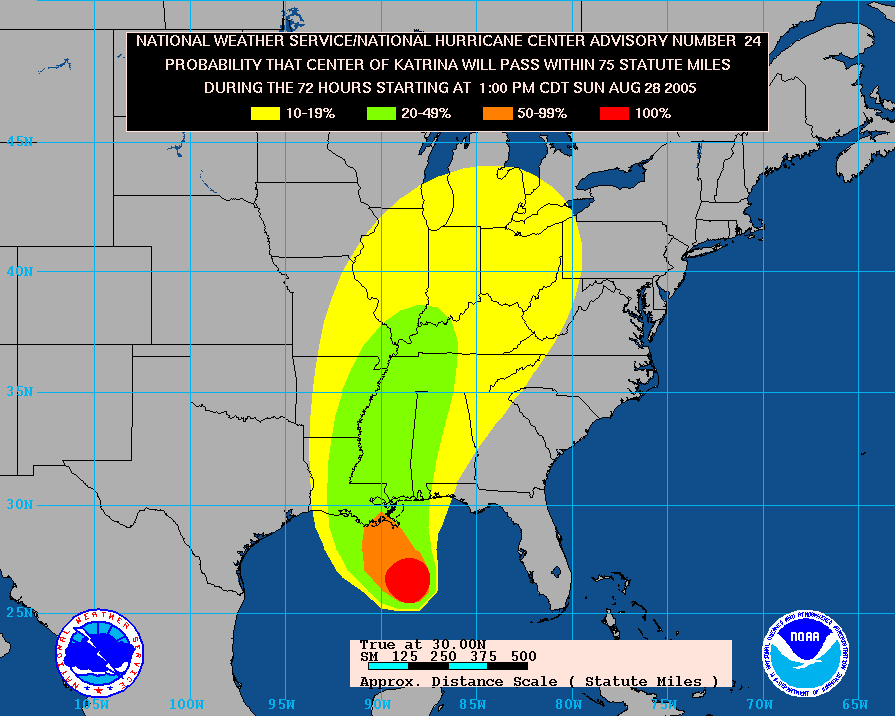
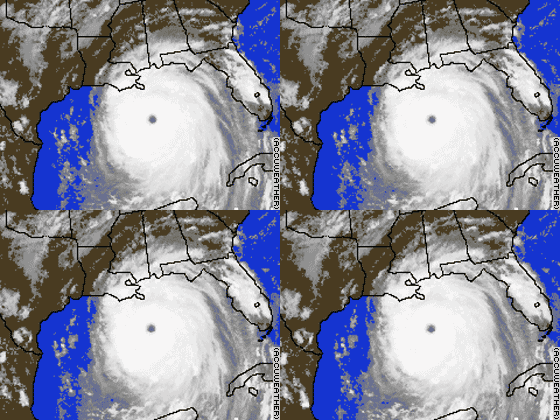
Hurricane Katrina is barreling down toward Louisiana as I write, and New Orleans has been nearly completely evacuated as a federal emergency exists for Louisiana and Mississippi, as well as "other parts of the northern Gulf coast states", according to the New York Times. The Louisiana Times-Picayune projects that Katrina "could build to a top-of-the-chart Category 5 storm, with winds of 155 mph or higher," according to "National Hurricane Center Director Max Mayfield". NHC's projection for Katrina's most likely path is above. According to the Red Cross, New Orleans Mayor Ray Nagin said that "'a storm this big heading directly toward it'" was unprecedented. (Relief efforts can be found at the above link.) Preparing for the worst, I extend my condolences to those whose lives will be affected, and to the survivors my deepest sympathies, by this storm.
"Brothers Grimm" Sucked, Don't See It
Oh, the power of advertising. Seems that previews can make any piece of shit movie look good. This applies wholeheartedly to Terry Gilliam's "The Brothers Grimm", which I saw yesterday. My disappointment, to put it delicately, revolves around the confused plot and cookie-cutter characters. Some funny moments, I guess. And then there is the inexplicably weird 'gingerbread' thing. Nevermind. It's ... not worth your time.
Thursday, August 25, 2005
A Thinly Veiled Censorship Regime?
My first thought was, What's this? We're flagging our fellow bloggers now, letting Blogger determine whether to remove our sites? Ah, only for "objectionable content". Unfortunately, we don't seem to know what that exactly means. It's rather vague. We're told that it's a method for the blogosphere to rid itself of hate, and like most people, I don't hate. It's pointless and stupid, and inherently irrational. That's not the game I'm in.
Unfortunately for me, some of my thoughts (delivered more often than not in a self-described ranting, random manner) may inspire offense to, say, some people. I don't know. It may arise an objection, whatever it could be, from someone. Can't say. I just don't want to see a sort of witchhunt come of this, where no one feels free to exercise freedom of thought and expression and we all start to turn against each other, a community where everyone's a snitch. I don't want that, and I hope most others don't, either. It would be a real shame for a great democratic medium like our blogosphere to become something like that.
Unfortunately for me, some of my thoughts (delivered more often than not in a self-described ranting, random manner) may inspire offense to, say, some people. I don't know. It may arise an objection, whatever it could be, from someone. Can't say. I just don't want to see a sort of witchhunt come of this, where no one feels free to exercise freedom of thought and expression and we all start to turn against each other, a community where everyone's a snitch. I don't want that, and I hope most others don't, either. It would be a real shame for a great democratic medium like our blogosphere to become something like that.
Friday, August 19, 2005

Sunday, August 14, 2005
Blogs and military misadventures are an odd mix. That said, Wired magazine, in its latest issue (August 2005, 13.08) has an article out, entitled "The Blogs of War", that talks about very courageous bloggers on the front-lines of the war in Iraq. (Well, wherever they have access to a computer and have the time.) And, as well, how this whole phenomenon is interacting with the Pentagon and its attempted censorship regime.
In the article, written by John Hockenberry, we hear of "an oddball online Greek chorus narrating the conflict in Iraq," whose "core group" consists "of about 100 regulars and hundreds more loosely organized activists, angry contrarians, jolly testosterone fuckups, self-appointed pundits, and would-be poets" in the milblogosphere that the Iraq war has created. The 'milbloggers', Hockenberry writes, "offer an unprecedented real-time real-life window on war and the people who wage it," and "constitute a rich subculture with a refreshing candor about the war, expressing views ranging from far right to far left." (It's good that it's a full spectrum.) But, though "the Pentagon officially tolerates this free-form online journalism and in-house peanut gallery," some measures are underway to filter out (i.e. censor), say, "casualty information".
"A new policy instituted this spring requires all military bloggers inside Iraq to register with their units," which seems reminiscent of the 'pooling' method by which media units were assigned to combat units during the first Iraq war. From Camp Falcon, stationed "in southern Baghdad", Cpt. Danjel Bout blogs to 365 and a Wakeup, which Hockenberry describes as "one of the most genuine accounts anywhere of what life is like for a soldier in Iraq." While the Pentagon appears ineffectual in its attempts to control the flow of information from soldiers writing from the battlefield, there has been at least one major instance of military censorship.
Just ask Michael Cohen. He was "a major and doctor with the 67th Combat Support Hospital based in Mosul," and his blog - 67cshdocs - "touched a nerve at the Pentagon late last year" when he recounted the medical response to the grisly attack against the mess hall tent there in December. Dr. Cohen was told by "'some people in the chain of command,'" as he tells it, that the details given on his blog "violate Army regulations," to which Cohen expressed shock. The Pentagon has shut it down, and so "Cohen stopped blogging" and is now "in Germany" (presumably at Ramstein AFB). However, you can still access his blog; the Internet Archive crawl has more-or-less all of it there.
Another target was "Army reservist Jason Hartley's popular and notoriously irreverent blog," Just Another Soldier. (Although it's been officially 'shut down', for some reason it's still online - well, another victory for democracy.) Hartley, who wrote on June 27, 2004, of coming across a Shi'a mosque that been blown up (concluding, "The Iraqis are as busy being assholes to each other as they are to us"), blogs no longer. He wrote: "Being a soldier is to live in a world of shit. From the pogues who cook my food and do my laundry to the Apache pilots and the Green Berets who do all the Hollywood stuff, our lives are in a constant state of suck." Meanwhile, the Pentagon's policy is "that blogs should not reveal any casualty information that could upset next of kin or any details that might jeopardize operational security." (Emphasis added) Hartley, though, was defiant, and continued "blogging a few months" after the Pentagon ordered his blog shut down. He was "demoted from sergeant to specialist," and since "returned to civilian life, though he's still in the reserves," with a memoir due to be published in September.
The milblogs that appear to rank highest are CBFTW's My War: Killing Time In Iraq, Sgt. Missick's A Line In The Sand, The Mudville Gazette, 1st Lt. Neil Prakash's Armor Geddon, Blackfive and 2Slick's Forum. I, for one, recommend reading them, and taking stock of the fact that, otherwise, that is if not for soldiers' blogs, the only journalists anywhere near the combat zone would be confined to the Green Zone, embedded at Camp Victory and surrounded by Bremer walls.
In the article, written by John Hockenberry, we hear of "an oddball online Greek chorus narrating the conflict in Iraq," whose "core group" consists "of about 100 regulars and hundreds more loosely organized activists, angry contrarians, jolly testosterone fuckups, self-appointed pundits, and would-be poets" in the milblogosphere that the Iraq war has created. The 'milbloggers', Hockenberry writes, "offer an unprecedented real-time real-life window on war and the people who wage it," and "constitute a rich subculture with a refreshing candor about the war, expressing views ranging from far right to far left." (It's good that it's a full spectrum.) But, though "the Pentagon officially tolerates this free-form online journalism and in-house peanut gallery," some measures are underway to filter out (i.e. censor), say, "casualty information".
"A new policy instituted this spring requires all military bloggers inside Iraq to register with their units," which seems reminiscent of the 'pooling' method by which media units were assigned to combat units during the first Iraq war. From Camp Falcon, stationed "in southern Baghdad", Cpt. Danjel Bout blogs to 365 and a Wakeup, which Hockenberry describes as "one of the most genuine accounts anywhere of what life is like for a soldier in Iraq." While the Pentagon appears ineffectual in its attempts to control the flow of information from soldiers writing from the battlefield, there has been at least one major instance of military censorship.
Just ask Michael Cohen. He was "a major and doctor with the 67th Combat Support Hospital based in Mosul," and his blog - 67cshdocs - "touched a nerve at the Pentagon late last year" when he recounted the medical response to the grisly attack against the mess hall tent there in December. Dr. Cohen was told by "'some people in the chain of command,'" as he tells it, that the details given on his blog "violate Army regulations," to which Cohen expressed shock. The Pentagon has shut it down, and so "Cohen stopped blogging" and is now "in Germany" (presumably at Ramstein AFB). However, you can still access his blog; the Internet Archive crawl has more-or-less all of it there.
Another target was "Army reservist Jason Hartley's popular and notoriously irreverent blog," Just Another Soldier. (Although it's been officially 'shut down', for some reason it's still online - well, another victory for democracy.) Hartley, who wrote on June 27, 2004, of coming across a Shi'a mosque that been blown up (concluding, "The Iraqis are as busy being assholes to each other as they are to us"), blogs no longer. He wrote: "Being a soldier is to live in a world of shit. From the pogues who cook my food and do my laundry to the Apache pilots and the Green Berets who do all the Hollywood stuff, our lives are in a constant state of suck." Meanwhile, the Pentagon's policy is "that blogs should not reveal any casualty information that could upset next of kin or any details that might jeopardize operational security." (Emphasis added) Hartley, though, was defiant, and continued "blogging a few months" after the Pentagon ordered his blog shut down. He was "demoted from sergeant to specialist," and since "returned to civilian life, though he's still in the reserves," with a memoir due to be published in September.
The milblogs that appear to rank highest are CBFTW's My War: Killing Time In Iraq, Sgt. Missick's A Line In The Sand, The Mudville Gazette, 1st Lt. Neil Prakash's Armor Geddon, Blackfive and 2Slick's Forum. I, for one, recommend reading them, and taking stock of the fact that, otherwise, that is if not for soldiers' blogs, the only journalists anywhere near the combat zone would be confined to the Green Zone, embedded at Camp Victory and surrounded by Bremer walls.
Tuesday, August 02, 2005
This is the continuation to a post on ZMag Blog, in response to a commenter by the alias "the-abyss", whose post can be found here:
... America is the greatest because of the unparalleled level of liberty its people enjoy, and the potential that follows from the responsibility granted by that freedom is enormous. We also should take pride in the absence of established religion in government, the oft-cited 'checks and balances' that prevent a tyranny of the majority, and protections for minorities. Sorry for the civics lesson, but those help define what makes us great; our greatness ought not deny that of others throughout the world, either, and doesn't. It ought offend the most sincerely enamored of the ideal of America such as myself that these assholes in our White House are actively orchestrating the decimation of any hope of global cooperation to root out, say, terrorism and nuclear proliferation. And these patroned leaders wrap themselves in the very flag they tarnish all the while. It's so very sad.
... America is the greatest because of the unparalleled level of liberty its people enjoy, and the potential that follows from the responsibility granted by that freedom is enormous. We also should take pride in the absence of established religion in government, the oft-cited 'checks and balances' that prevent a tyranny of the majority, and protections for minorities. Sorry for the civics lesson, but those help define what makes us great; our greatness ought not deny that of others throughout the world, either, and doesn't. It ought offend the most sincerely enamored of the ideal of America such as myself that these assholes in our White House are actively orchestrating the decimation of any hope of global cooperation to root out, say, terrorism and nuclear proliferation. And these patroned leaders wrap themselves in the very flag they tarnish all the while. It's so very sad.
Monday, August 01, 2005
It appears that monarchy reigns supreme: King Fahd of Saudi Arabia has died; the Prince has succeeded him to the throne. Congress is in recess; the President exploited his emergency appointment power to send John Bolton as Ambassador to the United Nations, until the end of 2006 pending confirmation by the Senate. Emergency! Obstructionist Senators (including turncoat Republican Voinovich) are blocking a radical unilateralist for some reason! (Abuse of power, anyone?) Oh, of course not.