Monday, July 16, 2007
“At the present moment, this Government has but three non-military tools with which to work in the Near East to place sufficient American impress on the region to win and hold it for the Western World. Those tools are: (a) Note-writing by the Department of State; (b) Propaganda regarding the high principles to which we claim to adhere; (c) Government loans made on a commercial basis and repayable in dollars. These tools are hopelessly inadequate. It is clear that unless the situation is handled firmly and adequately, a situation might well develop in the Near East which would result in another World War.”
— Gordon Merriam, Chief of the Division of Near Eastern Affairs (State Department), August 1945, in Foreign Relations of the United States: Diplomatic Papers, 1945, Near East and Africa, p. 46 (my emphasis)
— Gordon Merriam, Chief of the Division of Near Eastern Affairs (State Department), August 1945, in Foreign Relations of the United States: Diplomatic Papers, 1945, Near East and Africa, p. 46 (my emphasis)
Thomas Jefferson, a figure inexplicably considered to be mighty in our history albeit his futile objections to the then-existing order, seemed to have been stricken with the disease of idealism. Indeed, how terribly naïve and foolish were his words concerning the American Revolution, whose declaration of independence we celebrated two weeks ago. Jefferson, in a letter dated November 13, 1787, to William S. Smith, wrote: “The people cannot be all, & always, well informed. The part which is wrong will be discontented in proportion to the importance of the facts they misconceive. If they remain quiet under such misconceptions it is a lethargy, the forerunner of death to the public liberty… what country can preserve it’s [sic] liberties if their rulers are not warned from time to time that their people preserve the spirit of resistance?” Clearly a dangerous radical who needs to be bought out somehow before the rot he champions spreads until it is far too late.
Sunday, July 15, 2007
You learn something new everyday, it seems: the idea of youthful idealism, a natural yet ultimately futile process, refers to the sensible yet naïve critiques of how society appears to operate in transparently unfair and possibly amendable ways, best to be discarded as soon as possible once you learn to give up your alleged integrity and imagined autonomy as a free agent with free thoughts in service, without question, to the hands that will feed you into a lulling, fulfilling submission. It’s worthy of a lot of empathy, and leaves no room for the haughty contempt of know-betters and their lectures. You learn something new everyday.
Blogs have been around for ten years, apparently, according to this weekend’s Wall Street Journal, which has deemed “by widespread consensus, 1997 … a reasonable point at which to mark the emergence of the blog as a distinct life-form” (sec. P, p. 1). If my memory can be trusted (a dubious proposition), the hottest thing on the Web that year was the NASA Pathfinder mission, which had racked up a then-unprecedented number of hits. So these web logs, as they were initially known, didn’t gain much general appreciation until, say, 2002; that might be a more reasonable starting-point. This blogger didn’t get interviewed by the Journal, for very good reason, even though the Center has been here since 2003, when the medium was still quite young and the good people at Blogger were still operating a tiny, independent “push-button publish[er] for the people” that had yet to be acquired by Google.
In a similar vein, a recent item that has fancied my interest is this excellent compilation of “indecent” and “obscene” recordings from 1890-era wax cylinders created by the great Vaudeville-era performers of the day, only to be harassed and (in some cases) imprisoned under the rather theocratic police powers of Anthony Comstock and his — Saudi-like — New York Society for the Suppression of Vice, to be referred later as the infamous “Comstock laws.” In a way, it’s like the very early, and obviously different, sort of blogging; the Internet, infinitely more tied up and connected than the fairs, amusements and parlors of those days, had only been a commercial entity for two years preceding the apparent advent of the Blog, whose first author — quoting the Journal — is “regarded by many to be Jorn Barger” and his Robot Wisdom site. [Barger’s subtitles, in a very tiny print that run at the bottom of the top banner, have a curiousity of their own; according to the Internet Archive crawl, they’ve included colorful things like “stop economic satanism” and “smash with truth the lying machine,” along with “we are all palestinians now” and, as of right now, “judaism is racism is incompatible with democracy” — must he be the father of our craft?]
A very similar vein, it turns out; it is indeed quite profane to believe, no less broadcast, that an entire religion — particularly one that has suffered a terrible and obvious history of persecution at the hands of malevolent racists — is, irony of all ironies, racist(!) or is somehow “incompatible” with democratic governance, like some alien force. Fortunately, Actionable Offenses, that collection of cylindrical “smut,” is actually funny. And you’d never get my seal of approval for a band of witch-hunters seeking the suppression of blogland vice.
In a similar vein, a recent item that has fancied my interest is this excellent compilation of “indecent” and “obscene” recordings from 1890-era wax cylinders created by the great Vaudeville-era performers of the day, only to be harassed and (in some cases) imprisoned under the rather theocratic police powers of Anthony Comstock and his — Saudi-like — New York Society for the Suppression of Vice, to be referred later as the infamous “Comstock laws.” In a way, it’s like the very early, and obviously different, sort of blogging; the Internet, infinitely more tied up and connected than the fairs, amusements and parlors of those days, had only been a commercial entity for two years preceding the apparent advent of the Blog, whose first author — quoting the Journal — is “regarded by many to be Jorn Barger” and his Robot Wisdom site. [Barger’s subtitles, in a very tiny print that run at the bottom of the top banner, have a curiousity of their own; according to the Internet Archive crawl, they’ve included colorful things like “stop economic satanism” and “smash with truth the lying machine,” along with “we are all palestinians now” and, as of right now, “judaism is racism is incompatible with democracy” — must he be the father of our craft?]
A very similar vein, it turns out; it is indeed quite profane to believe, no less broadcast, that an entire religion — particularly one that has suffered a terrible and obvious history of persecution at the hands of malevolent racists — is, irony of all ironies, racist(!) or is somehow “incompatible” with democratic governance, like some alien force. Fortunately, Actionable Offenses, that collection of cylindrical “smut,” is actually funny. And you’d never get my seal of approval for a band of witch-hunters seeking the suppression of blogland vice.
Friday, July 13, 2007
The big news of this past day was the frighteningly lax licensing rules at the Nuclear Regulatory Commission (NRC), under which two fake companies were able to (almost) acquire enough radioactive material for a so-called dirty bomb — technically known as a “radiological dispersion device” or RDD. But is that true? Looking at the report itself, from the Government Accountability Office (GAO), what is actually discovered is that the investigators “could have acquired [enough radioactive material] … to reach the International Atomic Energy Agency’s (IAEA) definition of category 3.” (p. 3)
This is right in the middle of the IAEA scale of nuclear apocalypse*: “Category 3 sources include byproduct material, which is radioactive material generated by a nuclear reactor, and can be found in equipment that has medical, academic, and industrial applications,” to quote the GAO report. What about the dirty bomb idea? Here’s where the news media fearmongering comes in; both the Washington Post and New York Times led their stories with the mention that their NRC license “enabled them to buy enough radioactive material from U.S. suppliers to build a ‘dirty bomb,’” or “would have allowed them to buy the radioactive materials needed for a so-called dirty bomb” (respectively). The Times is actually slightly more accurate; it indeed would have, as nothing was enabled. Also appreciated is the use of “so-called” for the ridiculous descriptor of death — at least not as bureaucratically cumbersome as “radiological dispersion device,” which emotes no (reasonable) fear at all.
But it’s semantics to say more accurate in that sense, since both reports displayed an unnecessary bit of fright to their readers and, as well, the national agenda. The work of the NRC and the Energy Department is cited — from 2003 — which “identified several radioactive materials … as materials at higher risk of being used in an RDD, describing these as ‘materials of greatest concern,’” in the GAO report (p. 4). The specter of dirty bombs is mentioned in the “background” section, but there is no clear connection. What the papers accounted from this amounts, seemingly, to the fabrication of the very “fear and panic” (p. 3fn) such crude weapons would create.
*For ironic effect only.
This is right in the middle of the IAEA scale of nuclear apocalypse*: “Category 3 sources include byproduct material, which is radioactive material generated by a nuclear reactor, and can be found in equipment that has medical, academic, and industrial applications,” to quote the GAO report. What about the dirty bomb idea? Here’s where the news media fearmongering comes in; both the Washington Post and New York Times led their stories with the mention that their NRC license “enabled them to buy enough radioactive material from U.S. suppliers to build a ‘dirty bomb,’” or “would have allowed them to buy the radioactive materials needed for a so-called dirty bomb” (respectively). The Times is actually slightly more accurate; it indeed would have, as nothing was enabled. Also appreciated is the use of “so-called” for the ridiculous descriptor of death — at least not as bureaucratically cumbersome as “radiological dispersion device,” which emotes no (reasonable) fear at all.
But it’s semantics to say more accurate in that sense, since both reports displayed an unnecessary bit of fright to their readers and, as well, the national agenda. The work of the NRC and the Energy Department is cited — from 2003 — which “identified several radioactive materials … as materials at higher risk of being used in an RDD, describing these as ‘materials of greatest concern,’” in the GAO report (p. 4). The specter of dirty bombs is mentioned in the “background” section, but there is no clear connection. What the papers accounted from this amounts, seemingly, to the fabrication of the very “fear and panic” (p. 3fn) such crude weapons would create.
*For ironic effect only.
Thursday, July 12, 2007
Have been following the events surrounding the Lal Masjid (Red Mosque) siege, before the massive government-military crackdown began, as it happens, when it was just a fringe, violent ascetic cult. The whole impression of it does remind one of Waco and the Branch Davidians, and some comments about that comparison would be here had not a Google search shown something on the order of 650 hits making that very parallel. Ah, well.
The happenings at Lal Masjid caught my attention some months ago with news of a women-led demonstration outside of the mosque, whose leadership is especially misogynistic, for Islamabad. (Odd, then, how the lead cleric made his escape shrouded in a hijab.) Hopefully it is not considered insane to wonder if, globally, Islamist jihadi fundamentalism is on the wane. Personalities like Fareed Zakaria can expound at length that this may be case; at least he did a couple of years ago. The threat from al Qaeda is reported to be up so, well, seal the border. The one the hijackers traversed, i.e. the northern one. Why not wall off the Canucks?
The happenings at Lal Masjid caught my attention some months ago with news of a women-led demonstration outside of the mosque, whose leadership is especially misogynistic, for Islamabad. (Odd, then, how the lead cleric made his escape shrouded in a hijab.) Hopefully it is not considered insane to wonder if, globally, Islamist jihadi fundamentalism is on the wane. Personalities like Fareed Zakaria can expound at length that this may be case; at least he did a couple of years ago. The threat from al Qaeda is reported to be up so, well, seal the border. The one the hijackers traversed, i.e. the northern one. Why not wall off the Canucks?
Saturday, July 07, 2007
The documentary “Muslims Against Jihad” inspired me to pen my own anti-jihadist thoughts (as an infidel, admittedly) that do not fall into the trap that the cause celebre surrounding it seems to require, i.e. the irrational corralling of Islamic people — everywhere on all fronts — into an interesting, though infuriatingly simple-minded, dichotomy of “moderate” and “radical.” It is clear that we, as free people of the West, can look into the eyes of the puritanical, absolutist and fanatic strains within the political manifestations of Islamism and call it for what it is, while not succumbing to the wicked notion that all are suspect, prone to the same brush, within our gun-sights at the wrong moment’s notice. To borrow the words of David Grossman, an Israeli novelist, we must not condemn ourselves “to this absolute, fallacious and suffocating dichotomy — this inhumane choice to ‘be victim or aggressor,’ without having any third, more humane alternative.”
It is also clear, certainly this far along in the global terrorist war, that a truly fascist or at very least fascistic Islamic tawheed, that is world-view, threatens by its existential nature, throwing its weight around with a literalist rejection of any deviations of interpretations of its scripture and history. It constructs an ideology of clashing worlds in which the “laws of war” ought be thrown out at the command of uncompromising patriarchal figures claiming immutable holiness. Jihad is “struggle,” with murky origins. Most troublesome is its obvious co-option by these mindless extremists whose worldly presence we continually see. A corpus of commentary that has carefully delineated what is and what is not fair game in warfare suffers the habitual abuse of commandants who brutishly seek the total surrender of common humanity and good reason to their delusional righteousness. The hope of mankind is great.
It is also clear, certainly this far along in the global terrorist war, that a truly fascist or at very least fascistic Islamic tawheed, that is world-view, threatens by its existential nature, throwing its weight around with a literalist rejection of any deviations of interpretations of its scripture and history. It constructs an ideology of clashing worlds in which the “laws of war” ought be thrown out at the command of uncompromising patriarchal figures claiming immutable holiness. Jihad is “struggle,” with murky origins. Most troublesome is its obvious co-option by these mindless extremists whose worldly presence we continually see. A corpus of commentary that has carefully delineated what is and what is not fair game in warfare suffers the habitual abuse of commandants who brutishly seek the total surrender of common humanity and good reason to their delusional righteousness. The hope of mankind is great.
Tuesday, July 03, 2007

Happy Independence Day. Meanwhile:
The New York Times caption reads, “Iraqi boys staged a mock execution yesterday in Baghdad, with a 4-year-old, center, playing the role of the condemned. Children in Iraq have been heavily influenced by the violence in the country.…”(Courtesy Hadi Mizban/AP)
Not to spoil the fun, though; again, happy Fourth. You couldn’t take away the irrepressible grin of the hadji at the left. Let’s hear it, Jesse!

Saturday, June 30, 2007
“I know of no Muslim who would argue that we today exemplify — by any stretch of the imagination — the principles and ideals of Islam.”
— Jeremiah McAuliffe, Jr., from a 1997 essay, writing of the lack of understanding of self-criticism within the Islamic ‘world’; no less true these days, apparently, considering soberly whatever horror may befall the United Kingdom in the coming days because of the deeply irrational radicalization of the British Muslim community
ADDENDUM: Christopher Hitchens, in Slate, notes, “The fascistic subculture that has taken root in Britain and that lives by violence and hatred is composed of two main elements. One is a refugee phenomenon, made up of shady exiles from the Middle East and Asia who are exploiting London’s traditional hospitality, and one is the projection of an immigrant group that has its origins in a particularly backward and reactionary part of Pakistan.”
— Jeremiah McAuliffe, Jr., from a 1997 essay, writing of the lack of understanding of self-criticism within the Islamic ‘world’; no less true these days, apparently, considering soberly whatever horror may befall the United Kingdom in the coming days because of the deeply irrational radicalization of the British Muslim community
ADDENDUM: Christopher Hitchens, in Slate, notes, “The fascistic subculture that has taken root in Britain and that lives by violence and hatred is composed of two main elements. One is a refugee phenomenon, made up of shady exiles from the Middle East and Asia who are exploiting London’s traditional hospitality, and one is the projection of an immigrant group that has its origins in a particularly backward and reactionary part of Pakistan.”
Wednesday, June 27, 2007
Scott Horton at Harper’s is disturbing in his clear-eyed analysis of the coming US-Iran war. “Iraq redux,” as Vanity Fair quoted one high-end foreign policy specialist, regarding the build-up, planning and rhetoric. Pundits are already placing their bets on another “summertime war” between Israel and some combo of Lebanese militants, Gazan Hamas-heads or whoever. The situation is thoroughly disgusting. Back in May, for the last issue of the campus paper in which my editorials appear off-and-on, it looked like Iran was heading up to be the new enemy to destroy. “Iran is clearly a menace to [American] hegemonic interests in the Mideast,” went my words, concluding on the point about the horrid danger of “lending credibility to the Tehran regime, ramping up the threat of regional war and tying the fates of the Iranian and American people alike to the will of lunatics.”
Horton looks at the logistics, all within “striking range”: “Four aircraft carriers, 12-16 destroyers, 4-8 submarines, 4-8 AEGIS cruisers, and over 200 strike aircraft,” giving reason to why “an admiral [is] in charge of CENTCOM.” It is obvious that we’re preparing some kind of air assault; ground invasion is totally out of the question. As for the Iranian/American hostages (how symbolic), Horton thinks “the mullahs in Tehran” and their counterparts in “the Cheney clique … will demonize their respective hostages as spies and a threat to their national security.” It didn’t happen with the UK embroglio with the captured sailors, though it could just as easily happen this time; we can only pray. It is awful when people are used as pawns for wargames. To wit, Horton adds, our government is going to “portray Iran as a force for evil throughout the Middle East and beyond.” Destablizing, evil, threatening, gathering storm. Take it out. Surgical strikes. Preemption. Our force for good. Theirs for evil. Let’s hope history doesn’t unfurl redux at our expense, needless to say the world’s as well.
Horton looks at the logistics, all within “striking range”: “Four aircraft carriers, 12-16 destroyers, 4-8 submarines, 4-8 AEGIS cruisers, and over 200 strike aircraft,” giving reason to why “an admiral [is] in charge of CENTCOM.” It is obvious that we’re preparing some kind of air assault; ground invasion is totally out of the question. As for the Iranian/American hostages (how symbolic), Horton thinks “the mullahs in Tehran” and their counterparts in “the Cheney clique … will demonize their respective hostages as spies and a threat to their national security.” It didn’t happen with the UK embroglio with the captured sailors, though it could just as easily happen this time; we can only pray. It is awful when people are used as pawns for wargames. To wit, Horton adds, our government is going to “portray Iran as a force for evil throughout the Middle East and beyond.” Destablizing, evil, threatening, gathering storm. Take it out. Surgical strikes. Preemption. Our force for good. Theirs for evil. Let’s hope history doesn’t unfurl redux at our expense, needless to say the world’s as well.
Sunday, June 24, 2007
Speaking of military matters, former Army Major General Antonio Taguba, quoted in the latest issue of the New Yorker by investigative reporter Seymour Hersh, has a few words for the higher-ups who threw him out after he contributed to the investigation of the abuses at Abu Ghraib, surrounded by the evasions and deceit of the former Secretary of Defense, a man unworthy of the title from the beginning.
Quoting from Taguba at length, because it’s important: “From the moment a soldier enlists, we inculcate loyalty, duty, honor, integrity, and selfless service. And yet when we get to the senior-officer level we forget those values. I know that my peers in the Army will be mad at me for speaking out, but the fact is that we violated the laws of land warfare in Abu Ghraib. We violated the tenets of the Geneva Convention. We violated our own principles and we violated the core of our military values. The stress of combat is not an excuse, and I believe, even today, that those civilian and military leaders responsible should be held accountable.”
Agreed. Somewhere, sooner than later, Rumsfeld and all other parties to the scandal who knew full well and tried to dissemble their way out of it must be tried and thrown into prison for the rest of their natural lives.
Quoting from Taguba at length, because it’s important: “From the moment a soldier enlists, we inculcate loyalty, duty, honor, integrity, and selfless service. And yet when we get to the senior-officer level we forget those values. I know that my peers in the Army will be mad at me for speaking out, but the fact is that we violated the laws of land warfare in Abu Ghraib. We violated the tenets of the Geneva Convention. We violated our own principles and we violated the core of our military values. The stress of combat is not an excuse, and I believe, even today, that those civilian and military leaders responsible should be held accountable.”
Agreed. Somewhere, sooner than later, Rumsfeld and all other parties to the scandal who knew full well and tried to dissemble their way out of it must be tried and thrown into prison for the rest of their natural lives.
Wednesday, June 20, 2007
As two years have passed since my registration in the Selective Service System without (yet) being called up, maybe it’s a good time to deliver this excerpt from I’m Really Dragged But Nothing Gets Me Down (1968), Nat Hentoff’s “breakthrough novel” (Sunday Denver Post) whose “provocative timeliness” (Horn Book) explores “the conscience of the free individual versus the demands of state” (The Daily News [Whittier, CA]). Here’s such an exchange, if you will, between those forces as expressed in the mind of the book’s protagonist, Jeremy Wolf. (Words of the military bureaucrats in italics, Wolf’s in bold.)
Please, sirs, can’t you find it in the national interest not to make me a killer? Don’t be ridiculous, young man, do you want them Communists swarming up the street, raping your sister? I don’t have a sister. Your girl friend, then? But that’s not the point, sirs, they’re not attacking this country. Young man, we can’t take the time to argue with every Tom, Dick and Jeremy. You’ve got to have confidence that your President, on the basis of all the information, and only he knows all the information, has made the right decision in the national interest. You just sign up, and in four years, after you get out of college, we’ll see where you fit in best. I’ll think about it, sirs. Ain’t nothing to think about. You’ve got seven months and three days. You all come in and register or we are all going to come and get you. See, ain’t nothing to think about. You got no choice, boy. Yes, I do, I don’t have to register at all. Symbolic action, boy, that’s all it is, symbolic action. Waste of time. Face up, face up. Be a man!
But I don’t choose to be that kind of man. Hear that, Joe? He doesn’t choose to be that kind of man. Well, with that hair, I can see where he has a problem. But that’ll be all fixed up. Son, the Army’s the best thing that could happen to you. If I was your father, I’d say you ought to go right straight in, and go to college after. You’ll get a lot more out of that higher schooling, being a man. Sirs, I think you’re crazy. Boy, what kind of qualifications you got to make that kind of judgment? Trouble with you is, you don’t appreciate being an American. You’ve had it too soft, boy. That’s the trouble with kids like you. But sirs, why do I have to kill? For peace, damn it! Can’t you see that? How can we have peace if we don’t stop those people who are always aggressing against it? But aren’t we aggressing, sirs? Boy, I tell you, education has just gone to hell. Don’t you know the difference between aggressing and defending freedom?” (pp. 85-6, from the sixth printing, July 1973)
Saturday, June 16, 2007
“You aren’t going to Iraq to change the Iraqis. Just the opposite. We are fighting this war to preserve the principle of ‘live and let live.’ Maybe that sounded like a lot of words to you at home. Now you have a chance to prove it to yourself and others. If you can, it’s going to be a better world to live in for all of us.”
— A Short Guide to Iraq, U.S. War and Naval Depts., 1943 (p. 5)
Hat tip: Andrew Sullivan. (The link to the whole thing.)
— A Short Guide to Iraq, U.S. War and Naval Depts., 1943 (p. 5)
Hat tip: Andrew Sullivan. (The link to the whole thing.)
Monday, June 11, 2007

Stanley Fish, a professor of worldly repute, likes to throw some bombs. His latest piece for the Times looks at the collage of “atheist books” for which Richard Dawkins, the neuroscientist; philosopher Daniel Dennett; Sam Harris, asshole; and smart-alecky iconoclast (and fellow bomb-thrower) Christopher Hitchens have received notoriety and much hubbub. Thought to reprint my comments, along with a sampling of other ideas the readers had in mind for the whole chestnut of religion, faith, God.
There are three components to religion, as I see it. One involves the institutions of religious faith, the second the religious community and, third, the deity to which the faith is professed.
The authors, with very different agenda notwithstanding, seem to be focusing on religion as the organized, institutional force through human history that has, by their outlook, engendered terrible violence and intolerance, irrationalism and everything inspired by a zealous factionalism toward a particular protecting and vengeful god. That, if I am understanding their theses correctly, sets up religious (or even spiritual) faith as the embodiment of ancient prejudice with the usage of ‘religion’ as its vehicle; this is unfair.
Harris is the worst offender at conflating a fundamentalist approach to religion with belief in a Supreme Being (or Force) itself. I agree with Prof. Fish regarding Hitchens, who, according to a recent review of this spate of God-bashing books by The Nation, is the only one to treat the subject of God as an adult, and approaches the texts therein with a better understanding of religion’s abuses than the others.
As for my own opinion, I suppose I’m alternately agnostic on the question of God, whatever it may be, and my best hopes go with the communities of believers who derive their strength from simply believing in something beyond our human power of logic and reason, which are obviously important enough.
Atheism seems awfully empty of something very important, I think, whatever it is. The point of ‘religious’ mystery, maybe, is not knowing; when atheism as Harris-Dawkins-Hitchens (hyphenating while being aware of their divergences) deconstruct with such certainty, there is a richness lost, with full appreciation (not approval) of the terrors history has seen in the name of God.”
Someone going by the handle “jlangill” had this to say:
To look at atheists in any light one needs to define faith. Atheists that write about it are people of faith, true to their own dogma one of logic and absolute truths. If one looks at faith in the perspective of reason and absolute truths it falls apart every time because the points of religious faith are ‘Trust’, ‘Love’, and ‘Justice’. These three items are where all of the argument arises because there is no ‘logical” or ‘reasonable’ point to any of them. Many a thousand tomes of law and we are little closer to true justice.
…The pundits of atheist beliefs would have you think that these things are ruined by religious faith because of the actions of people that have lost the objectivity of an all powerful god… ‘We must rid the world of the infidels’ is what the zealots cry in the world of the all powerful god. Why should I raise a hand against anyone where God is the issuer of all judgment. So if the rationalists and the logical thinkers think that zealots are the beginning and the end of religious faith than they have missed the point.
In the book of Mica there is the shortest statement of faith. Being a youth group leader I teach this to all the youth I come in contact with whether they are of faith or not it goes, ‘And what does the LORD require of you But to do justice, to love kindness, And to walk humbly with your God?’(New American standard translation Mica 6:8) Even if I remove god from the statement I could live in a world where we ‘Do justice’ ‘Love kindness’ and ‘Walk Humbly’ couldn’t you? But it is that elusive something more, of having a light to guide me, the path already walked, even to my death that binds me to my religious faith.…”

And this, from one Paul Tuttle, quoting Ann Druyan, the widow of the late Carl Sagan:
His argument was not with God but with those who believed that our understanding of the sacred had been completed. Science’s permanently revolutionary conviction that the search for truth never ends seemed to him the only approach with sufficient humility to be worthy of the universe that it revealed. The methodology of science, with its error-correcting mechanism of keeping us honest in spite of our chronic tendencies to project, to misunderstand, to deceive ourselves and others, seemed to him the height of spiritual discipline.
…Ann quotes Bertrand Russell that ‘what is wanted is not the will to believe, but the desire to find out, which is the exact opposite.’ [Tuttle adds:] To argue in the support of science requires education and discipline, to argue in support of a religion only requires a vocabulary. But the real problem with belief without evidence is its ability create and maintain privilege. Carried to its extreme privilege justified through religion is capable of subjugating entire populations.”
Humanity and its abuse of faith in a higher spirit, or a higher authority, seems to define religion generically considered by the authors, in their own way. Another commenter, Colin Nicholas, has the perceptive sense to draw from Einstein’s God (quoted below), maybe as old as Aristotle’s, which exists as some intelligent force that somehow created everything but does not take part in human matters:
About God, I cannot accept any concept based on the authority of the Church. As long as I can remember, I have resented mass indocrination [sic]. I do not believe in the fear of life, in the fear of death, in blind faith. I cannot prove to you that there is no personal God, but if I were to speak of him, I would be a liar. I do not believe in the God of theology who rewards good and punishes evil. My God created laws that take care of that. His universe is not ruled by wishful thinking, but by immutable laws.” [Nicholas cites William Hermanns’ Einstein and the Poet: In Search of the Cosmic Man]
All for now.
Thursday, June 07, 2007

Speaking of Vermont, some trouble seems to be brewing there; very small group of people there are actually serious about — no joke — seceding from the United States. Their manifesto (from the Vermont Commons) reads, quoting Newsday’s excerpts from the declaration of one Thomas Naylor, formerly a professor at Duke: “Thoughtful Vermonters, opposed to the tyranny of the United States government, corporate America and globalization, believe that Vermont should once again become an independent republic, as it was between 1777 and 1791, and that the United States of America should begin to peacefully dissolve.
“Ultimately, as was the case with the American revolution, whether or not a state is allowed to secede is neither a legal question nor a constitutional question, but rather a matter of political will. The ultimate test of sovereignty lies with the people themselves: How strong is the will of the people of the departing state to be free and independent of the control of the larger nation it was a part of?
“My own favorite fantasy would be for Vermont to join Maine, New Hampshire and the four Atlantic provinces of Canada to create a new nation I would call New Acadia.” Ok, the last line is where it gets completely ridiculous. Naylor does have a point about constitutionality; there is no prohibition against succession, although history may show its futility.
The leader of the group, one Rob Williams, has this (sophomoric) thing to say: “If bloodshed were required to take back our country from the corporations, from big government and from the heavy hand of the law, then shed mine first. Our constitution was born out of revolution and a revolution will be required to restore it. We must re-establish the vision that is lost in the greed, the corruption and the oppression of the present establishment.
“We must re-stoke the forge of liberty and as a nation, pick up the hammer of freedom and strike America upon the anvil of justice and make it strong again.” Fairly frightening, and maybe a bit extreme. The ideals appear to be (at least sourced) in the right place. Hopefully.
“Ultimately, as was the case with the American revolution, whether or not a state is allowed to secede is neither a legal question nor a constitutional question, but rather a matter of political will. The ultimate test of sovereignty lies with the people themselves: How strong is the will of the people of the departing state to be free and independent of the control of the larger nation it was a part of?
“My own favorite fantasy would be for Vermont to join Maine, New Hampshire and the four Atlantic provinces of Canada to create a new nation I would call New Acadia.” Ok, the last line is where it gets completely ridiculous. Naylor does have a point about constitutionality; there is no prohibition against succession, although history may show its futility.
The leader of the group, one Rob Williams, has this (sophomoric) thing to say: “If bloodshed were required to take back our country from the corporations, from big government and from the heavy hand of the law, then shed mine first. Our constitution was born out of revolution and a revolution will be required to restore it. We must re-establish the vision that is lost in the greed, the corruption and the oppression of the present establishment.
“We must re-stoke the forge of liberty and as a nation, pick up the hammer of freedom and strike America upon the anvil of justice and make it strong again.” Fairly frightening, and maybe a bit extreme. The ideals appear to be (at least sourced) in the right place. Hopefully.
Thursday, May 31, 2007
Foreign Affairs, the leading establishment international relations journal, published the first of a series of foreign policy essays by the top-rung presidential candidates, first among them Barack Obama and Mitt Romney, respectively the presumed centrist candidates for the Dems and GOP. Without poring over minutia, there doesn’t seem to be a hair’s breadth of difference between them.
In “Renewing American Leadership,” Obama effectively refrains much of the so-called Bush Doctrine: dismissal of “outdated thinking” in service to “visionary leadership,” the United States’ divine “promise and purpose,” etc. It is not simply rhetorical. Toward “the broader Middle East,” we must use “tough-minded diplomacy” in which, for example, “we must not rule out using military force” against irritants like Iran. More worrisome is that he declares that he “will not hesitate” to “unilaterally” use force (“if necessary”), to protect undefined “vital interests” under the specter of being “imminently threatened,” whatever that may be. Our role is to fight the “evils” of the world, in the name of the “ultimate good.”
As for the other, “Rising to a New Generation of Global Challenges,” Romney is stuck with boilerplate extremism dressed up as calm, cool-headed statesmanship. There is “a new generation of challenges,” he writes, to which we can face with our “power and influence,” which “stems from [our] values and ideals.” A “bold” new struggle is needed; the U.S. “cannot remain mired in the past.” Public opinion on foreign policy matters, particularly viz. Iraq, is folded into neatly packaged contempt: “…we cannot let current polls and political dynamics drive us to repeat mistakes,” etc. All of this, of course, in the name of exporting “moral leadership” and our status as “a unique nation.”
Obama and Romney are correct in asserting that, respectively, our obsession with militarism must be pared down and that we are up to our necks in trouble. Their solutions reflect a very narrow range of policy choices that the parties find acceptable; the people are probably far ahead. There is no pretense, in any case, that you are going to find peace plans on this page, ever. It is just a bit threatening when there is little disagreement about supporting, and avidly promoting, the same sort of ideas that resulted in the mess we’re in now, and in the blood on our hands.
In “Renewing American Leadership,” Obama effectively refrains much of the so-called Bush Doctrine: dismissal of “outdated thinking” in service to “visionary leadership,” the United States’ divine “promise and purpose,” etc. It is not simply rhetorical. Toward “the broader Middle East,” we must use “tough-minded diplomacy” in which, for example, “we must not rule out using military force” against irritants like Iran. More worrisome is that he declares that he “will not hesitate” to “unilaterally” use force (“if necessary”), to protect undefined “vital interests” under the specter of being “imminently threatened,” whatever that may be. Our role is to fight the “evils” of the world, in the name of the “ultimate good.”
As for the other, “Rising to a New Generation of Global Challenges,” Romney is stuck with boilerplate extremism dressed up as calm, cool-headed statesmanship. There is “a new generation of challenges,” he writes, to which we can face with our “power and influence,” which “stems from [our] values and ideals.” A “bold” new struggle is needed; the U.S. “cannot remain mired in the past.” Public opinion on foreign policy matters, particularly viz. Iraq, is folded into neatly packaged contempt: “…we cannot let current polls and political dynamics drive us to repeat mistakes,” etc. All of this, of course, in the name of exporting “moral leadership” and our status as “a unique nation.”
Obama and Romney are correct in asserting that, respectively, our obsession with militarism must be pared down and that we are up to our necks in trouble. Their solutions reflect a very narrow range of policy choices that the parties find acceptable; the people are probably far ahead. There is no pretense, in any case, that you are going to find peace plans on this page, ever. It is just a bit threatening when there is little disagreement about supporting, and avidly promoting, the same sort of ideas that resulted in the mess we’re in now, and in the blood on our hands.
Friday, May 25, 2007
Yesterday, the Wall Street Journal published a letter that is worth quoting at length because it reads as the most eloquent case for impeachment yet. Dan DeWalt of South Newfane, Vermont writes (“The Call Goes Out From Vermont: Impeach!”, A15):
DeWalt also has (needed) harsh words for the Dems, who
I sure hope someone is listening to this guy.
While the Bush administration’s attempts to change the constitutional balance of powers by establishing a unitary executive of government is radical, following the proscribed constitutional remedy for such a breach, impeachment, is an act of conservation. To declare himself to be above the law, as the president has done in his signing statements, is both radical and unconstitutional. Calling on Congress to investigate these actions is an act of conservatism. To expect our representatives to honor their oaths of office to defend and uphold the constitution is an act of citizenship, neither left nor right.”
DeWalt also has (needed) harsh words for the Dems, who
have made a crass political calculation to let the president stew in the disaster that he has had simmering for six years. The thousands of lives to be lost in the next year and a half of unchecked war, as well as the tattered Constitution that will have suffered under the Bush administration for eight years, are, apparently, collateral damage to be sacrificed for the greater good sure to come when the Democrats regain the White House.”
I sure hope someone is listening to this guy.
Saturday, May 19, 2007
After revelations like these, from Eugene Robinson’s condemnations based on the testimony of former Justice Dept. deputy James Comey, it turns out this writer was completely wrong about Alberto Gonzales. The day he became Attorney General of the United States was not the day Lady Liberty was punched in the face.
No. It was the day she was raped, repeatedly, without shame. What a disgusting human being. The fatal assumption here had been that the man would be decent enough to stop and cry for his repentence after clocking her jaw and wounding her pride.
No. It was the day she was raped, repeatedly, without shame. What a disgusting human being. The fatal assumption here had been that the man would be decent enough to stop and cry for his repentence after clocking her jaw and wounding her pride.
Friday, May 18, 2007
The past is not always prologue; however, a “failure of generalship” appears to be plaguing the Iraq war, much like (though not identical) with past conflicts. An excerpt from Lt. Col. Paul Yingling, 3rd Armored Cavalry Regiment deputy commander (in the Armed Forces Journal), below:
Iraq is not Vietnam; it’s its own war, and it’s worse, perhaps immeasurably. One can only imagine what its memorial will look like, in blood, treasure and the brightest lights of this country.
After going into Iraq with too few troops and no coherent plan for postwar stabilization, America’s general officer corps did not accurately portray the intensity of the insurgency to the American public. The Iraq Study Group concluded that ‘there is significant underreporting of the violence in Iraq.’ The ISG noted … ‘Good policy is difficult to make when information is systematically collected in a way that minimizes its discrepancy with policy goals [my emphases].’ … America’s general officer corps underestimated the strength of the enemy, overestimated the capabilities of Iraq’s government and security forces and failed to provide Congress with an accurate assessment of security conditions in Iraq. … The intellectual and moral failures common to [the corps] in Vietnam and Iraq constitute a crisis in American generalship. Any explanation that fixes culpability on individuals is insufficient.”
Iraq is not Vietnam; it’s its own war, and it’s worse, perhaps immeasurably. One can only imagine what its memorial will look like, in blood, treasure and the brightest lights of this country.
Tuesday, May 15, 2007
The breaking news is that the Rev. Jerry Falwell has died, at the age of 73. My thought here is that although he denied humanity to the victims of 9/11 by casting the atrocities of that day as God’s retribution, we should not, in turn, deny him his humanity. For a man is dead, and his family grieves.
Tuesday, May 08, 2007
Little is more obnoxious than when political commentators appropriate ancient verse to lend “moral clarity” to (clear-as-day) aggressive and thoroughly illegal, seemingly never-ending occupation — all the more irritating when it’s done in the name of supporting our fighting men and women. For the sake of fairness, Dennis Prager’s intentions seem to be in the right place: fight evil, good soldiers; we support you, don’t listen to the nay-sayers. All well and good. Here’s his passage, which is quoted from the Book of Isaiah: “Woe to those who call evil good, and good evil.” Here’s the rest, which is omitted: “Woe to those who are wise in their own eyes, and shrewd in their own sight! Woe to those who … acquit the guilty for a bribe, and deprive the innocent of his right!”
It makes sense to not include these, because no one can reasonably apply them to the soldiers themselves. But it is quite clear that our occupation has entailed the very sort of hypocrisy, corruption and denial of human rights that the prophet Isaiah rightly condemned those “two-and-a-half millennia” ago, as Prager can tell you. His letter to our Armed Forces in Iraq, who have been shafted at every turn by policies that Prager supports as immutably holy, is simply a dishonest pose, masked with the trappings of false patriotism and dishonest piety.
It makes sense to not include these, because no one can reasonably apply them to the soldiers themselves. But it is quite clear that our occupation has entailed the very sort of hypocrisy, corruption and denial of human rights that the prophet Isaiah rightly condemned those “two-and-a-half millennia” ago, as Prager can tell you. His letter to our Armed Forces in Iraq, who have been shafted at every turn by policies that Prager supports as immutably holy, is simply a dishonest pose, masked with the trappings of false patriotism and dishonest piety.

Friday, May 04, 2007
Monday, April 23, 2007
Forget Oldboy. Did Cho ever listen to the Doors; like, really listen?
I’d hate to drag in Morrison’s good name into this, but some parts of “The End” are really chilling in light of what happened last week (aside of course from the oedipal references). Not trying to establish any real connection — which doesn’t exist — but, for the sake of hindsight (excerpted below):
“This is the end … of our elaborate plans, the end/Of everything that stands … No safety or surprise, the end/I’ll never look into your eyes again … Desperately in need of some stranger’s hand, in a desperate land/Lost in a Roman wilderness of pain, and all the children are insane...
“There’s danger on the edge of town … The killer awoke before dawn, he put his boots on/He took a face from the ancient gallery, and he walked on down the hall … It hurts to set you free, but you’ll never follow me/The end of laughter and soft lies…”
Anyway, Jim, you can rest in peace; God knows that with such an awful tragedy you definitely don’t merit any blame.
I’d hate to drag in Morrison’s good name into this, but some parts of “The End” are really chilling in light of what happened last week (aside of course from the oedipal references). Not trying to establish any real connection — which doesn’t exist — but, for the sake of hindsight (excerpted below):
“This is the end … of our elaborate plans, the end/Of everything that stands … No safety or surprise, the end/I’ll never look into your eyes again … Desperately in need of some stranger’s hand, in a desperate land/Lost in a Roman wilderness of pain, and all the children are insane...
“There’s danger on the edge of town … The killer awoke before dawn, he put his boots on/He took a face from the ancient gallery, and he walked on down the hall … It hurts to set you free, but you’ll never follow me/The end of laughter and soft lies…”
Anyway, Jim, you can rest in peace; God knows that with such an awful tragedy you definitely don’t merit any blame.
Friday, April 20, 2007

Thursday, April 19, 2007
CNN reported Wednesday night that NBC News received the videotaped final rites of the murderous psychopath who rampaged Virginia Tech Monday. After (reluctantly) watching it in full, with eyes aghast and conscience shocked by this despicable basketcase, all that really can be said is this: My God, there’s no soul there; blood colder than ice went through him. What a crime against all humanity, and his deeds were simply the quintessence of evil, when the heartless are allowed to roam free and destroy their imagined demons. All there is to say, really.
Tuesday, April 17, 2007
The murderer has a name: Cho Seung-Hui. AOL News reported earlier today that a former classmate, Ian MacFarlane, pointed to two plays Cho had written. They read, in terms of the violent psychosis and immaturity within, almost exactly like the Harris-Klebold diaries released last year.
Excerpted from “Mr. Brownstone” (above), through an apparent alter ego, John. As far as his story goes, John and friends sneak into a casino and win the jackpot, whereupon the teacher (who is portrayed as an evil figure [four professors were murdered at Virginia Polytechnic]) named Brownstone, intervenes and calls security forces on them. After kicking them out, one of the officers says, “I am sorry about those gangsters, sir. We’ll beef up our security.”
Seems disturbingly prescient. Yet what gives rise to such unreasoning anger and lunacy?
Is it me or do I smell evil around here? … I feel a satanic presence around me. Do you guys feel it?”
Excerpted from “Mr. Brownstone” (above), through an apparent alter ego, John. As far as his story goes, John and friends sneak into a casino and win the jackpot, whereupon the teacher (who is portrayed as an evil figure [four professors were murdered at Virginia Polytechnic]) named Brownstone, intervenes and calls security forces on them. After kicking them out, one of the officers says, “I am sorry about those gangsters, sir. We’ll beef up our security.”
Seems disturbingly prescient. Yet what gives rise to such unreasoning anger and lunacy?
Monday, April 16, 2007

“‘I can imagine what they’re going through,’ Frank DeAngelis, Columbine High principal for almost three decades, said in a telephone interview. ‘You’re hoping there would be lessons learned from Columbine but that’s obviously not the case’” (Bloomberg News).
One would have thought so (Photo by Alan Kim, Roanoke Times).
Friday, April 13, 2007

Thursday, April 12, 2007
From the London Guardian’s excerpts of Vonnegut’s final work, “A Man Without a Country” (2005):
This analysis was rolled out at the height of their dominance; they’re unraveling and imploding not a moment too soon. You will be missed.
I myself feel that our country, for whose Constitution I fought in a just war, might as well have been invaded by Martians and body snatchers. Sometimes I wish it had been. What has happened instead is that it was taken over by means of the sleaziest, low-comedy, Keystone Cops-style coup d’état imaginable. … George W Bush has gathered around him … psychopathic personalities, or PPs, the medical term for smart, personable people who have no consciences. … These were people born without consciences, and suddenly they are taking charge of everything. PPs are presentable, they know full well the suffering their actions may cause others, but they do not care. … Unlike normal people, they are never filled with doubts, for the simple reason that they don’t give a fuck what happens next. Simply can’t….”
This analysis was rolled out at the height of their dominance; they’re unraveling and imploding not a moment too soon. You will be missed.
The crucification of Don Imus has to stop. Free speech shouldn’t stop at the opening of anyone’s offense. Tasteless, yes; stupid, yes. Grounds for a barrage of punishment? No. Wasn’t he trying to riff off a Spike Lee movie? Where is Spike’s share of the blame? Imus is, or rather was, a shock jock; it is the nature of the profession to make ribald, provocative remarks that are typically directed toward, well, everybody. Don’t take him out of the context of his ignorant comments about Jews and women. It’s nothing new. The key part of racism seems to be hate; if you specialize in cracking wise, which was his attempt, that’s not necessarily racism. One would have the same basis to call Carlos Mencia, apparently a total fraud, racist — and you wouldn’t hear that from me.
This reminds me of a recent spate of papering around the residence halls here, which read, “Only 15 of the 137 faculty members identify as non-white. What are you going to do about it?” Um, nothing. If it is representative of the demographics of the surrounding community (in the case of Wooster, Ohio, quite so; the words “vanilla suburbs” from George Clinton come to mind), no issue. Why is the color of someone’s skin at all relevant? Only racists think like that, or instead crypto-racists grotesquely posing as champions of diversity. Anyway, hi, I’m back.
This reminds me of a recent spate of papering around the residence halls here, which read, “Only 15 of the 137 faculty members identify as non-white. What are you going to do about it?” Um, nothing. If it is representative of the demographics of the surrounding community (in the case of Wooster, Ohio, quite so; the words “vanilla suburbs” from George Clinton come to mind), no issue. Why is the color of someone’s skin at all relevant? Only racists think like that, or instead crypto-racists grotesquely posing as champions of diversity. Anyway, hi, I’m back.
Sunday, April 01, 2007
Saturday, March 24, 2007
At long last, there is proof-positive that this blogger is psycho-physio-ethically damaged, according to a report in the journal Nature as cited in Thursday’s New York Times:
“Damage to an area of the brain behind the forehead, inches behind the eyes, transforms the way people make moral judgments in life-or-death situations…” Okay, look, there’s no brain damage up here; maybe a serotonin imbalance, but that’s about it. But take a gander at the question that’s quoted.
It’s a hypothetical that leaves no room for uncertainty. Here it is, in the original italics with some useful comments in brackets: You have abandoned a sinking cruise ship and are in a crowded lifeboat that is dangerously low in water. [Okay, very frantic circumstances where people ain’t gonna think normally anyway, right?] If nothing is done — assuming quite a bit — it will sink before the rescue boats arrive and everyone will die.
However, there is an injured person who will not survive in any case [my emphasis]. If you throw that person overboard, the boat will stay afloat and the remaining passengers will be saved. So it becomes do or die. And according to the Nature article slightly over 20 percent of “normal” patients say yes, they would throw the poor guy over; and just over 80 percent of “brain injured” folks say yes.
Um, according to the very hypothetical presented, isn’t this a no-brainer (no pun intended)? Now, certainly you wouldn’t ask me to be the man to do it. Maybe that’s what a fair amount of the 80 percent of normal people who said no might have thought: Well, yeah, in principle, but not me. So either there’s some brain damage that’s gone under the radar on my behalf, or this was a totally loaded situation. Forget it.
“Damage to an area of the brain behind the forehead, inches behind the eyes, transforms the way people make moral judgments in life-or-death situations…” Okay, look, there’s no brain damage up here; maybe a serotonin imbalance, but that’s about it. But take a gander at the question that’s quoted.
It’s a hypothetical that leaves no room for uncertainty. Here it is, in the original italics with some useful comments in brackets: You have abandoned a sinking cruise ship and are in a crowded lifeboat that is dangerously low in water. [Okay, very frantic circumstances where people ain’t gonna think normally anyway, right?] If nothing is done — assuming quite a bit — it will sink before the rescue boats arrive and everyone will die.
However, there is an injured person who will not survive in any case [my emphasis]. If you throw that person overboard, the boat will stay afloat and the remaining passengers will be saved. So it becomes do or die. And according to the Nature article slightly over 20 percent of “normal” patients say yes, they would throw the poor guy over; and just over 80 percent of “brain injured” folks say yes.
Um, according to the very hypothetical presented, isn’t this a no-brainer (no pun intended)? Now, certainly you wouldn’t ask me to be the man to do it. Maybe that’s what a fair amount of the 80 percent of normal people who said no might have thought: Well, yeah, in principle, but not me. So either there’s some brain damage that’s gone under the radar on my behalf, or this was a totally loaded situation. Forget it.
Thursday, March 22, 2007
Ran into Paul Bremer at the grocery today. Didn’t think it was him (at first), though the recognition was almost instant. Things didn’t go past perfunctory greetings, and it shouldn’t have been otherwise. Didn’t feel it appropriate to ask if the de-Ba’athification policies over which he presided as head of the Coalition Provisional Authority back in ’03 were too drastic or extreme, so didn’t go there. Seemed like a nice fellow.

Friday, March 09, 2007
The old captain died not a minute too soon (from the executive summary of an internal FBI audit released today, below):
“… we identified many instances in which the FBI obtained telephone toll billing records and subscriber information from 3 telephone companies pursuant to more than 700 ‘exigent letters’ signed by personnel in the Counterterrorism Division without first issuing national security letters [NSL]. We concluded that the FBI’s acquisition of this information circumvented the requirements of the ECPA [Electronic Communications Privacy Act] NSL statute and violated the Attorney General’s Guidelines for FBI National Security Investigations and Foreign Intelligence Collection … and internal FBI policy” (p. 41).
Until later.
“… we identified many instances in which the FBI obtained telephone toll billing records and subscriber information from 3 telephone companies pursuant to more than 700 ‘exigent letters’ signed by personnel in the Counterterrorism Division without first issuing national security letters [NSL]. We concluded that the FBI’s acquisition of this information circumvented the requirements of the ECPA [Electronic Communications Privacy Act] NSL statute and violated the Attorney General’s Guidelines for FBI National Security Investigations and Foreign Intelligence Collection … and internal FBI policy” (p. 41).
Until later.
Friday, March 02, 2007
Lest you thought you’d gotten me pinned down with the last post, here’s a sampling from another political philosophy that seems quite attractive to me as well (via Project Gutenberg):
“Society is indeed a contract… but the state ought not to be considered nothing better than a partnership agreement in a trade of pepper and coffee, calico or tobacco, or some other such low concern… It is a partnership in all science; a partnership in all art; a partnership in every virtue … between those who are living, those who are dead, and those who are to be born. Each contract of each particular state is but a clause in the great primeval contract of eternal society … connecting the visible and invisible world… The municipal corporations of that universal kingdom are not morally at liberty at their pleasure…”
— Edmund Burke (emphasis added)
“Society is indeed a contract… but the state ought not to be considered nothing better than a partnership agreement in a trade of pepper and coffee, calico or tobacco, or some other such low concern… It is a partnership in all science; a partnership in all art; a partnership in every virtue … between those who are living, those who are dead, and those who are to be born. Each contract of each particular state is but a clause in the great primeval contract of eternal society … connecting the visible and invisible world… The municipal corporations of that universal kingdom are not morally at liberty at their pleasure…”
— Edmund Burke (emphasis added)
Referred to this topic in an earlier post, but this possibly could indicate why democratic socialism, at least by its immediate connotations, may not become a viable alternative in the U.S. for a long time, from Jason Schulman and Joseph Schwartz:
One could say that they’ve yet to get it back.
Hopes for a rapid democratic transition to socialism were shattered by the horrors of Stalinism and the failure of social democratic governments to discern a socialist road out of the Great Depression. After World War II, ‘democratic socialism’ increasingly became identified with the ‘Keynesian’ welfare state… with the crisis of the welfare state due to the end of post-WWII growth in the 1970s, the mainstream left … faced a crisis of vision and program.”
One could say that they’ve yet to get it back.

Thursday, February 22, 2007
For this blog’s fourth birthday tomorrow, it might be fitting that sensationalist journalism from the New York Times deserves condemnation. (What else is new?) “In open defiance of the United Nations,” we read, “Iran is steadily expanding its efforts to enrich uranium, the International Atomic Energy Agency [IAEA] reported…” Is this true?
The actual IAEA report, to which the Times provides a link, says something quite different. “The Agency has no information to report regarding the assembly of centrifuges…” The Times: “…the nuclear agency reported that Iran was now operating or about to switch on roughly a thousand centrifuges … at its nuclear facility at Natanz.” There is no mention of any new developments at Natanz; this appears to be complete fabrication.
IAEA: “As of 17 February 2007, no UF6 [uranium enrichment gas] had been fed into the process at FEP [Fuel Enrichment Plant].” Times: “If the country could operate 3,000 centrifuges continuously for a year, it could produce about one weapon’s worth of highly enriched uranium [HEU].” This gets buried several paragraphs later: “The report said that between Nov. 2 [2006] and Feb. 17, Iranian crews fed 145 pounds of uranium into the pilot plant for enrichment,” which “produced only about 15 pounds of low-enriched uranium — too little for anything but experimental analysis.”
The IAEA is more specific: “The environmental sample results thus far indicate a maximum enrichment of 4.2%…” (The threshold beyond which it becomes highly-enriched is 5%, according to the Depleted Uranium Management Information Network, a branch of the Argonne National Laboratory’s Environmental Science Division.) This is alarming; about that there’s no doubt. It seems, though, to be a far cry from catastrophe.
Some cause for concern, from the report: “Iran has not agreed to any of the required transparency measures, which are essential for the clarification of certain aspects of the scope and nature of its nuclear programme.” The Islamic Republic is being arrogant (no surprise), and we’re threatening war. The heart of the matter appears to be that “Iran has not suspended its enrichment related activites,” what the Times calls “open defiance” — omitting where the IAEA also says that “Iran has been providing the Agency with access to declared nuclear material and facilities…” Or it’s just playing cat-and-mouse about the stockpiles it’s keeping hidden, like Iraq did.
Maybe we all, the Times and its buddies in the White House included, should stop giving invaluable ammunition, and massive boosts of ego, to the madmen of this world — like Bush and Ahmadinejad — and their apocalyptic visions.
The actual IAEA report, to which the Times provides a link, says something quite different. “The Agency has no information to report regarding the assembly of centrifuges…” The Times: “…the nuclear agency reported that Iran was now operating or about to switch on roughly a thousand centrifuges … at its nuclear facility at Natanz.” There is no mention of any new developments at Natanz; this appears to be complete fabrication.
IAEA: “As of 17 February 2007, no UF6 [uranium enrichment gas] had been fed into the process at FEP [Fuel Enrichment Plant].” Times: “If the country could operate 3,000 centrifuges continuously for a year, it could produce about one weapon’s worth of highly enriched uranium [HEU].” This gets buried several paragraphs later: “The report said that between Nov. 2 [2006] and Feb. 17, Iranian crews fed 145 pounds of uranium into the pilot plant for enrichment,” which “produced only about 15 pounds of low-enriched uranium — too little for anything but experimental analysis.”
The IAEA is more specific: “The environmental sample results thus far indicate a maximum enrichment of 4.2%…” (The threshold beyond which it becomes highly-enriched is 5%, according to the Depleted Uranium Management Information Network, a branch of the Argonne National Laboratory’s Environmental Science Division.) This is alarming; about that there’s no doubt. It seems, though, to be a far cry from catastrophe.
Some cause for concern, from the report: “Iran has not agreed to any of the required transparency measures, which are essential for the clarification of certain aspects of the scope and nature of its nuclear programme.” The Islamic Republic is being arrogant (no surprise), and we’re threatening war. The heart of the matter appears to be that “Iran has not suspended its enrichment related activites,” what the Times calls “open defiance” — omitting where the IAEA also says that “Iran has been providing the Agency with access to declared nuclear material and facilities…” Or it’s just playing cat-and-mouse about the stockpiles it’s keeping hidden, like Iraq did.
Maybe we all, the Times and its buddies in the White House included, should stop giving invaluable ammunition, and massive boosts of ego, to the madmen of this world — like Bush and Ahmadinejad — and their apocalyptic visions.
Monday, February 19, 2007
Wednesday, February 14, 2007
So it’s finally come to this: There’s no discernable way to tell whether it’s the Washington Post or the Onion that’s joking. Crazy times.

Tuesday, February 06, 2007
Okay, so this isn’t about YouTube. Enough’s been said about it, and the national obsession is starting to get embarrassing. But in a way, everything now seems to relate in some way; regardless, the issue is much larger and snags along a lot in its way. Lemme get right to it: we are living in a universe of media in which the traditional notions of copyright and even hallowed intellectual property are becoming irrelevant.
One could say that Old Copyright is in itself increasingly a form of theft in today’s environment. It might seem crazy to say that, but how do the provincial holdings of hard media not deny a freer, more open nebula of information that “new” media promise? There is a wholly novel understanding of media ownership that escapes the logic of a system struggling to keep up. Print journalism is already dead, for example. Not as in lifeless, but without currency.
Ideas that are the creation of an author still belong to him, of course. No one is taking away what rightfully belongs to anyone; there is no actual piracy when it comes to media/file sharing and associated trends because things like information, and even music, are more a part of the so-called public domain than the holding of barons who make intangible things like thoughts and notes their own. People should give credit where credit is due, and respect basic property rights, but there are natural limits and they have been crossed for too long. Yet, hopefully, things are starting to turn around.
FOOTNOTE: Earlier today, Apple chieftan Steve Jobs announced that the stranglehold of Digital Rights Management (DRM) should no longer be enforced. In “Thoughts on Music,” Jobs writes, “Convincing [the major record labels] to license their music to Apple and others DRM-free will create a truly interoperable music marketplace” that “Apple will embrace … wholeheartedly.” His message is directedly principally to “Universal, Sony BMG, Warner and EMI,” which “control the distribution of over 70% of the world’s music.” It’s a start, so keep fighting.
One could say that Old Copyright is in itself increasingly a form of theft in today’s environment. It might seem crazy to say that, but how do the provincial holdings of hard media not deny a freer, more open nebula of information that “new” media promise? There is a wholly novel understanding of media ownership that escapes the logic of a system struggling to keep up. Print journalism is already dead, for example. Not as in lifeless, but without currency.
Ideas that are the creation of an author still belong to him, of course. No one is taking away what rightfully belongs to anyone; there is no actual piracy when it comes to media/file sharing and associated trends because things like information, and even music, are more a part of the so-called public domain than the holding of barons who make intangible things like thoughts and notes their own. People should give credit where credit is due, and respect basic property rights, but there are natural limits and they have been crossed for too long. Yet, hopefully, things are starting to turn around.
FOOTNOTE: Earlier today, Apple chieftan Steve Jobs announced that the stranglehold of Digital Rights Management (DRM) should no longer be enforced. In “Thoughts on Music,” Jobs writes, “Convincing [the major record labels] to license their music to Apple and others DRM-free will create a truly interoperable music marketplace” that “Apple will embrace … wholeheartedly.” His message is directedly principally to “Universal, Sony BMG, Warner and EMI,” which “control the distribution of over 70% of the world’s music.” It’s a start, so keep fighting.
Friday, February 02, 2007
Old insights as the jabber-jaws continue prattling about ’08:
“Is it a trifling mischief, that our population, divided into two almost equal numerical halves, should be every four years … precipitated against each other, with all the animosity, bitterness, revilings, and resentments which now mingle all their bad elements to swell that huge evil of Party Spirit, which all deplore, yet all share, and all contribute to stimulate? That so much time should be wasted, so much capital squandered, so much energy misapplied, so much bad feeling mutually excited, so much demoralization, public and private, engendered?”
— from “A Much-Needed Reform” (April 1865), in the United States Magazine, and Democratic Review
“Is it a trifling mischief, that our population, divided into two almost equal numerical halves, should be every four years … precipitated against each other, with all the animosity, bitterness, revilings, and resentments which now mingle all their bad elements to swell that huge evil of Party Spirit, which all deplore, yet all share, and all contribute to stimulate? That so much time should be wasted, so much capital squandered, so much energy misapplied, so much bad feeling mutually excited, so much demoralization, public and private, engendered?”
— from “A Much-Needed Reform” (April 1865), in the United States Magazine, and Democratic Review
Monday, January 29, 2007
Saturday, January 27, 2007
Kudos to Garry Wills, from whom excerpts follow (below):
To add, we’re also told that the United States is itself a “battleground” in the war on terrorism, to which the “war at home” is frequently alluded.
We hear constantly now about ‘our commander in chief.’ The word has become a synonym for ‘president.’ It is said that we ‘elect a commander in chief.’ It is asked whether this or that candidate is ‘worthy to be our commander in chief.’ But the president is not … the commander in chief of civilians. … When Abraham Lincoln took actions based on military considerations, he gave himself the proper title, ‘commander in chief of the Army and Navy of the United States.’ That title is rarely — more like never — heard today. It is just ‘commander in chief,’ or even ‘commander in chief of the United States.’”
“This reflects the increasing militarization of our politics. The citizenry at large is now thought of as under military discipline. … We must simply trust our lords and obey the commander in chief. … We used to take pride in civilian leadership of the military under the Constitution, a principle that George Washington embraced when he avoided military symbols at Mount Vernon. We are not led — or were not in the past — by caudillos.”
To add, we’re also told that the United States is itself a “battleground” in the war on terrorism, to which the “war at home” is frequently alluded.
Thursday, January 25, 2007
Does our beloved Coca-Cola, the “classic” “real thing” that always refreshes and is nearly ubiquitous in our land, hire paramilitary death squads in Latin America to assassinate bottler workers trying to unionize their plants?
There is ample documentation pointing the blame squarely on the supposed death merchants at Coke, as well as case after case of all-too-convenient murders which are alleged to be occurring up to the present day. If such a case proves true, the bare moral minimum would be to end all business and sever its ties. This could be prompted by a student-led boycott of Coca-Cola and its subsidiary brands, which includes Minute Maid, PowerAde and others.
The incidents are not widely reported in the mainstream — with the apparent exceptions of two respective reports in the New York Times from 2001 and 2003, alleging that the United Self-Defense Forces of Colombia (known as the AUC) has, and continues, to slaughter unionists under the orders of bottling firms like the Panamco Industrial de Gaseosas, “the major Coke bottler in Colombia.” The Times also explains that the legal basis for filing lawsuits against these actions “interfere[s] with foreign policy and open[s] multinational companies to frivolous or irrelevant grievances,” according to Bush administration officials cited.
By that standard, the taking of human lives is either immaterial or — probably worse — completely necessary for the interests of corporate dominion, anywhere it looks to operate with impunity and with total sanction. Yet there are other, more substantiating accounts that bear mentioning. In the Nation (“The Case Against Coca-Cola,” 1 May 2006), free-lancer Michael Blanding quotes Javier Correa, the president of the Sindicato Nacional de Trabajadores de la Industria de Alimentos, which is known as Sinaltrainal, as saying that Coca-Cola policy is “to not only eliminate the union but to destroy its workers,” and stated that Sinaltrainal “membership has fallen from about 1,400 to less than 400” from 1996 to 2006.
Ed Potter, the labor-relations director at Coke, put up a seemingly good front that Blanding demolished as “at best irrelevant and at worst misleading.” It may be unfair, however, to blame Potter on that basis since he’s simply doing his job. It might also be worth noting that the International Union of Food, Agricultural, Hotel, Restaurant, Catering, Tobacco and Allied Workers Associations, thankfully abbreviated as the IUF, “condemned the anti-Coke movement” as “‘based on unsubstantiated allegations and empty political slogans,’” according to the National Review. On the other hand, the allegations seem far from unsubstantiated.
Yet in September 2006, the District Court for the Southern District of Florida ruled that the Alien Tort Claims Act, under which Sinaltrainal sued the Coke bottlers for human rights violations, did not give the court enough “subject matter jurisdiction” to decide whether the allegations were “in violation of the law of nations,” according to the docket signed off by José Martinez, the presiding judge. The court also ruled that “there is a risk that vague … allegations will allow individuals … to engage in unwarranted ‘fishing expeditions’ against corporate entities and to abuse the judicial process in order to pursue political agendas.” All outstanding charges against the Coca-Cola bottling companies were thrown out.
For the record, here are some of the names of the slain workers, in fact murders for which Coca-Cola appears to bear responsibility — and, by extension, ourselves as consumers — according to what has so far been recorded: Oscar Darío Soto, José Eleazar Manco, Luis Enrique Gómez, Isídro Segundo Gil, and dozens of others. More than a few other workers, including Luis Adolfo Cardona, Juan Carlos Gavis, Jorgé Humberto Leal and José Domingo Flores, were tortured by security forces — or captured, intimidated, brutally handled and lucky to escape alive.
Within all of this, boycotts are not guaranteed to be successful; about that no one should have any illusions. A vibrant, sustained campaign against Coca-Cola could have an important educational effect as well as shed more light on what continue to be largely hidden abuses, specifically those acts of brutality against the very lowest links of a long chain that reaches right up to cafeterias and hallways in college campuses throughout the nation. There looks to be both promise and peril in any kind of undertaking to stop man’s inhumanity to man. And it ought to be a common-sense position that no organization should have a legitimate reason to do business with a criminal outfit, even if by proxy.
There is ample documentation pointing the blame squarely on the supposed death merchants at Coke, as well as case after case of all-too-convenient murders which are alleged to be occurring up to the present day. If such a case proves true, the bare moral minimum would be to end all business and sever its ties. This could be prompted by a student-led boycott of Coca-Cola and its subsidiary brands, which includes Minute Maid, PowerAde and others.
The incidents are not widely reported in the mainstream — with the apparent exceptions of two respective reports in the New York Times from 2001 and 2003, alleging that the United Self-Defense Forces of Colombia (known as the AUC) has, and continues, to slaughter unionists under the orders of bottling firms like the Panamco Industrial de Gaseosas, “the major Coke bottler in Colombia.” The Times also explains that the legal basis for filing lawsuits against these actions “interfere[s] with foreign policy and open[s] multinational companies to frivolous or irrelevant grievances,” according to Bush administration officials cited.
By that standard, the taking of human lives is either immaterial or — probably worse — completely necessary for the interests of corporate dominion, anywhere it looks to operate with impunity and with total sanction. Yet there are other, more substantiating accounts that bear mentioning. In the Nation (“The Case Against Coca-Cola,” 1 May 2006), free-lancer Michael Blanding quotes Javier Correa, the president of the Sindicato Nacional de Trabajadores de la Industria de Alimentos, which is known as Sinaltrainal, as saying that Coca-Cola policy is “to not only eliminate the union but to destroy its workers,” and stated that Sinaltrainal “membership has fallen from about 1,400 to less than 400” from 1996 to 2006.
Ed Potter, the labor-relations director at Coke, put up a seemingly good front that Blanding demolished as “at best irrelevant and at worst misleading.” It may be unfair, however, to blame Potter on that basis since he’s simply doing his job. It might also be worth noting that the International Union of Food, Agricultural, Hotel, Restaurant, Catering, Tobacco and Allied Workers Associations, thankfully abbreviated as the IUF, “condemned the anti-Coke movement” as “‘based on unsubstantiated allegations and empty political slogans,’” according to the National Review. On the other hand, the allegations seem far from unsubstantiated.
Yet in September 2006, the District Court for the Southern District of Florida ruled that the Alien Tort Claims Act, under which Sinaltrainal sued the Coke bottlers for human rights violations, did not give the court enough “subject matter jurisdiction” to decide whether the allegations were “in violation of the law of nations,” according to the docket signed off by José Martinez, the presiding judge. The court also ruled that “there is a risk that vague … allegations will allow individuals … to engage in unwarranted ‘fishing expeditions’ against corporate entities and to abuse the judicial process in order to pursue political agendas.” All outstanding charges against the Coca-Cola bottling companies were thrown out.
For the record, here are some of the names of the slain workers, in fact murders for which Coca-Cola appears to bear responsibility — and, by extension, ourselves as consumers — according to what has so far been recorded: Oscar Darío Soto, José Eleazar Manco, Luis Enrique Gómez, Isídro Segundo Gil, and dozens of others. More than a few other workers, including Luis Adolfo Cardona, Juan Carlos Gavis, Jorgé Humberto Leal and José Domingo Flores, were tortured by security forces — or captured, intimidated, brutally handled and lucky to escape alive.
Within all of this, boycotts are not guaranteed to be successful; about that no one should have any illusions. A vibrant, sustained campaign against Coca-Cola could have an important educational effect as well as shed more light on what continue to be largely hidden abuses, specifically those acts of brutality against the very lowest links of a long chain that reaches right up to cafeterias and hallways in college campuses throughout the nation. There looks to be both promise and peril in any kind of undertaking to stop man’s inhumanity to man. And it ought to be a common-sense position that no organization should have a legitimate reason to do business with a criminal outfit, even if by proxy.
Thursday, January 18, 2007
Wednesday, January 17, 2007
MORE ON IRAN: Dariush Zahedi and Omid Memarian, from openDemocracy, report that US-Iran relations are definitely going to sour further as this new year goes forward, thanks to the response of the reactionary fanatics at the helm in Tehran to the December municipal elections — and the coming “confrontation” with the United States, where (not by Zahedi and Memarian’s mention) the response of the reactionary fanatics at the helm in Washington to the November elections has continued to unfold.*
Zahedi and Memarian do point out the “ideological zealotry” of the Ahmadinejad clique that is threatening Iran, including whatever democratic prospects exist within the society; those aspirations look sort of hopeful now, but that could change. Nonetheless, any zealotry that aggresses toward peace and affronts historical memory must be condemned without equivocation. Extremism within and without Iran may cripple the hope of a democratic future, but not unless Iranians and Americans of good faith do a damn good thing or two about it.
*No hesitation will be drawn here to point out the critical parallels between the leaders that are bringing their respective countries ever closer to war. Much like Bush, Ahmadinejad has distracted Iranians from disastrous economic policies with bellicosity and aggression, thinly masked with diplomatic pretense. There is of course a major difference here; we have a much larger economy to ruin and we bear the guilt and shame of foreign aggression and invasion, which does not really apply to Iran. Their government sponsors terror groups for their strategic purposes; so does ours (Hezb’ullah and the Mujahideen-e Khalq, respectively, for one example).
Zahedi and Memarian do point out the “ideological zealotry” of the Ahmadinejad clique that is threatening Iran, including whatever democratic prospects exist within the society; those aspirations look sort of hopeful now, but that could change. Nonetheless, any zealotry that aggresses toward peace and affronts historical memory must be condemned without equivocation. Extremism within and without Iran may cripple the hope of a democratic future, but not unless Iranians and Americans of good faith do a damn good thing or two about it.
*No hesitation will be drawn here to point out the critical parallels between the leaders that are bringing their respective countries ever closer to war. Much like Bush, Ahmadinejad has distracted Iranians from disastrous economic policies with bellicosity and aggression, thinly masked with diplomatic pretense. There is of course a major difference here; we have a much larger economy to ruin and we bear the guilt and shame of foreign aggression and invasion, which does not really apply to Iran. Their government sponsors terror groups for their strategic purposes; so does ours (Hezb’ullah and the Mujahideen-e Khalq, respectively, for one example).
Monday, January 15, 2007
Thursday, January 11, 2007
JUST A NOTE: Don’t really want to talk about this at much length, but there are interesting things about the idea of a surge, linguistically. Bear with me.
Dictionary.com is not authoritative, but it has something useful here for surge. The principal definition is “a strong, wavelike volume or body of something,” in this case several armed brigades storming into the boroughs of Baghdad. Fine; that’s the main image.
In meteorological parlance, a surge can be attributed to “normal diurnal changes,” as in the back and forth of the seas as dictated by the impersonal forces of lunar gravity. What goes up goes down. As a electrical term, surges are irrational spikes of voltage that “oscillate violently,” with unpredictable results. You cannot channel a surge constructively. Nautically, a surge refers to the slackening and “slip[ping] back” of rope, indicating retreat, going backward.
Not the New Way Forward we’re promised, then. Finally, in terms of mechanics, a surge is “something driven by an engine,” therefore without appeal to reason. To me it suggests a shift in the gears of the war machine, panicking and squealing out of control as it approaches the edge of a cliff. Don’t forget that surge is central to insurgency. Maybe the United States is better off with some surge protection.
Dictionary.com is not authoritative, but it has something useful here for surge. The principal definition is “a strong, wavelike volume or body of something,” in this case several armed brigades storming into the boroughs of Baghdad. Fine; that’s the main image.
In meteorological parlance, a surge can be attributed to “normal diurnal changes,” as in the back and forth of the seas as dictated by the impersonal forces of lunar gravity. What goes up goes down. As a electrical term, surges are irrational spikes of voltage that “oscillate violently,” with unpredictable results. You cannot channel a surge constructively. Nautically, a surge refers to the slackening and “slip[ping] back” of rope, indicating retreat, going backward.
Not the New Way Forward we’re promised, then. Finally, in terms of mechanics, a surge is “something driven by an engine,” therefore without appeal to reason. To me it suggests a shift in the gears of the war machine, panicking and squealing out of control as it approaches the edge of a cliff. Don’t forget that surge is central to insurgency. Maybe the United States is better off with some surge protection.
Wednesday, January 10, 2007
Probably won’t be able to make it to the Young Democratic Socialists* conference this February, which also coincides with the fourth birthday of this ’blog. Anyway, looks interesting and maybe a good place to meet some people; you know, those naïve idealists folks hear so much about.
The focus, according to some of the literature they have and including their bare-bones flyer, is the usual anti-corporate, anti-imperialism stuff. The phrase “anti-capitalist” does indeed sound scary to many an American ear; suffice it to say the idea of anti-corporatism is genuinely pro-market, or at least that’s my crazy thinking.
But for whoever does have a car or whatever, and actually has some money and the time and the interest or what-have-you, check it out. Why not; this country is worth saving. (Then report back to me. Nah, that’s alright.)
*The term democratic socialism (DS) simultaneously sounds threatening and contradictory. But from what passes as my awareness of it, DS sounds well in keeping with the spirit of our Founding Fathers and the Republic they created, and therefore totally benign; but maybe there’s my naiveté. Regardless, democracy and socialism don’t inherently conflict (except for the communist off-shoot, which can rot in hell).
The focus, according to some of the literature they have and including their bare-bones flyer, is the usual anti-corporate, anti-imperialism stuff. The phrase “anti-capitalist” does indeed sound scary to many an American ear; suffice it to say the idea of anti-corporatism is genuinely pro-market, or at least that’s my crazy thinking.
But for whoever does have a car or whatever, and actually has some money and the time and the interest or what-have-you, check it out. Why not; this country is worth saving. (Then report back to me. Nah, that’s alright.)
*The term democratic socialism (DS) simultaneously sounds threatening and contradictory. But from what passes as my awareness of it, DS sounds well in keeping with the spirit of our Founding Fathers and the Republic they created, and therefore totally benign; but maybe there’s my naiveté. Regardless, democracy and socialism don’t inherently conflict (except for the communist off-shoot, which can rot in hell).
Monday, January 08, 2007
On Sunday, the Washington Post printed up a staggeringly complex graphic blaring out the corporate campaign contributions — per sector — to the House and Senate chairmanships, from the outgoing to the incoming people, etc. (Karen Yourish and Laura Stanton, “Congress Changes Hands — or Does It?” 7 January 2007, B2) The rhetorical question: “… is the 110th [Congress] really all that different from the 109th?” (No.)
According to my ’rithmetic, just taking the difference between the figures of the old and new in aggregate, out of the total contributions from each place (the Post uses data from the Center for Responsive Politics), you get: two percent less piggy-backing in the House and three-tenths of one percent less in the Senate (where you have the biggest offenders, notably Joe Lieberman and Joe Biden).
Oh, how politics is such a horrid game.
According to my ’rithmetic, just taking the difference between the figures of the old and new in aggregate, out of the total contributions from each place (the Post uses data from the Center for Responsive Politics), you get: two percent less piggy-backing in the House and three-tenths of one percent less in the Senate (where you have the biggest offenders, notably Joe Lieberman and Joe Biden).
Oh, how politics is such a horrid game.
Tuesday, December 26, 2006
Guess this is a sort of fixation of interest lately, but here’s some more about the Iranian nuclear threat, except one could say it’s less of a threat than what’s otherwise imagined.
For instance, in a March 2006 address to the International Atomic Energy Agency (IAEA) Board of Generals, director-general Mohamed ElBaradei declared that “the Agency has not seen indications of diversion of nuclear material to nuclear weapons or other nuclear explosive devices. Regrettably, however, after three years of intensive verification, there remain uncertainties with regard to both the scope and the nature of Iran’s nuclear programme” (my emphasis). That’s a big qualifier, but my suspicion is it won’t be changed by threatening war.
According to a November 2005 report entitled Implementation of the NPT [Non-Proliferation Treaty] Safeguards Agreement in the Islamic Republic of Iran, “The Agency has continued to monitor installations related to the uranium gas centrifuge and laser enrichment programmes, and has not observed any inconsistency with Iran’s voluntary undertaking not to carry out any enrichment activities” (my emphasis once again).
John Chipman, director of the International Institute for Strategic Studies explained in a 6 September 2005 report, “Iran has submitted to extensive investigations by the [IAEA] since 2003 to verify Iran’s acknowledgement of undeclared nuclear activities extending back over nearly 20 years. … Although a number of uncertainties remain about past and current activities, including the history of Iran’s enrichment and reprocessing efforts, we judge it is unlikely that Iran is hiding significant stocks of fissile material or production facilities for such material.” According to the Chipman dossier, “Public estimates for how long it would take Iran to acquire nuclear weapons range from only a few years to at least a decade.”
Ten years would put us in 2016, very close to the time when Iranian “revenue from its oil exports” might “virtually disappear” and another energy source would be needed — as “economic geographer” Roger Stern of the National Academy of Sciences just reported, according to an AP wire in today’s Washington Post (“Iran Oil Revenue Quickly Drying Up, Analysis Says,” A9). One finding from the Stern report declares that “there could be merit to Iran’s assertion that it needs nuclear power for civilian purposes.”
Without going on a limb, one could argue somewhat forcefully that canceling the economic sanctions we’re enforcing, at great peril to the Iranian people, would strip the regime ruling roughshod over them of any plausible reason to continue developing nuclear energy — much less any potential for acquiring weapons.
For instance, in a March 2006 address to the International Atomic Energy Agency (IAEA) Board of Generals, director-general Mohamed ElBaradei declared that “the Agency has not seen indications of diversion of nuclear material to nuclear weapons or other nuclear explosive devices. Regrettably, however, after three years of intensive verification, there remain uncertainties with regard to both the scope and the nature of Iran’s nuclear programme” (my emphasis). That’s a big qualifier, but my suspicion is it won’t be changed by threatening war.
According to a November 2005 report entitled Implementation of the NPT [Non-Proliferation Treaty] Safeguards Agreement in the Islamic Republic of Iran, “The Agency has continued to monitor installations related to the uranium gas centrifuge and laser enrichment programmes, and has not observed any inconsistency with Iran’s voluntary undertaking not to carry out any enrichment activities” (my emphasis once again).
John Chipman, director of the International Institute for Strategic Studies explained in a 6 September 2005 report, “Iran has submitted to extensive investigations by the [IAEA] since 2003 to verify Iran’s acknowledgement of undeclared nuclear activities extending back over nearly 20 years. … Although a number of uncertainties remain about past and current activities, including the history of Iran’s enrichment and reprocessing efforts, we judge it is unlikely that Iran is hiding significant stocks of fissile material or production facilities for such material.” According to the Chipman dossier, “Public estimates for how long it would take Iran to acquire nuclear weapons range from only a few years to at least a decade.”
Ten years would put us in 2016, very close to the time when Iranian “revenue from its oil exports” might “virtually disappear” and another energy source would be needed — as “economic geographer” Roger Stern of the National Academy of Sciences just reported, according to an AP wire in today’s Washington Post (“Iran Oil Revenue Quickly Drying Up, Analysis Says,” A9). One finding from the Stern report declares that “there could be merit to Iran’s assertion that it needs nuclear power for civilian purposes.”
Without going on a limb, one could argue somewhat forcefully that canceling the economic sanctions we’re enforcing, at great peril to the Iranian people, would strip the regime ruling roughshod over them of any plausible reason to continue developing nuclear energy — much less any potential for acquiring weapons.
Tuesday, December 19, 2006
(from my [poorly-written] post on a recent openDemocracy forum)
The Iranian elections signal a good measure of hope for the country and the region. Ahmadinejad campaigned (to a narrow win in 2005) on a populist platform and spent it all on embarrassing Iranians with his belligerent rhetoric and antics that, I think, draw instant parallels vis-à-vis the United States and Bush.
It is clear that the Iranian people want to defang their renegade president and hopefully steer their future toward a more moderate standing viz. the U.S., if not outright reform. There is still room for good-faith negotiations; there is also still plenty of time. If they have no (perceived) reason to acquire a nuclear deterrent, they probably won’t have one.
Iran, to be sure, is not a free country. But the youth there are said to be quite pro-Western and pro-American, and that’s very good. A crucial mistake would be to further isolate the country, including signs like that as well as the now-defunct reformist movements that can be jump-started, by screwing this up with further steps of aggressive threat and covert war-plans. Iraq is a basket-case next to this.
The Iranian elections signal a good measure of hope for the country and the region. Ahmadinejad campaigned (to a narrow win in 2005) on a populist platform and spent it all on embarrassing Iranians with his belligerent rhetoric and antics that, I think, draw instant parallels vis-à-vis the United States and Bush.
It is clear that the Iranian people want to defang their renegade president and hopefully steer their future toward a more moderate standing viz. the U.S., if not outright reform. There is still room for good-faith negotiations; there is also still plenty of time. If they have no (perceived) reason to acquire a nuclear deterrent, they probably won’t have one.
Iran, to be sure, is not a free country. But the youth there are said to be quite pro-Western and pro-American, and that’s very good. A crucial mistake would be to further isolate the country, including signs like that as well as the now-defunct reformist movements that can be jump-started, by screwing this up with further steps of aggressive threat and covert war-plans. Iraq is a basket-case next to this.
Monday, December 18, 2006
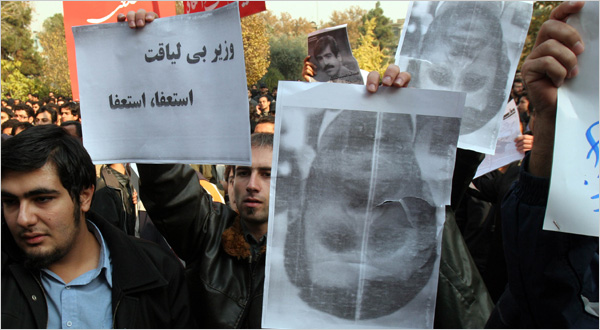
Monday, December 11, 2006
WAR OF CIVILIZATIONS UPDATE:
Well, not really, according to Nicholas Kristof, the New York Times columnist whose admonitions to stop the Darfur slaughter have gone totally unheeded. But he’s talking about Muslims this time. No, not Arabs, he is quick to add. (Not all Arabs are Muslim, not all Muslims are Arab; in fact, most are not.)
Here’s a passage — or, borrowing from Sullivan’s lexicon, the ‘money quote’:
“The Koran and Bible alike have passages that make 21st-century readers flinch; most Christians just ignore sections on slavery or admonitions to kill a disobedient child. Likewise, some Muslims are reinterpreting Koranic passages on polygamy and amputations, saying they were restricted to particular circumstances that no longer apply. [For great analysis from an avowed Islamic humanist going by the moniker Ali Eteraz, check out the archives of his now-defunct site which is listed under my links.]
“Frankly, I don’t see that any religion’s influence is intrinsically peaceful or violent. Christianity inspired both Mother Teresa and pogroms. Hinduism nurtured Gandhi and also the pioneers of suicide bombings. [True, true, although I didn’t know about the Hindu suicide bombers thing; and Hitchens has some questions about Teresa’s saintliness.]
“These days, ferocious anti-Semitism thrives in some Muslim countries, but in the Dreyfus affair a century ago Muslims sided with a Jew persecuted by anti-Semitic Christians. And the biggest sectarian slaughter in Europe in modern times involved Christians massacring Muslims at Srebrenica. [Um, if we’re counting “modern times” … oh, sectarian slaughter; regardless, the Holocaust should be included in that category.]
“The plain fact is that some Muslim societies [point of confusion: when is it Muslim, versus Islamic or Islamist? These have almost become interchangeable] do have a real problem with violence, with the subjugation of women, with tolerance. But the mosaic of Islam is vast and contains many more hopeful glimpses of the future.
“There is a historic dichotomy between desert Islam — the austere fundamentalism of countries like Saudi Arabia — and riverine or coastal Islam, more outward-looking, flexible and tolerant. Desert Muslims grab the headlines, but my bet is that in the struggle for the soul of Islam, maritime Muslims have the edge.”
Ah, okay. Those damn desert A-rabs are the ones getting us in a pinch, Mr. Kristof; I see. Of course that is just irony. What’s interesting here is that he takes pains to differentiate the Muslim populations but has no problem grouping the ‘sand monkeys’ together as one homogenous, threatening group. Subtly racist of that distinction, no?
Well, not really, according to Nicholas Kristof, the New York Times columnist whose admonitions to stop the Darfur slaughter have gone totally unheeded. But he’s talking about Muslims this time. No, not Arabs, he is quick to add. (Not all Arabs are Muslim, not all Muslims are Arab; in fact, most are not.)
Here’s a passage — or, borrowing from Sullivan’s lexicon, the ‘money quote’:
“The Koran and Bible alike have passages that make 21st-century readers flinch; most Christians just ignore sections on slavery or admonitions to kill a disobedient child. Likewise, some Muslims are reinterpreting Koranic passages on polygamy and amputations, saying they were restricted to particular circumstances that no longer apply. [For great analysis from an avowed Islamic humanist going by the moniker Ali Eteraz, check out the archives of his now-defunct site which is listed under my links.]
“Frankly, I don’t see that any religion’s influence is intrinsically peaceful or violent. Christianity inspired both Mother Teresa and pogroms. Hinduism nurtured Gandhi and also the pioneers of suicide bombings. [True, true, although I didn’t know about the Hindu suicide bombers thing; and Hitchens has some questions about Teresa’s saintliness.]
“These days, ferocious anti-Semitism thrives in some Muslim countries, but in the Dreyfus affair a century ago Muslims sided with a Jew persecuted by anti-Semitic Christians. And the biggest sectarian slaughter in Europe in modern times involved Christians massacring Muslims at Srebrenica. [Um, if we’re counting “modern times” … oh, sectarian slaughter; regardless, the Holocaust should be included in that category.]
“The plain fact is that some Muslim societies [point of confusion: when is it Muslim, versus Islamic or Islamist? These have almost become interchangeable] do have a real problem with violence, with the subjugation of women, with tolerance. But the mosaic of Islam is vast and contains many more hopeful glimpses of the future.
“There is a historic dichotomy between desert Islam — the austere fundamentalism of countries like Saudi Arabia — and riverine or coastal Islam, more outward-looking, flexible and tolerant. Desert Muslims grab the headlines, but my bet is that in the struggle for the soul of Islam, maritime Muslims have the edge.”
Ah, okay. Those damn desert A-rabs are the ones getting us in a pinch, Mr. Kristof; I see. Of course that is just irony. What’s interesting here is that he takes pains to differentiate the Muslim populations but has no problem grouping the ‘sand monkeys’ together as one homogenous, threatening group. Subtly racist of that distinction, no?
Saturday, December 02, 2006
I don’t pretend to any expertise or field experience, so this is just from what’s been reported and the situation as I’ve followed it. But enough with the disclaimers; they’re redundant and therefore unnecessary, and perhaps annoying and … I guess that’s disclaiming the disclaimer.
The need to express an opinion on things of pressing importance and consequence seems high for a lot of people, especially for those (myself included) who are neither directly involved nor actually knowledgeable. Sometimes things are better left unsaid, as they may simply add nothing new to the dialogue. But this blogger is not here to determine that, because for someone to say “That’s nothing new” smacks of elitist presupposition.
Yet that’s exactly the problem. An elite of commentators and analysts digests reality for us nearly constantly, too rapidly to either absorb or reflect on what we see and hear, enforcing some memes and throwing out others. The idea of being overabundantly interconnected with the world and yet so disconnected from it emerges, no longer so paradoxically. We want the real-world picture, with the fuzzy ambiguities sharpened, the murky subtext dredged out onto the microscope slide for powerful focus, all and everything chopped up, packed away and sold en masse.
What about the cynical, absolutist and simplistic lenses wielded at times by our self-appointed opinionists? I’ll of course admit my membership in the “blogosphere,” something that remains unclear in what it is or what it’s doing, or contributing to. It certainly cannot be a coherent whole, and therefore not any kind of sphere. (Maybe, instead, it’s a sphere in the sense of a gaseous ball of fire, which has no real surface but is rather pulled into its shape by the force of gravity.) Whatever it is, the blogs themselves form a sort of disjointed group that has plenty of opinionists, commentating aggregators, etc.
The world may be totally insane, but I think a lot of promise exists in many places. One hope of mine is that the collective power of human thought (in any medium) will eventually break apart the forces of evil that the surface of these media keep reflecting, masking that hope with overwhelmed notes of resignation and pretensions of understanding.
The need to express an opinion on things of pressing importance and consequence seems high for a lot of people, especially for those (myself included) who are neither directly involved nor actually knowledgeable. Sometimes things are better left unsaid, as they may simply add nothing new to the dialogue. But this blogger is not here to determine that, because for someone to say “That’s nothing new” smacks of elitist presupposition.
Yet that’s exactly the problem. An elite of commentators and analysts digests reality for us nearly constantly, too rapidly to either absorb or reflect on what we see and hear, enforcing some memes and throwing out others. The idea of being overabundantly interconnected with the world and yet so disconnected from it emerges, no longer so paradoxically. We want the real-world picture, with the fuzzy ambiguities sharpened, the murky subtext dredged out onto the microscope slide for powerful focus, all and everything chopped up, packed away and sold en masse.
What about the cynical, absolutist and simplistic lenses wielded at times by our self-appointed opinionists? I’ll of course admit my membership in the “blogosphere,” something that remains unclear in what it is or what it’s doing, or contributing to. It certainly cannot be a coherent whole, and therefore not any kind of sphere. (Maybe, instead, it’s a sphere in the sense of a gaseous ball of fire, which has no real surface but is rather pulled into its shape by the force of gravity.) Whatever it is, the blogs themselves form a sort of disjointed group that has plenty of opinionists, commentating aggregators, etc.
The world may be totally insane, but I think a lot of promise exists in many places. One hope of mine is that the collective power of human thought (in any medium) will eventually break apart the forces of evil that the surface of these media keep reflecting, masking that hope with overwhelmed notes of resignation and pretensions of understanding.
Saturday, November 25, 2006
I give thanks for this too...
(from the 1956 Defense Dept. Coolidge Committee Report on Classified Information, via the Memory Hole)
Saturday, November 18, 2006

Wednesday, November 15, 2006
“While some on principles baptized to strict party platform ties, social clubs in drag disguise outsiders they can freely criticize/Tell nothing except who to idolize and then say God bless him …
“My eyes collide head-on with stuffed graveyards/False gods, I scuff, at pettiness which plays so rough/Walk upside-down inside handcuffs, kick my legs to crash it off/Say okay, I have had enough, What else can you show me?”
(R. Zimmerman, 1965)
“My eyes collide head-on with stuffed graveyards/False gods, I scuff, at pettiness which plays so rough/Walk upside-down inside handcuffs, kick my legs to crash it off/Say okay, I have had enough, What else can you show me?”
(R. Zimmerman, 1965)
Friday, November 10, 2006
Wednesday, November 08, 2006
I’d hate to pontificate, so instead an old chestnut from a simpler, bloodier time is in order. “A house divided against itself cannot stand.” That house, as it was then, is the United States. Civil war no longer greets us here, but the climate feels somewhat similar, if something in the old history books bears truth. It seems that elections are a form of parlor game, so the only mention of this week’s will go in the way of instrumental, passing remarks that — without resort to cynicism — illustrate the larger state in which I think we’ve become entrapped. Tuesday should give Americans pause for hope, as it does represent a small step forward, or at least a step backward from the abyss. The ideological chasms must be bridged and we have to stop putting the worst of our nature into our politics.
In some circles a pundit or two observed that a Senate split right down the middle, with the Vice President enabled to cast the tie-breaking vote, was a possibility. Currently at about 52 percent, the House (as was expected) has a slight majority for the opposition party. Either way, the dominant party can plausibly claim victory. The President can veto whatever he likes and, regardless, can resort to a signing statement that absolves him of enforcing any law as he has done hundreds of times before. It took the collosal failure of their policy, and not much else, to propel the former minority back into the lower chamber. Victory is also to be credited to the entrenched system of patronage and gerrymandering, which may have held off much of the popular will.
Andrea Cukor, in a letter printed in the Times, says that the American people have “got to stop the political tribalism that has taken over the democratic process of our Republic!” It is indeed something to exclaim and proclaim, but unlike her I wouldn’t understate it. That tribal mentality, which appeals only to emotion and superficially-important matters, is tearing apart our nation. A political science professor explained in my freshman year that we are headed in a “fascist” direction, with the focus less on governing the country and more on electioneering that toys with the citizenry on the bases of “fear, anger and division,” to borrow the characterization of the supposed Newspaper of Record last week. I hope the professor’s prediction is wrong, but it looks like we have not had a government for some time now and will not have one regardless of what happened this week.
The Milwaukee Journal Sentinel reported Sunday that our “political structure … seems impervious to big partisan swings — thanks to a 50/50 electorate, the advantages of incumbency and the scarcity of competitive congressional districts.” In October, econopolitical analyst Paul Krugman wondered whether the oppositional “wave” — however great — could actually “overtop the levee” that the dominant party has built, given that “in close elections many Democratic votes … simply add to huge majorities in a small number of districts, while the more widely spread Republican vote allows the G.O.P. to win by narrower margins in a larger number of districts.” Roll Call opinionator Morton Kondracke agreed, writing on Nov. 2 that the vote was shaping up to be “tempered by some Republican structural advantages.”
National Review editor Ramesh Ponnuru commented back in September that a loss for the then reigning partisans could be a net gain. “Freed from the obligation of cobbling together thin majorities for watered-down legislation,” Ponnuru wrote, “Republicans would be able to stand for something attractive.” That is preferable to the mess of things with which Americans have been surrounded. Upon seizing the mantle again, the Democrats’ “left-leaning ‘net-roots’ may grow more enraged still,” as the newly ascendant party “would … have the illusion of power without its reality.” These musings reflect on the longer-term picture, in which it can soon enough be claimed that nothing is going to get done and the corrosive polarization will maybe intensify.
The party that lost its dominance, at least its majority by narrow margins, has appeared to be riven over tactical disagreements about how to most effectively secure our rapidly fading hegemon status. However, the party that just ascended to power, more of a splinter association than anything else, lacks an overarching vision or strategy. This is a problem if Americans want their representatives to roll back the damage wrought to our country, in all of the anti-constitutional and anti-republican forms inflicted. There are no guarantees, nor do any quick fixes pretend to appear; whatever does unfold holds some confident measure of promise. That hope, however, is not up to the political system that has wholly failed the people for whom it purports to speak and, more absurdly, to lead.
In some circles a pundit or two observed that a Senate split right down the middle, with the Vice President enabled to cast the tie-breaking vote, was a possibility. Currently at about 52 percent, the House (as was expected) has a slight majority for the opposition party. Either way, the dominant party can plausibly claim victory. The President can veto whatever he likes and, regardless, can resort to a signing statement that absolves him of enforcing any law as he has done hundreds of times before. It took the collosal failure of their policy, and not much else, to propel the former minority back into the lower chamber. Victory is also to be credited to the entrenched system of patronage and gerrymandering, which may have held off much of the popular will.
Andrea Cukor, in a letter printed in the Times, says that the American people have “got to stop the political tribalism that has taken over the democratic process of our Republic!” It is indeed something to exclaim and proclaim, but unlike her I wouldn’t understate it. That tribal mentality, which appeals only to emotion and superficially-important matters, is tearing apart our nation. A political science professor explained in my freshman year that we are headed in a “fascist” direction, with the focus less on governing the country and more on electioneering that toys with the citizenry on the bases of “fear, anger and division,” to borrow the characterization of the supposed Newspaper of Record last week. I hope the professor’s prediction is wrong, but it looks like we have not had a government for some time now and will not have one regardless of what happened this week.
The Milwaukee Journal Sentinel reported Sunday that our “political structure … seems impervious to big partisan swings — thanks to a 50/50 electorate, the advantages of incumbency and the scarcity of competitive congressional districts.” In October, econopolitical analyst Paul Krugman wondered whether the oppositional “wave” — however great — could actually “overtop the levee” that the dominant party has built, given that “in close elections many Democratic votes … simply add to huge majorities in a small number of districts, while the more widely spread Republican vote allows the G.O.P. to win by narrower margins in a larger number of districts.” Roll Call opinionator Morton Kondracke agreed, writing on Nov. 2 that the vote was shaping up to be “tempered by some Republican structural advantages.”
National Review editor Ramesh Ponnuru commented back in September that a loss for the then reigning partisans could be a net gain. “Freed from the obligation of cobbling together thin majorities for watered-down legislation,” Ponnuru wrote, “Republicans would be able to stand for something attractive.” That is preferable to the mess of things with which Americans have been surrounded. Upon seizing the mantle again, the Democrats’ “left-leaning ‘net-roots’ may grow more enraged still,” as the newly ascendant party “would … have the illusion of power without its reality.” These musings reflect on the longer-term picture, in which it can soon enough be claimed that nothing is going to get done and the corrosive polarization will maybe intensify.
The party that lost its dominance, at least its majority by narrow margins, has appeared to be riven over tactical disagreements about how to most effectively secure our rapidly fading hegemon status. However, the party that just ascended to power, more of a splinter association than anything else, lacks an overarching vision or strategy. This is a problem if Americans want their representatives to roll back the damage wrought to our country, in all of the anti-constitutional and anti-republican forms inflicted. There are no guarantees, nor do any quick fixes pretend to appear; whatever does unfold holds some confident measure of promise. That hope, however, is not up to the political system that has wholly failed the people for whom it purports to speak and, more absurdly, to lead.
Monday, October 30, 2006
“The politicians, special interests and the media are in a spate of high excitement over next week’s elections,” writes Bob Herbert (New York Times, “The System’s Broken,” 30 October 2006, A27). On the other side, there is “an increasing sense of disenchantment and unease … Big money and gerrymandering have placed government out of the reach of most Americans. … It’s time to bring the intelligence, creativity and energy of the broader population into the quest for constructive change.”
Amen.
Amen.
Sunday, October 15, 2006
Sometime this Tuesday, Oct. 17 (7:45 in the morning or thereabout is my guess), the U.S. population will hit 300 million. According to figures reported in the Wall Street Journal, it will reach 400 million in about 35 years. I think everything is gonna be fine. No worries, demographers. Honest. (From the ranting fellow who has no idea what he is talking about.)
Wednesday, October 11, 2006
Grim Numbers
Bulletin: (Maybe) 600,000 Iraqi dead from the war we launched three years ago, out of their population of roughly 27 million, according to a Johns Hopkins Bloomberg School of Public Health study as reported in today’s New York Times.
600,000 is the mean estimate, and said to be by no means exact. Our “coalition forces,” it is sad to say, are to blame for much of the carnage though not all.
Taking the very mininum count — which is reported to be 426,369 — as a percentage of the Iraqi population, the equivalent American count would be 4,651,299. Would you put that on page 16?
600,000 is the mean estimate, and said to be by no means exact. Our “coalition forces,” it is sad to say, are to blame for much of the carnage though not all.
Taking the very mininum count — which is reported to be 426,369 — as a percentage of the Iraqi population, the equivalent American count would be 4,651,299. Would you put that on page 16?
Sunday, October 01, 2006
A Note on a Great Betrayal
From a letter to the editor; the New York Times, printed 29 September 2006 (A22):
The Rev. Connell Maguire, Navy cpt (ret.), puts the recent shameful repudiation of the bedrock legal principle on which the U.S. stands (English Common Law, of which a major part is the right to habeas corpus) in a solemnly eloquent way:
“The day the detainee bill is signed will be a day that will live in dishonor in our history. The practices that appalled us in the past when used by sleazy regimes will be incorporated into our legal heritage.
“If we do not reject the responsible party in power, we will indict ourselves as accomplices before decent world opinion.”
Americans are a good, decent people. We must demonstrate this in a few weeks and throw out the outlaws dominating — and destroying — the principles for which our patriot ancestors bled and died.
The Rev. Connell Maguire, Navy cpt (ret.), puts the recent shameful repudiation of the bedrock legal principle on which the U.S. stands (English Common Law, of which a major part is the right to habeas corpus) in a solemnly eloquent way:
“The day the detainee bill is signed will be a day that will live in dishonor in our history. The practices that appalled us in the past when used by sleazy regimes will be incorporated into our legal heritage.
“If we do not reject the responsible party in power, we will indict ourselves as accomplices before decent world opinion.”
Americans are a good, decent people. We must demonstrate this in a few weeks and throw out the outlaws dominating — and destroying — the principles for which our patriot ancestors bled and died.